17-4 PH against 15-5 PH: same hardening, different grain, different best use
October 6, 2026
17-4 PH and 15-5 PH are the two precipitation hardening stainless grades most often found on machined part drawings. Both are martensitic stainless steels hardened by a copper rich precipitate after a low temperature ageing treatment, and both can be machined soft and then hardened with little distortion. A buyer who sees one named on a drawing often asks whether the other is acceptable. The answer depends on the part size, the load direction and what the specification allows.
This guide compares the two grades, explains where the differences matter and gives the callout that avoids a mix-up. For how 17-4 PH behaves on the machine, the existing 17-4 PH machining conditions guide goes into the heat treatment condition in detail.
What they have in common
Both grades are:
- magnetic in every condition,
- hardened by ageing at 480 to 620 °C after a solution anneal, with little distortion because no quench is needed,
- more corrosion resistant than the hardenable 400 series, with a PREN around 15 or 16,
- machined in the solution annealed condition (Condition A) and then aged,
- specified for bar in ASTM A564 or the equivalent aerospace and EN standards.
They cut roughly alike. The site reference rates them at 50 for 17-4 and 48 for 15-5 against B1112 at 100. Both are gummy in Condition A and cut better after partial ageing, at H1150 or similar, which is why shops sometimes machine in a softened condition.
The chemistry difference
| Element | 17-4 PH (S17400) | 15-5 PH (S15500) |
|---|---|---|
| Chromium | 15.0 to 17.5 % | 14.0 to 15.5 % |
| Nickel | 3.0 to 5.0 % | 3.5 to 5.5 % |
| Copper | 3.0 to 5.0 % | 2.5 to 4.5 % |
| Niobium + tantalum | 0.15 to 0.45 % | 0.15 to 0.45 % |
| Carbon, max | 0.07 % | 0.07 % |
| Delta ferrite | May be present | Essentially none |
| Typical PREN | 16 | 15 |
The cause of the difference is chromium and nickel balance. 17-4 can retain small islands of delta ferrite after melting and hot working. 15-5 is balanced so that delta ferrite does not form. That one metallurgical detail drives most of the differences below.
Where 15-5 wins
Transverse toughness and ductility. Delta ferrite stringers lower toughness across the grain, especially in thicker sections. 15-5 has more uniform properties in all directions.
Large sections and forgings. In heavy bar, plate or open die forgings, the ferrite effect grows. 15-5 is the usual choice for large aerospace forgings, landing gear parts and structural fittings.
Parts loaded across the grain. If a bracket sees bending in the short transverse direction, 15-5 offers more margin.
Consistent polish and finish. A more homogeneous structure can give a cleaner surface after polishing.
Where 17-4 wins
Availability. 17-4 is the dominant grade in the market. Bar in common sizes ships from stock at many distributors, and small orders are easy. 15-5 is stocked in fewer sizes and often has longer lead times, which matters for small runs.
Price. 17-4 usually carries a smaller premium over 304 than 15-5, because of volume.
Small machined parts. For parts under about 50 mm section, the toughness difference rarely changes a design.
Ecosystem. Many standards, drawings and approved processes name 17-4. Switching grade can mean re-qualifying a process or paperwork.
Standards and callouts
| Spec | What it covers | Note |
|---|---|---|
| ASTM A564 | Hot or cold finished precipitation hardening bars and shapes | Covers both grades (type 630 for 17-4 and XM-12 for 15-5) |
| ASTM A693 | Plate, sheet and strip | For flat products |
| AMS 5643 | 17-4 bar, aerospace | Condition A |
| AMS 5659 | 15-5 bar, aerospace | Condition A |
| AMS 2759/3 | Heat treatment of precipitation hardening steel parts | Defines H conditions for aerospace |
Check the current editions. Name the grade, the product standard, the supply condition and the final H condition on the drawing. A callout such as “17-4 PH, ASTM A564 type 630, Condition H1025” removes doubt.
The H conditions
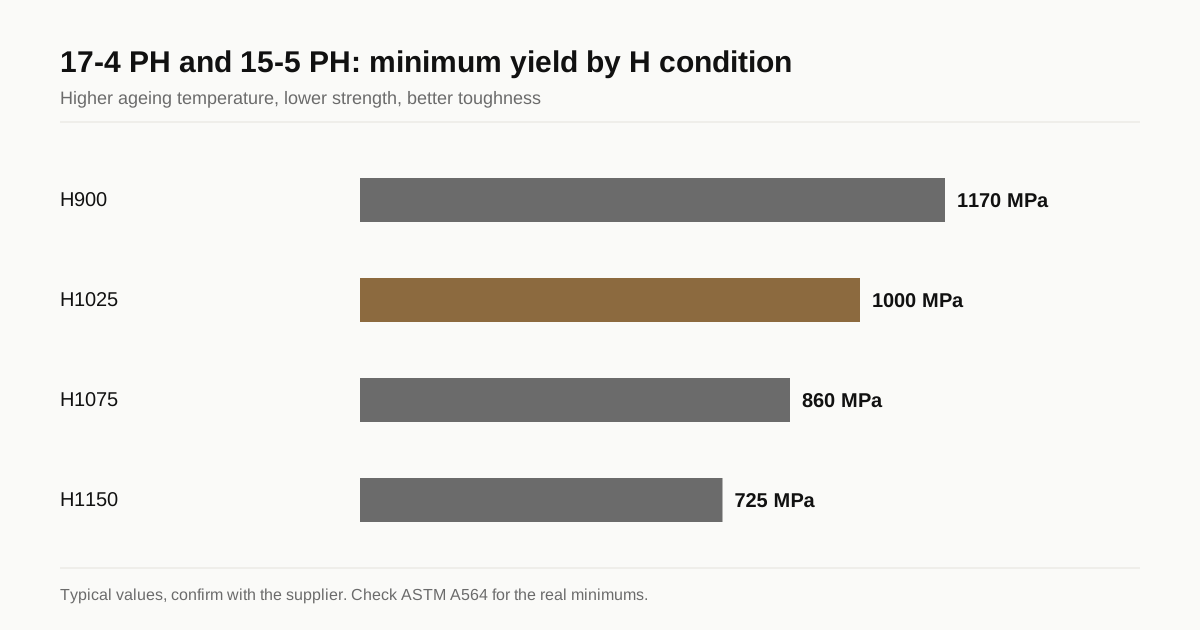
The number after H is the ageing temperature in °F. Higher ageing gives lower strength and better toughness. Typical published values for both grades, from the standard minimums:
| Condition | Ageing temperature | Typical hardness | Yield strength (min) | Use |
|---|---|---|---|---|
| H900 | 482 °C | about 40 to 44 HRC | about 1170 MPa | Highest strength, lower toughness |
| H1025 | 552 °C | about 35 to 38 HRC | about 1000 MPa | Balanced, common choice |
| H1075 | 580 °C | about 32 to 36 HRC | about 860 MPa | More toughness |
| H1150 | 621 °C | about 28 to 33 HRC | about 725 MPa | Best toughness and SCC resistance |
These are published typical minimums for bar. Always confirm against your standard and heat treat records.
H900 is brittle enough to be a concern in stress corrosion service. For parts in chloride environments or under sustained tension, H1025 or H1150 is safer. Material notes in most standards make the same point: higher ageing improves stress corrosion resistance.
Dimension change on ageing
Both grades shrink slightly during ageing. The change is small and predictable, about 0.0004 to 0.001 mm per mm of length, depending on the condition. A finished tolerance of ±0.01 mm on a 50 mm dimension therefore needs either a machining allowance and a finish operation after ageing, or a calculated pre-ageing size. The standard approach is to rough machine in Condition A, age, then finish grind or finish machine the critical dimensions. The tolerance guide shows how a finishing step adds cost.
Need a quote for this part? Get a quote for your stainless parts
Corrosion and welding
Both grades resist general corrosion about as well as 304 in mild environments and not as well as 316L in chlorides. Neither is a marine grade. For chloride service, consider the options in the grade reference and avoid H900.
Welding is possible with care for both, usually followed by re-ageing or a full solution plus age cycle. For machined parts, avoid welding where possible.
How to choose
- Is the part small and made from stock bar? 17-4 is the practical choice.
- Is the section large, forged or loaded across the grain? Consider 15-5.
- Does a specification, drawing or approved process name one grade? Follow it.
- Does the part see chlorides or sustained tension? Choose a higher ageing condition, whichever grade.
- Is lead time important for a small quantity? Check what is in stock before choosing.
What to put in the RFQ
- Grade and product standard, and whether the alternate grade is acceptable.
- Supply condition (A) and final H condition.
- Hardness and strength requirements to be certified.
- Whether heat treatment is done in house or outsourced, and the standard followed.
- Dimensional tolerances before and after heat treatment.
- Certificate requirements, including heat number and test results. The RFQ checklist lists the usual points.
Heat treatment logistics
Precipitation hardening is a simple heat treatment, but it has to happen somewhere, and who does it affects lead time, cost and paperwork.
In house or outsourced. Many machine shops send parts to a heat treater. The part leaves the shop, ages in a furnace for about an hour to four hours, and comes back with a certificate. That round trip often takes a few days to a week. If the shop heat treats in house, lead time is shorter.
Furnace control. The ageing temperature tolerance is narrow, typically within 10 °C of the target, and the record should show the actual temperature and time. Aerospace work requires pyrometry to a defined standard, and AMS 2750 sets the rules. Other buyers want a plain certificate with temperature, time and cooling method.
Protective atmosphere. Ageing in air leaves a thin oxide that must be cleaned off before passivation. A vacuum or inert atmosphere avoids it. State on the drawing whether the finish after ageing must be bright.
Hardness and tensile test. A hardness test on the part or on a coupon from the same lot confirms the condition. Tensile tests need test bars, which add cost, so say whether they are needed.
Typical parts and how the choice falls
17-4 PH shows up in valve stems, pump shafts, fasteners, gears, sporting goods, surgical instrument bodies and a wide range of general machined parts. 15-5 PH shows up more in aerospace brackets, landing gear fittings, structural fittings and large forgings, because the buyers in those fields care about transverse toughness and consistency across large sections. For a small valve stem in a food plant, either works and the shop will quote whichever is in stock. For a forged aerospace fitting, the specification usually names the grade and no choice exists.
When a drawing offers either grade, tell the shop. That gives them the freedom to buy the cheaper or faster bar, and you may save a week of lead time.
Substitution rules of thumb
- If the drawing names a grade only, do not substitute without written approval.
- If a customer specification names a grade, a substitution may need re-qualification of the part.
- If the drawing says 17-4 PH or 15-5 PH, the shop may supply either and note it on the certificate.
- If the part sees fatigue or cyclic loading, discuss it with the design owner before changing.
The certificate is the proof. Check the grade, the heat treatment condition and the test results on it.
Checklist before you request a quote
- Name 17-4 PH or 15-5 PH, never “PH stainless”.
- Call out the H condition.
- State whether substitution is allowed.
- Mark dimensions that need a post-ageing finish.
- Request the certificate and hardness report.
Send the drawing through the RFQ form. We send one itemised quote within 24 business hours and place the work with partner shops that machine and heat treat precipitation hardening stainless. We own no machines.
Frequently asked questions
Is 15-5 PH better than 17-4 PH?
Not in general. 15-5 PH has better transverse toughness and a more uniform structure in large sections and forgings, because it is almost free of delta ferrite. 17-4 PH is far more widely stocked in bar and costs less. For most small machined parts the two perform the same.
Can I substitute 15-5 for 17-4 on a drawing?
Only with approval. The chemistry, specifications and material certificates differ, and some customers or standards name one grade only. Ask the design owner and state the alternative on the drawing if both are acceptable.
What does H900 or H1025 mean?
It is the ageing condition. H900 means ageing at 900 degrees Fahrenheit, which gives the highest strength and hardness. H1025 and higher temperatures give lower strength and better toughness and stress corrosion resistance. The number sets the mechanical properties of the finished part.
Need a quote for this part?
Send the drawing. We read it, send one itemised quote within 24 business hours and place the work with a partner shop that cuts stainless.
Get a quote for your stainless partsFigures in this guide are published specification limits or published typical values for the alloy, not measurements of any part. Machinability is rated against free-machining carbon steel B1112 at 100 and PREN is chromium plus 3.3 times molybdenum plus 16 times nitrogen. The conventions are set out in thereference section and the editorial standards.