3D printed vs machined stainless: how laser powder bed 316L compares with 316L cut from bar on density, surface and cost
November 7, 2026
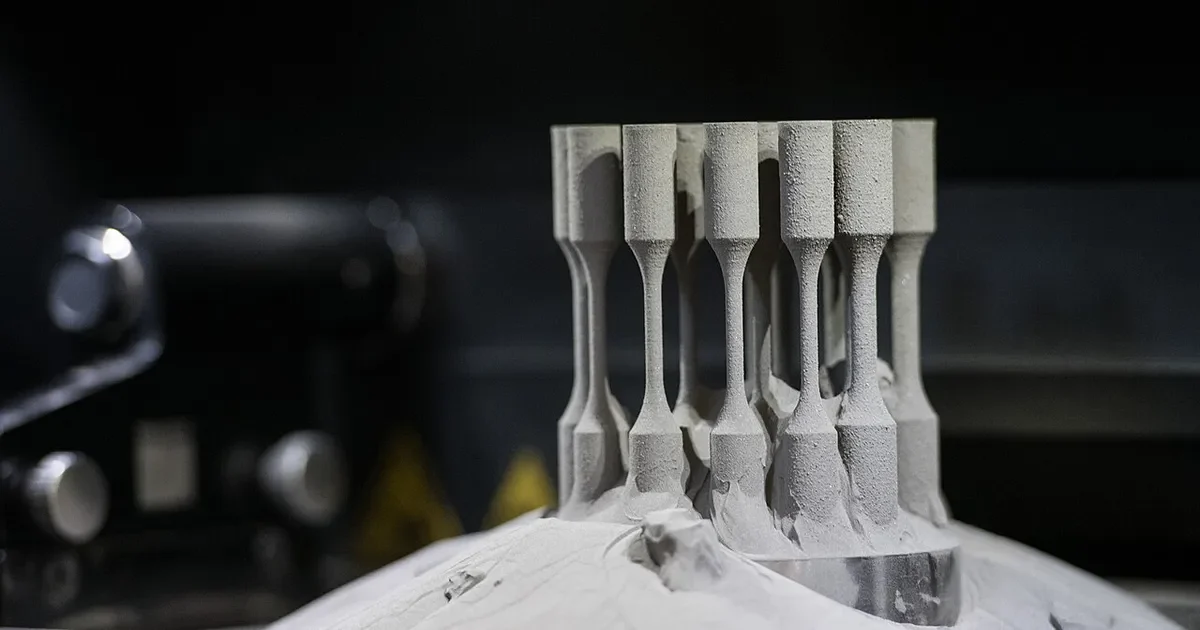
For most machined stainless parts the answer is simple: cut them from 316L bar, and consider printing only when the shape cannot be machined or the quantity is very small. Laser powder bed fusion (LPBF) 316L can reach the yield strength of wrought material, but published tests show lower toughness, density below 100 percent unless it is treated, and an as-built surface 10 to 30 µm Ra rough. A printed part with a thread, seal face or tight bore still ends up on a CNC machine. This guide compares the two routes on the numbers that exist and lists what to write on an RFQ.
Density and strength: what the tests show
Two open test programmes give a fair picture. A US Bureau of Reclamation report printed a 5 by 5 inch open cube in 316L and cut test pieces from it. Density was 96 to 97 percent for all but one sample, and the average yield stress was 74,800 psi (about 516 MPa) against 49,000 psi (about 338 MPa) for wrought plate tested alongside. Ultimate strength was higher parallel to the print layers, 96,200 to 97,500 psi (about 663 to 672 MPa), than across them, 88,500 to 88,800 psi (about 610 to 613 MPa), and the wrought plate sat at 88,900 to 92,300 psi. Impact energy averaged 123 ft-lb (about 167 J) parallel and 117 ft-lb (about 159 J) transverse. The report quotes 180 to 350 ft-lb (about 244 to 475 J) for wrought 316L from the literature and concludes that the printed material has lower toughness and shows anisotropy, most clearly across the layers.
A 2021 study in the journal Materials varied the laser energy and measured density and tensile properties on vertically built bars. The ranges below cover two test strain rates:
| Material | Density | Yield, MPa | Ultimate, MPa | Total elongation |
|---|---|---|---|---|
| Wrought reference bar | 100 percent | 382 to 390 | 887 to 935 | 43 to 54 percent |
| LPBF, low energy | 91.9 percent | 479 to 481 | 786 to 821 | 29 to 35 percent |
| LPBF, medium energy | 94.6 percent | 478 to 489 | 790 to 805 | 34 to 41 percent |
| LPBF, high energy | 99.6 percent | 460 to 475 | 788 to 834 | 42 to 51 percent |
The pattern repeats across both sources. Yield is the same or higher than wrought, ultimate strength is a little lower, and the damage from porosity shows up as lost elongation. Only the dense build came near the wrought ductility. Values depend on machine, powder, parameters, orientation and heat treatment, so use them as a reason to ask for evidence on your part rather than as design data. For a pressure boundary, a fatigue part or a cryogenic part, the design authority decides, not the shop.
Surface and corrosion: why printed faces get machined
An abstract in the journal Tribologia puts conventional milling and grinding at an average Ra of less than 1 to 2 µm and laser powder bed fusion at roughly 10 to 30 µm. That roughness is not cosmetic. Los Alamos researchers who compared as-built 316L from five different machines found significant machine to machine variability in susceptibility to local corrosion, which they linked to passive film stability, segregation, microstructure and surface roughness features. Removing the as-built layer by grinding or electropolishing reduced that variability.
A 2020 study in npj Materials Degradation tested printed 316L in six surface states. Ground and electropolished surfaces reached a breakdown potential near +1.0 V against Ag/AgCl. As-printed, tumble polished, chemically passivated and re-melted surfaces were all much lower, around +0.3 V. Surfaces inclined at high angles to the build direction were rougher and failed earlier. Chemical passivation alone did not rescue the as-printed surface in that test. Buyers who need pitting resistance on a wetted face should plan to remove the as-built skin, and the passivation against electropolishing guide covers the choice that follows.
Open pores at a surface are a further reason to ask what depth will be removed. Any porosity that machining opens becomes a defect on the finished face. That is our reading of the density data, not a figure from a test, so ask the printer for density evidence and a plan for the faces that matter.
Cost: what is known and what is not
No independent public survey compares printed and machined 316L part prices, and none is likely to hold across geometries. The figures that exist come from a quoting marketplace, MakerVerse, which sells both routes. Read them as directional:
| Item | Printed | Machined from bar |
|---|---|---|
| Material | 316L powder at EUR 15 to 100 per kg | Bar at EUR 4 to 6 per kg |
| Tolerance as built | plus or minus 0.1 to 0.5 mm | plus or minus 0.025 mm |
| Surface as built | Ra 6 to 30 µm | Ra 0.8 µm or better |
| Ten pieces, mid complexity 316L | EUR 250 to 550 | EUR 400 to 900 |
| Break-even, mid complexity 316L | Below about 20 to 50 parts | Above it |
| Post processing share | 27 to 70 percent of printed part cost, citing the Wohlers Report 2021 and Fraunhofer IWU | Low |
The page adds that print quotes often leave out support removal, stress relief, hot isostatic pressing and finishing, which can reverse an apparent saving. So the comparison that matters is finished price on the same drawing, with the same tolerances, finish and document pack. Our cost drivers guide and the quantity economics guide show how the machining side moves with quantity.
Need a quote for this part? Get a quote for your stainless parts
When to print and when to machine
| Situation | Better route |
|---|---|
| Internal channels or lattice that no tool can reach | Print, then machine datums |
| One to a few pieces of a complex shape | Print, with a finishing plan |
| Dozens of parts or more, simple to medium shape | Machine from bar |
| Sealing face, thread, bearing seat or tolerance under 0.1 mm | Machine, even if the blank is printed |
| Pressure or fatigue duty with a code requirement | Machine from certified bar unless the design authority approves print |
| Hygienic or pitting critical surface | Machine or electropolish, remove the as-built skin |
| Material certificate by heat number | Bar, see the mill certificate guide |
What to put in the RFQ
- State the route you expect: machined from bar, or a printed blank to be finished. Shops can only quote what they are told.
- For a printed blank, name the process, the powder lot, the build orientation and the heat treatment or hot isostatic pressing you require, and who supplies the blank.
- Mark the faces to be machined and the stock to leave. The marketplace suggests 0.5 to 1.0 mm, but no public standard sets it, so agree it with the finisher.
- Call out the finish as a number with the method, as in the Ra guide.
- Ask for density or porosity evidence if the part holds pressure, seals or is cleaned in place.
- List the documents: powder certificate, build record and the finishing steps.
ASTM F3530 is the design guide for post processing of metal laser powder bed fusion parts. Its scope lists powder removal, thermal post processing, build platform removal, support removal, machining and surface finishing, and it excludes inspection and hybrid manufacturing, so it is a checklist of steps rather than a quality limit.
To get quotes for machined stainless parts, or for finishing a printed blank, send the drawing through the RFQ form and say which route you mean. We send one itemised quote within 24 business hours and place the work with partner shops that cut stainless. We do not offer printing. The processes page outlines the machining routes.
Sources
- US Bureau of Reclamation, Analysis of 316L Stainless Steel Powder Bed Fusion Material, ST-2021-19085-3
- Tensile Properties and Deformation of AISI 316L Additively Manufactured with Various Energy Densities, Materials, 2021
- Tribologia, On the surface roughness of 316L stainless steel fabricated using L-PBF additive manufacturing
- Melia et al., How build angle and post processing impact roughness and corrosion of 316L, npj Materials Degradation, 2020
- Clark et al., Machine to machine variability of roughness and corrosion in additively manufactured 316L, Journal of Manufacturing Processes, 2023
- ASTM F3530, Guide for Additive Manufacturing, Design, Post-Processing for Metal PBF-LB, scope
- MakerVerse, CNC vs metal 3D printing: how to compare costs accurately, quoting marketplace, directional
- Wikimedia Commons, FZU 3Dprinting 4, image source

Test values come from specific builds, machines and orientations. Confirm the process, orientation and finishing plan with the design authority before ordering.
Frequently asked questions
Is 3D printed 316L as strong as machined 316L?
On yield strength it can be stronger. A US Bureau of Reclamation test report measured an average yield of 74,800 psi for printed 316L against 49,000 psi for wrought material. Toughness and ductility run the other way, and strength depends on build direction and density. Ask for tests in the direction your part loads.
How rough is a 3D printed stainless steel surface?
A tribology paper abstract puts laser powder bed fusion at roughly 10 to 30 µm Ra as built, against less than 1 to 2 µm for milling and grinding. Roughness also changes with build angle. Any sealing face, bearing seat, thread or hygienic surface normally needs machining or polishing after printing.
How many parts before machining is cheaper than printing?
No independent public study gives a 316L crossover. A quoting marketplace puts mid complexity 316L at about 20 to 50 parts, and says it moves with geometry and post processing. Treat that as directional. Request a print quote and a machining quote on the same drawing and compare the finished part price.
Does a printed 316L part still need machining?
For most functional parts, yes. ASTM F3530, a design guide for metal powder bed fusion, lists machining and surface finishing among post processing steps after a build. The same marketplace suggests 0.5 to 1.0 mm of extra stock on faces to be machined. Confirm the allowance with the shop that will do the finishing.
Need a quote for this part?
Send the drawing. We read it, send one itemised quote within 24 business hours and place the work with a partner shop that cuts stainless.
Get a quote for your stainless partsFigures in this guide are published specification limits or published typical values for the alloy, not measurements of any part. Machinability is rated against free-machining carbon steel B1112 at 100 and PREN is chromium plus 3.3 times molybdenum plus 16 times nitrogen. The conventions are set out in thereference section and the editorial standards.