Where the weeks go in a machined stainless part order
November 21, 2026
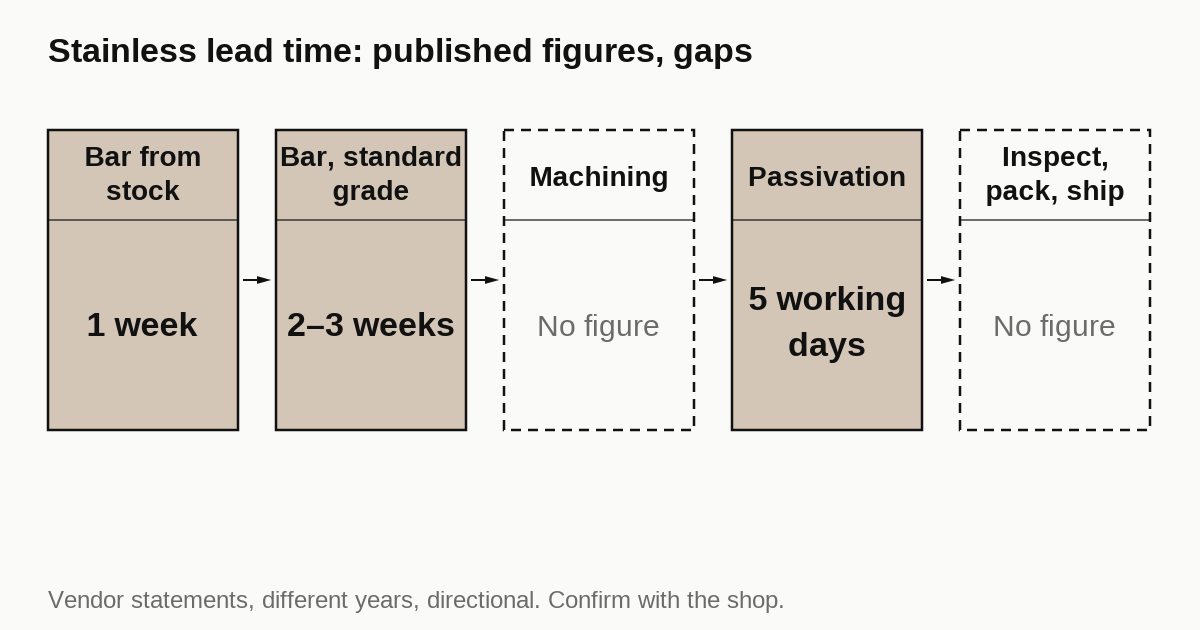
Lead time on a machined stainless part is a sum of five steps, and the shop controls only some of them. Bar has to be in stock or ordered; the part is machined; outside finishing runs in its own queue; inspection and certificates follow; packing and freight close the order. This post is part of our guide to a stainless steel machining quote, and it shows where the published figures exist, where they do not and what to ask so a quoted date means something.
Every figure below comes from a public source and is labelled with its limits.
What the published figures cover
| Driver | Direction | Magnitude | Who controls it |
|---|---|---|---|
| Bar from stock | Adds days | 1 week, one service centre promise, 2019 | Stockist |
| Bar, standard grade, order | Adds weeks | 2 to 3 weeks, one supplier FAQ, orders up to 50 tonnes | Stockist or mill |
| Non-standard grade or condition | Adds more weeks | A 2012 mill list shows several (see below) | Mill |
| Machining | Adds weeks | We found no public figure | Shop, by part and load |
| Outside passivation | Adds days | 5 working days standard, one vendor, January 2026 | Finisher |
| Certificates and inspection | Adds days | We found no public figure | Shop |
| Packing and freight | Adds days | We found no public figure | Shop and carrier |
Sources: Outokumpu news release (2019), a US supplier FAQ, a North American Stainless lead-time sheet (undated, 2012 weeks), a UK passivation service article (January 2026). All are statements by sellers and differ in age.
Bar availability
Bar is the first step and the one with the most public information. Outokumpu announced in November 2019 a service centre in Sweden, due to start in January 2020, with a stated promise of delivery within one week in the Nordics. A US supplier’s FAQ says its lead time for standard 304 and 316L grades is 2 to 3 weeks on orders up to 50 tonnes, with faster turnaround often possible on smaller runs. Both are marketing statements and neither is a current mill schedule. We found no current public rolling schedule for stainless bar.
Two things move bar availability for you. A standard grade in a common size is more likely to be in stock, and the 2 to 3 week supplier statement above is the nearest published figure for ordering it. An unusual hex size, a plate thickness between standard gauges or a requirement for one named mill is not. The stock form guide covers how the form you write changes what the shop has to buy.
Grade and condition
Not every stainless product ships on the same schedule. A North American Stainless lead-time sheet is the one mill list we found. It carries no date, but its week references fall in September and October 2012. It lists items by ship week and says the dates are subject to order-book capacity. For orders received by 21 August 2012 it showed cold-drawn bar for the fourth week of September, 416 bar for the second week of October and 17-4 in the heat-treated H1150 condition for the fourth week of October, about five, seven and nine weeks after the cut-off. It listed duplex flat product at 8 weeks. The sheet’s own week labels are not fully consistent, so read the gaps as approximate.
The sheet is fourteen years old and says nothing about 2026. It shows a pattern that still makes sense: standard grades in standard forms ship first, and hardenable or duplex products queue longer. If your drawing names 17-4 PH, 416 or a duplex grade, ask about bar availability before you ask about the part.
Machine time and the shop queue
Machine time has no public figure, because it depends on the drawing. What the producers publish explains why it runs long. Outokumpu’s machining guide says stainless work hardens, conducts heat poorly, is tough, sticks to the tool and breaks chips badly, and that austenitic grades show the strongest tendency to work harden. It also says a part’s cost cannot be estimated from a test cut on one operation, because a grade that cuts easily in one operation can be demanding in another.
The queue in front of the machine is the shop’s own and also has no public figure. Ask for the date the shop expects to start cutting, not only the delivery date. The gap between them is the run time.
Outside finishing
Most passivation and electropolishing happens at a second supplier, which means a queue and a transport step. One UK passivation house states in a January 2026 company article that its standard turnaround is 5 working days, with a 24-hour express option. That is one vendor’s statement, and a seller’s one at that. We found no public survey of finisher turnaround.
Two choices change the finishing time on your side. Name the standard and the test in the RFQ, so no one waits for a decision about acid or acceptance, and do not ask for electropolishing when passivation meets the requirement. The difference between the two finishes is covered in our passivation against electropolishing guide.
Certificates, inspection and packing
Documents are office time. A mill certificate, a passivation certificate and a first article report each take hours to assemble and check. We found no public figure for what they add to elapsed time, and the figure depends on whether the shop has the mill certificate for the bar on the day. The mill certificate guide shows what the document contains and why heat numbers have to match the parts.
Packing matters when the part needs cleaning and capping, and freight depends on the carrier and the destination. Ask whether lead time on the quote stops at the shop door or at your dock.
Need a quote for this part? Get a quote for your stainless parts
A worked example with explicit assumptions
This is an example with assumed durations, not data about any shop. The assumptions are marked.
| Step | Assumption | Duration |
|---|---|---|
| Bar from stock | Upper bound of the 1 week statement | 1 week |
| Machining and queue | Assumed | 3 weeks |
| Outside passivation | 5 working days, one vendor | 1 week |
| Inspection and certificates | Assumed | 3 working days |
| Pack and hand to carrier | Assumed | 2 working days |
| Total, ex works | Sum | About 6 weeks |
If the bar must be ordered at the 2 to 3 week supplier statement, the same example reaches about 7 to 8 weeks. A heat-treated or duplex condition can add more. The example shows the structure: a quoted lead time of three weeks on this part means that one of the steps is shorter than assumed, subcontracted at once or left out.
The lead time lines to ask for
Ask each shop to state, in writing:
- Whether bar is in stock or must be ordered, and the grade and size.
- The date cutting is expected to start.
- Which steps are subcontracted and whether the slot is confirmed.
- Whether the date is ex works or delivered.
- What the quote assumes for certificates and inspection.
- Whether the date holds if the material line moves with the mill surcharge.
How to shorten it without paying for it
- Send a complete RFQ the first time, with the finish, documents and inspection stated.
- Name a standard grade and bar specification, and accept dual certified bar where the application allows it.
- Say whether the delivery date is firm or flexible. A shop may choose a different route for a firm date.
- Combine repeat requirements into one order with scheduled releases.
If you want quotes that state the lead time lines above, send the drawing and the date you need through the RFQ form. We send one itemised quote within 24 business hours and place the work with partner shops that cut stainless. The guide to a stainless steel machining quote shows where lead time sits among the other lines.
Sources
- Outokumpu, bar stock services in the Nordics (2019), the delivery promise
- MW Alloys, stainless bar FAQ, supplier statement of 2 to 3 weeks for standard grades
- North American Stainless, lead times sheet (undated, weeks of September and October 2012), an old mill list
- Outokumpu, Machining stainless steel bar: a short guide, work hardening and machinability
- Approved Business, a UK passivation service article (21 January 2026), vendor statement of turnaround
Frequently asked questions
How long does a machined stainless part take?
It depends on the sum of bar availability, machining, outside finishing, inspection and freight. We found no public figure for machine time, and none for a typical total. Published supplier statements put stock bar at about a week (a 2019 announcement) and standard grades at 2 to 3 weeks, plus about 5 working days at a finisher.
Why does a stainless part take longer than aluminium?
Outokumpu's machining guide says stainless work hardens, conducts heat poorly, is tough and breaks chips badly, which raises cutting forces and slows machining. We found no public comparison of lead times against aluminium, so ask each shop for its own start date and run time.
Does passivation add lead time?
Usually yes when it happens at a second supplier. One UK passivation house states a standard turnaround of 5 working days with a 24-hour express option. We found no public survey of finisher turnaround, so ask which steps the shop subcontracts and whether the slot is confirmed.
How do I shorten the lead time without paying for expediting?
Send a complete RFQ, name a standard bar grade and size, choose the finish by standard so nothing waits for a decision, and say whether the delivery date is firm. Each question the shop has to ask costs days before the order is even placed.
Need a quote for this part?
Send the drawing. We read it, send one itemised quote within 24 business hours and place the work with a partner shop that cuts stainless.
Get a quote for your stainless partsFigures in this guide are published specification limits or published typical values for the alloy, not measurements of any part. Machinability is rated against free-machining carbon steel B1112 at 100 and PREN is chromium plus 3.3 times molybdenum plus 16 times nitrogen. The conventions are set out in thereference section and the editorial standards.