How to read, defend and compare a stainless steel machining quote
November 21, 2026
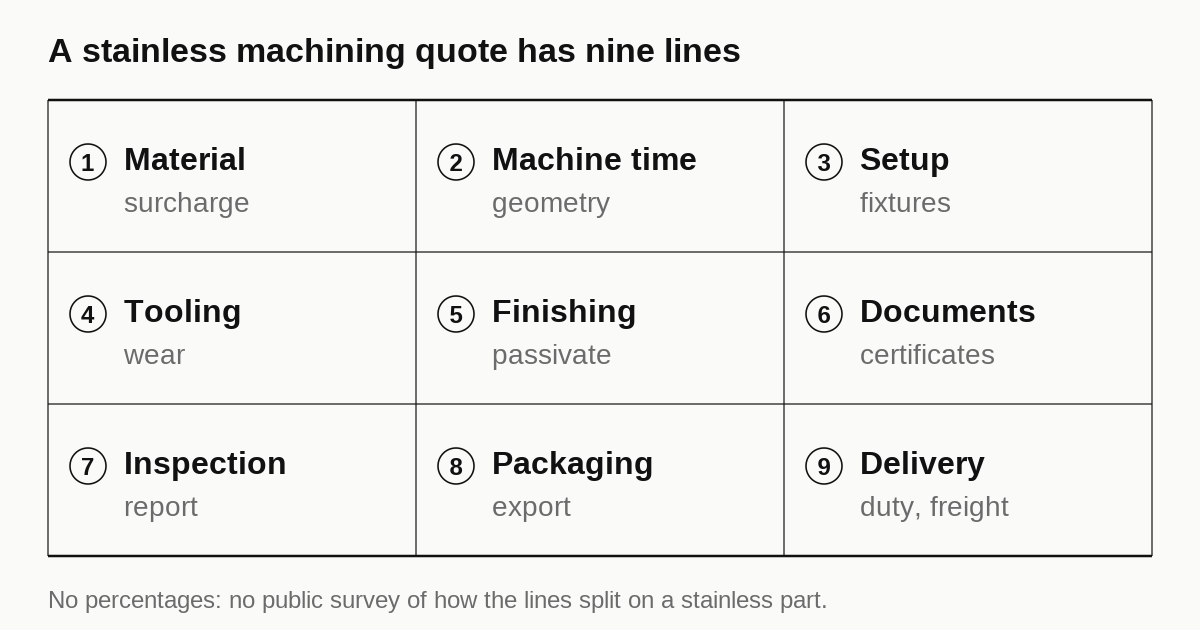
A stainless steel machining quote is the sum of about nine lines: material, machine time, setup, tooling, finishing, documents, inspection, packaging and delivery. A buyer controls roughly half of them on the drawing and in the RFQ, and the rest sit with the shop, the mill or the customs authority. This guide is for a buyer or engineer who holds a stainless drawing, has to send an RFQ and then has to choose between answers that look different. It leads to one decision: which quote to accept, and on what written scope.
Everything below applies whichever shop cuts the part. Where we found no public figure for a line, we say so instead of offering a rule of thumb.
Last reviewed: October 2026. Figures carry the date they were checked; confirm tariffs and regulations with your broker before you rely on them.
- What a stainless quote is made of
- Grade and the material line
- Work hardening and cycle time
- Tolerance and the general note
- Quantity and setup
- Finishing and the outside queue
- Certificates and traceability
- Duty and carbon cost
- Lead time and where the weeks go
- Machined or cast
- Levers that cut the price
- Write the RFQ and line up the quotes
- Checklist before you accept a quote
- Send the RFQ
What a stainless quote is made of
Every quote answers the same nine questions, even when the layout hides them. The table shows each line, what sets it and who can move it. The figure below the table shows the same split at a glance.
| Quote line | What sets it | Who can move it |
|---|---|---|
| Material | Grade, bar specification, stock form, weight per part, mill surcharge | You (grade and form), the mill (surcharge) |
| Machine time | Geometry, grade, tolerance, number of setups | You (drawing), the shop (method) |
| Setup and programming | Number of operations, fixturing, first part proving | Shared across the quantity |
| Tooling | Tool wear, which depends on grade and work hardening | The shop, priced on grade |
| Finishing | Deburr, blast, passivation, electropolish, marking | You (callouts), a second supplier |
| Documents | Mill certificate, passivation certificate, reports | You, by what you ask for |
| Inspection | Features measured, report format | You, by scope |
| Packaging | Bagging, capping, cleanroom, export packing | You |
| Delivery | Terms, freight, duty, carbon cost | You, by terms and destination |
Source: our breakdown of what a shop prices. We found no public survey of how the lines split across an average stainless part, so no percentages are given. Compare shares only on your own quotes.
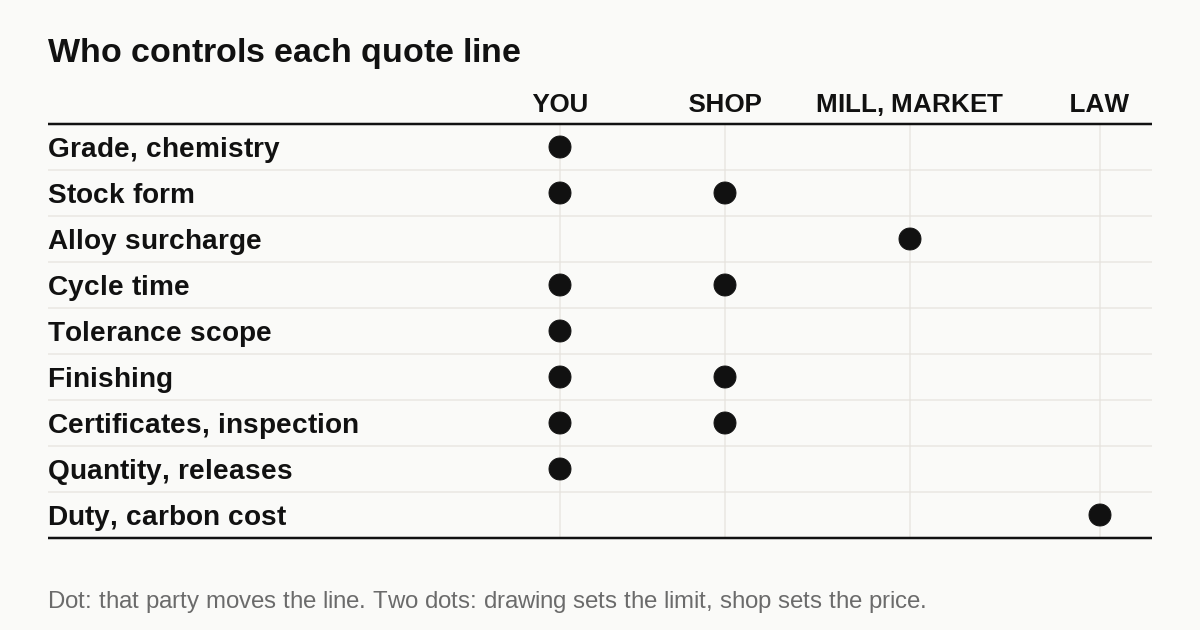
The practical point: two lines are fixed by the market on the day and two by law; the remainder follow what you write. A drawing that leaves finish, documents and inspection open hands those decisions to each shop separately, and the quotes then differ for reasons that have nothing to do with price. The cost drivers guide walks through six of these lines in the order buyers usually meet them.
Read more: Stainless machining cost: what actually drives price
Grade and the material line
The material line has two parts: the weight of bar or plate the shop buys, and the price per kilogram on the day. The second part moves with the alloy surcharge. Outokumpu, a large European producer, describes its price as a base price, extras for non-standard dimensions and an alloy surcharge that passes on changes in alloy cost. The producer says surcharges are usually published month by month, and describes averaging over a fixed period before delivery as the industry standard, while noting that calculation periods differ.
Cleveland-Cliffs lists its stainless surcharge as a per-pound amount by grade. The values below come from its list for shipments from 30 August to 3 October 2026, in the column for material 0.015 inch and thicker. That column is sheet-based, so treat the figures as directional for bar.
| Grade | Surcharge, $/lb | Surcharge, $/kg |
|---|---|---|
| 304 or 304L (8.00 percent Ni) | 0.9427 | 2.08 |
| 316 or 316L | 1.7594 | 3.88 |
| 2205 | 1.9115 | 4.21 |
| 17-4 PH | 0.8252 | 1.82 |
Source: Cleveland-Cliffs stainless raw material surcharges, 30 August to 3 October 2026. Per-kilogram column is the per-pound figure times 2.2046. One producer, one product form; other mills differ.
Two readings matter to a buyer. First, 316L carries about 1.87 times the surcharge of 304 on this list, so a grade swap changes the material line before it changes anything else. Second, small chemistry choices move the number: the same list shows 316L with a 2.75 percent molybdenum minimum about 17 percent above standard 316L. Do not write a tighter chemistry than the application needs.
Stock form is the other half of the line, because chips carry the same surcharge per kilogram as the part. A flat part cut from round bar pays for the waste.
Read more: Stainless alloy surcharge: how nickel moves part price
Read more: Bar, plate or near-net: stainless stock form and cost
Work hardening and cycle time
Machine time is the line that surprises buyers most, and grade drives it. Outokumpu’s machining guide gives five reasons stainless is demanding to cut: it work hardens, it conducts heat poorly, it is tough, it tends to stick to the tool and it breaks chips badly. Austenitic grades show the strongest work hardening, and the guide says the high cutting forces and hardened surface follow from that. It also says hardness cannot be used as a guide to machinability for these ductile grades.
The site’s grade reference lists published typical machinability ratings against free-machining steel B1112 at 100: 303 at 78, 304 at 45, 316L at 36, 17-4 PH at 50 and 2205 at 30. Read them as an ordering, not as a measurement, because ratings differ between sources and between operations. Outokumpu makes the same point from the other side: a grade that cuts easily in one operation can be demanding in another, so a part price cannot be inferred from a single test cut.
Two buyer-side consequences follow:
- The same grade can cost differently by route. Outokumpu shows improved-machinability versions of 304 and 316 that approach free-machining behaviour without the usual loss of corrosion resistance. Ask the shop whether such a bar exists for your grade and whether the specification allows it.
- Free-machining grades trade away other properties. Sulphur at 0.15 to 0.35 percent improves chip breaking, and the same guide lists weldability, toughness and corrosion resistance among the losses. A part that is welded, polished or wet is the wrong place for it.
The grade selector shows the trade between machinability and pitting resistance, and the guide linked below explains the mechanism and the geometry changes that reduce it.
Read more: Work hardening: why stainless quotes come back high
Tolerance and the general note
Tolerance is the line buyers control most directly and use least carefully. ISO 2768-1 exists to let a drawing carry one general note instead of a tolerance on every dimension. It sets four classes, fine (f), medium (m), coarse (c) and very coarse (v), for linear and angular dimensions without individual tolerance, on parts made by metal removal or from sheet. The designation is written in or near the title block, for example ISO 2768-m.
| Basic size, mm | Class f, mm | Class m, mm |
|---|---|---|
| 0.5 up to 3 | ±0.05 | ±0.1 |
| over 3 up to 6 | ±0.05 | ±0.1 |
| over 6 up to 30 | ±0.1 | ±0.2 |
| over 30 up to 120 | ±0.15 | ±0.3 |
| over 120 up to 400 | ±0.2 | ±0.5 |
| over 400 up to 1,000 | ±0.3 | ±0.8 |
Source: ISO 2768-1:1989, Table 1, read from the publisher’s preview pages, not the full standard. A later edition may change the text; check the edition your drawing cites.
The standard’s own annex gives the logic: the class should match customary workshop accuracy, a tighter value goes next to the one dimension that needs it, and a larger value is worth stating where the function allows it. Clause 6 adds that a workpiece outside the general tolerance is not automatically rejected if its function is not impaired, unless the drawing says otherwise. Say so on the drawing when you want rejection to be automatic.
We found no public survey that prices each tolerance band on stainless. The tolerances guide below gives bands as shop practice. Use it for the ordering of effort, then ask each shop which features drive its figure.
Read more: Stainless tolerances: what each decimal place costs
Quantity and setup
Setup, programming and first-part proving cost the same whether you order one part or a hundred, so quantity changes the unit price more than most other lines. The quantity guide below gives a rough curve as practice, not as survey data. We found no public dataset of setup share by quantity for stainless, so the useful move is to ask each shop to quote two or three break points on your own drawing.
Three habits protect you:
- State the real quantity and the real repeat. “20 now, 300 to 500 a year if validation passes” lets a shop quote both and tell you where the price steps.
- Ask for a blanket order with releases when the requirement is known. Four quarterly orders sent as four separate RFQs pay four setups and four sets of paperwork.
- Keep the prototype shop in the loop when it can also run volume. A second shop pays the setup learning again.
Validity belongs here because quantity and material timing interact. A fixed price needs a validity date. If the material line follows the mill surcharge, the quote should name the table and the month. A quote with neither tells you nothing about which party carries the material risk, and that is the easiest line to compare by asking one question.
The RFQ form on this site offers quantity bands of 1-10, 11-100, 101-1,000 and 1,000+. Pick the band that matches the real order and say in the part description whether it repeats, so the shops that receive it quote the order you will place and not a smaller one.
Read more: Prototype or production: stainless quantity economics
Finishing and the outside queue
Finishing is the line most often priced on an unstated assumption. The word “passivate” without a standard lets each shop quote something different: one a documented citric bath with a copper sulphate test and a certificate, another a rinse. ASTM A967 covers immersion in nitric acid solutions, immersion in citric acid solution and electrochemical treatment, and lists seven test practices, A to G, which include water immersion, high humidity, salt spray and copper sulphate. It also states that it makes no recommendation on the suitability of any grade, treatment or acceptance criteria for an application, so the choice and the test are yours to write.
Most finishing happens at a second supplier, which adds a queue, transport and paperwork. We found no public survey of finisher turnaround. One UK passivation house states a standard turnaround of 5 working days with a 24-hour express option, in a company article dated January 2026. Treat it as one vendor’s statement, not a market figure.
Blasting and marking sit in the same chain. Media and method decide whether iron is embedded in the surface before passivation, which the bead blasting guide covers. Say which blast media and which marking method are acceptable, because laser marking and etching behave differently on a passivated surface.
Three callouts change the quote most:
- A global Ra note applies the expensive requirement to every surface. Mark the surfaces that need it.
- Passivation without standard and test is not comparable between quotes.
- Electropolishing removes material, so allow for it on tight features before machining.
The guide linked below covers which finish a part needs, and the citric against nitric guide covers how to write the acid choice.
Read more: Passivation vs electropolishing for stainless parts
Certificates and traceability
Every document you ask for is office time, and the quote prices it. The one document nobody at the machine shop writes is the mill certificate, which ties a heat number to the chemistry measured on that melt. A buyer who needs traceability should say so before the quote, because not every length of bar a shop holds comes with a certificate.
EN 10204 defines the types buyers meet. A summary from a materials trading site, which we use as directional because the standard text is paywalled and we did not read it, lists four: type 2.1 a declaration of compliance, 2.2 a test report on non-specific inspection, 3.1 an inspection certificate on specific inspection of the delivered product issued by the manufacturer’s authorised representative, and 3.2 the same with an independent inspection body co-signing. Name the type on the RFQ instead of writing “certificate”.
A certificate proves what melt the part came from. It does not prove the part is dimensionally correct, which is the job of the shop’s own inspection. Ask for both when the part needs either, and name which features carry a report, because a report on six critical dimensions costs far less office time than a report on forty.
We found no public figure for what a certificate pack adds per part. It falls with quantity, because it is a fixed block of hours. On a batch of five it can be a large share of the price. On a batch of 500 it disappears into the unit price.
Read more: Reading a mill test certificate for stainless parts
Duty and carbon cost
Imported parts carry costs that a domestic quote does not show. As of October 2026, two regimes matter for stainless.
United States, Section 232. Proclamation 11021 of 2 April 2026 applies to goods entered on or after 6 April 2026. The duty is charged on the full customs value of the product regardless of metal content. Annex I-A articles, including some derivatives, pay 50 percent and Annex I-B articles pay 25 percent, and derivatives made entirely from US melted and poured metal pay 10 percent. The lists changed again in June 2026; the Section 232 guide below tracks the changes and cites them. The tier depends on how a part is classified, not on the bar it was cut from.
European Union, CBAM. The definitive regime applies from 1 January 2026, covers iron and steel and puts the obligations on the importer. A mass-based exemption exists for small importers, and the CBAM guide below gives its figure and source.
Delivery terms decide who handles these. The International Chamber of Commerce notes that under both DAP and DDP risk passes at the named destination, but under DAP the buyer handles and pays for import clearance and under DDP the seller does. Some countries require a local importer to clear goods, which rules out DDP.
A quote that is silent on duty is not comparable with one that includes it. Ask for the proposed HTS or CN code, the delivery term and who is importer of record, and have a customs broker confirm all three.
Read more: Section 232 steel tariffs on stainless parts in 2026
Read more: CBAM for stainless steel parts: what EU importers report
Need a quote for this part? Get a quote for your stainless parts
Lead time and where the weeks go
A lead time on a quote is a sum, and the steps are not all in the shop’s hands. Bar must be in stock or ordered; the part is machined; outside finishing runs in its own queue; inspection and certificates follow; packing and freight close the order. A quote that gives one number should say which of these steps it covers.
Published figures are thin. The few supplier statements we found for bar are listed with their sources in the lead time guide below, and the single UK finisher statement of 5 working days is the one above. We found no public figure for machine time on a stainless part, because it depends on the drawing, and no current public mill rolling schedule for bar.
| Step | Public figure we found | Who sets it |
|---|---|---|
| Bar from stock | Supplier statements only, see the lead time guide | Stockist |
| Bar, standard grade | Supplier statements only, see the lead time guide | Stockist or mill |
| Machining | No public figure | Shop, by part and load |
| Outside passivation | 5 working days standard, one vendor, January 2026 | Finisher |
| Inspection, packing, freight | No public figure | Shop and carrier |
Source: supplier statements, directional and from different years. Confirm current figures with each shop.
Ask which steps are subcontracted and whether the subcontractor has confirmed its slot. A lead time much shorter than every other quote usually hides one of them.
Read more: Lead Time for Machined Stainless Parts: Where the Weeks Go
Machined or cast
For some parts the quote should compare two routes, not one. Investment casting builds the part near its final shape from a ceramic mould. An Open University manufacturing page, published more than eight years ago, says production runs of 50 to 10 million are not unusual and that casting is usually viable only when no suitable alternative exists or when it saves a lot of machining. The case for casting strengthens with complex outside shape, internal passages that are hard to cut and volume large enough to repay tooling. The case for machining strengthens with low volume, tight tolerances on individual features and parts that must be leak-tight without a casting-soundness question.
The practical way to settle it is to put both routes in the RFQ. State the annual volume and ask for a machined-from-bar quote and a cast-plus-finish-machined quote, each with its tolerance statement and its pressure-test plan if the part holds fluid. Cast grades carry their own designations and chemistry limits, and for pressure parts the purchaser chooses the grade, so do not assume a cast equivalent of 316L is identical.
Two details from ISO 2768-1 matter when the routes meet on one drawing. The standard says that parallel standards exist for castings, naming ISO 8062, and that for a dimension between an unfinished surface and a finished one the larger of the two general tolerances applies. A part that is cast and then finish machined therefore needs its general tolerances stated for each stage, not one note for the whole drawing.
We found no public tooling price list for stainless investment casting, so this guide gives no break-even figure. The cluster guide below gives the tolerance comparison with its sources and the grade and porosity points a buyer should write into the request.
Read more: Machined vs Investment Cast Stainless Parts: Cost Compared
Levers that cut the price
Most savings come from what you write, not from negotiating the total. Six levers do the work, and each is covered by an earlier section:
- Open the general tolerance and keep tight values for mating features (see the tolerance section).
- Mark finish locally, not with one global Ra note.
- Name the passivation standard and test, so the shop prices one scope.
- Do not write tighter chemistry than the application needs.
- Pick the stock form that matches the part’s shape.
- State quantity and repeats so setup is shared across the run.
Written on a drawing, the first four levers look like this:
General tolerance: ISO 2768-m. Tight tolerance only where marked. Surface finish: Ra 0.8 micrometre on surfaces A and B, all other surfaces as machined. Passivation: ASTM A967 citric, copper sulphate test, certificate returned. Material: 316L per ASTM A276, mill certificate type 3.1 with heat number.
Corner radii, pocket depth and thread length also move cycle time, and tool makers publish rules for them. We treat those as directional because they come from sellers of machining. The guide below lists every lever with the line where you write it and the failure point of each.
One lever is not on the list: changing the grade. It is the largest single move on the material line and the one most often wrong. Change it only after you have written the environment and checked it against pitting, welding and magnetism, which the grade reference lays out.
Read more: Reduce Stainless Machining Cost Without Changing the Grade
Write the RFQ and line up the quotes
Three quotes on an incomplete drawing are three scopes. The RFQ that avoids this names the grade and bar specification, the general tolerance and the few tight features, the finish and passivation standard with its test, the documents to return, the inspection scope, the quantity and repeat, the destination and the delivery term. The RFQ guide below has the full list and a template.
When the answers arrive, normalise them before you compare totals. The example below is an illustration, not a market price: two quotes for the same drawing, indexed so that A is 100 and B is 140.
| Line | Quote A (index 100) | Quote B (index 140) |
|---|---|---|
| Grade and bar | 316L, specification not stated | 316L per ASTM A276 |
| Certificate | None listed | EN 10204 type 3.1 with heat number |
| Passivation | “Included”, standard not named | ASTM A967 citric, copper sulphate test, certificate |
| Inspection | Not listed | First article, six marked dimensions |
| Delivery term | Ex works | DAP, duty not included |
| Validity | Not stated | 30 days, material line indexed |
Illustration only. The scope in B explains part or all of the gap; the shop answers will tell you how much.
Ask A to re-quote with B’s scope, or ask B which lines it would drop. After that the two prices describe the same thing and the difference is the shop. Add duty and freight to A before you conclude that B is dearer.
Read more: What to put in a stainless RFQ so quotes are comparable
Read more: Comparing Stainless Machining Quotes: A Line by Line Check
Checklist before you accept a quote
Run through this before you send a purchase order. Each item has one reason behind it.
- The grade and bar specification are restated in the quote. A quote that repeats your specification gives you a chance to catch a misreading.
- The tolerance scope is the same on every quote. Otherwise one shop priced the general note and another priced the title block.
- Passivation or electropolishing names the standard and the test. The test produces the certificate.
- Documents are listed by type. For example mill certificate type 3.1 with heat number, passivation certificate, first article report.
- Inspection names the features and the report format. Six critical dimensions or all of them are different prices.
- Delivery terms and importer of record are written. Duty and carbon cost land on a different line under DAP and DDP.
- The material line states fixed price with a validity date or the surcharge table it follows.
- The lead time says which steps it covers, including any outside finishing.
- The shop answered what it would change to cut cost and what worries it on the part. These two answers tell you more than a certificate does.
Four things in a quote are red flags on their own: it arrives at once with no questions on a drawing that has gaps, it is far below the others, its lead time is far shorter than the others and it does not restate your specification. Each one usually means an assumption you cannot see.
If two quotes pass all nine and still differ by a lot, the gap is about the shop. The vetting guide covers the questions that separate a stainless shop from a shop.
Read more: How to vet a stainless machine shop before you order
Send the RFQ
If you want a quote on this written scope, send the drawing, the quantity and repeat, the finish and documents and the destination through the RFQ form. We read it, tell you if something important is missing and send one itemised quote within 24 business hours, with the work placed with a partner shop that cuts stainless. You deal with one contact.
Send these in the first message so no shop has to guess:
- The drawing as PDF and a STEP file, with the revision.
- Grade and bar specification, or the environment if the grade is open.
- Quantity now and the expected repeat.
- General tolerance and the marked tight features.
- Finish, passivation standard and test, and the documents to return.
- Inspection scope, delivery term and destination, and whether you need an NDA first.
Sources
- Proclamation 11021, Strengthening Actions Taken to Adjust Imports of Aluminum, Steel, and Copper, 2 April 2026 (govinfo), full-value duty, annex tiers and the 10 percent US-melt rate
- Cleveland-Cliffs stainless steel raw material surcharges, 30 August to 3 October 2026, producer price list
- Outokumpu, alloy surcharges, base price, extras and surcharge
- Outokumpu, Machining stainless steel bar: a short guide, producer guide to work hardening and machinability
- ISO 2768-1:1989 preview pages (iTeh Standards), classes, Table 1 and clause 6
- ASTM A967/A967M, Chemical Passivation Treatments for Stainless Steel Parts (ASTM store, 2017 edition page; a later edition is active), scope and test practices
- Project Materials, EN 10204 certificate types, directional summary of types 2.1 to 3.2
- ICC Academy, DAP and DDP Incoterms 2020 explained, import clearance and risk transfer
- European Commission, Carbon Border Adjustment Mechanism, definitive regime from 1 January 2026
- Open University, Manupedia: Investment casting, university page, more than eight years old
- Approved Business, a UK passivation service article (21 January 2026), vendor statement of a 5 working day standard turnaround
Rates and lists are as published on the dates above. Duties and regulations change, so confirm with a customs broker before you commit to a price.
Frequently asked questions
Why do two stainless steel machining quotes for the same drawing differ so much?
Usually the scope differs, not the price. One shop includes a mill certificate, a named passivation standard, a first article report and delivery to your door, and another quotes bare parts ex works. Line the two up on grade, stock form, finish, documents, inspection, lot size and delivery terms before you compare totals.
What should a stainless machining quote list?
At least the grade and bar specification, stock form, quantity, tolerance scope, finish and passivation standard, documents returned, inspection scope, packaging, delivery terms, lead time and validity date. A quote that leaves any of these out is priced on an assumption you cannot see, and that assumption can change the total.
Can the price change after I accept a stainless quote?
It can if the quote is not fixed. Mills add an alloy surcharge that they publish month by month, and a shop either carries that risk until a validity date or indexes the material line to a named table. Ask which method the quote uses and keep the validity date in writing.
Who pays Section 232 duty or CBAM cost on imported stainless parts?
It depends on the delivery terms. Under DDP the seller clears import and prices duty in, under DAP the buyer handles import clearance and its costs. CBAM obligations sit with the EU importer. Compare quotes on the same terms and ask a customs broker to confirm the code for each part.
How long is a stainless machining quote valid?
We found no public survey of validity periods. Validity is a line the shop sets, and a short window usually reflects material price risk. Ask for the date in writing, and ask whether the material line is fixed or follows the mill surcharge, because that decides what the date protects.
Is the cheapest stainless quote the one to accept?
Only after the scope matches. A low quote often leaves out the certificate, the passivation test or the inspection report, and those lines come back as extras. Normalise every quote to the same written scope first, then compare price, lead time and how the shop answered your questions.
Need a quote for this part?
Send the drawing. We read it, send one itemised quote within 24 business hours and place the work with a partner shop that cuts stainless.
Get a quote for your stainless partsFigures in this guide are published specification limits or published typical values for the alloy, not measurements of any part. Machinability is rated against free-machining carbon steel B1112 at 100 and PREN is chromium plus 3.3 times molybdenum plus 16 times nitrogen. The conventions are set out in thereference section and the editorial standards.