Nine changes to a stainless drawing and RFQ that lower the quote
November 20, 2026
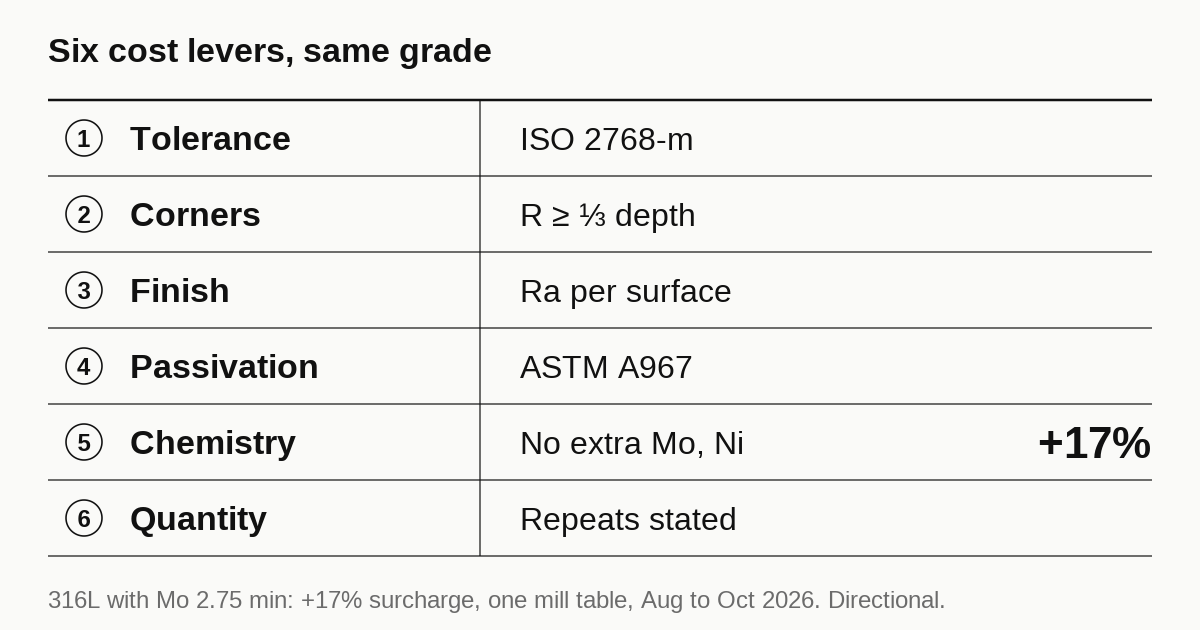
You can lower the cost of a machined stainless part without touching the grade by changing what you write on the drawing and in the RFQ. Nine changes do most of the work: the general tolerance, finish, passivation, chemistry, stock form, internal corners, bar version, quantity and one question to the shop. This post is part of our guide to a stainless steel machining quote, and it gives each change with the place to write it and the way it goes wrong.
The sources are at the end, and where a figure comes from a seller of machining we label it directional.
What you need first
You need the drawing and its revision, the environment the part sees in service and the quantity with its repeat. Allow time to mark up the drawing and for shops to answer. The person who owns the function of the part has to agree, because several of these changes depend on knowing which features matter.
The nine changes
1. Set a general tolerance and mark the few tight features
ISO 2768-1 lets a drawing carry one general class, such as ISO 2768-m, for dimensions without an individual tolerance. The standard, which we read from the publisher’s preview pages, says a tighter value belongs next to the one dimension that needs it, and a larger value is worth stating where the function allows it. Write the class once and mark individual tolerances on mating features.
Failure point: a tight note in the title block applies the cost to every dimension. Check the title block before you send.
2. Mark finish locally
Write Ra on the surfaces that need it and leave the rest as machined. A global Ra note applies the expensive requirement everywhere.
Failure point: a note that mixes micrometre and microinch invites a misreading. State the unit.
3. Name the passivation standard and the test
ASTM A967 covers nitric, citric and electrochemical treatments and lists seven test practices. It makes no recommendation on which suits an application, so write the treatment, the test and whether a certificate returns. Shops then price one scope.
Failure point: the word “passivate” alone. Each shop quotes something different, and you cannot compare them.
4. Do not write tighter chemistry than the application needs
A Cleveland-Cliffs surcharge list for shipments from 30 August to 3 October 2026 gives 316 or 316L at $1.7594 per pound and 316L with a 2.75 percent molybdenum minimum at $2.0637, about 17 percent more. It gives 304 or 304L at 8.00 percent nickel as $0.9427 and at 9.50 percent nickel as $1.0422, about 11 percent more. Sheet-based, one mill, directional for bar, but the direction is clear.
Failure point: copying a minimum from a previous drawing without checking whether the application needs it.
5. Match the stock form to the shape
A flat part cut from round bar pays for the waste, and chips carry the same material cost per kilogram as the part. Name the form when the shape does not suggest one. The stock form guide covers the forms.
Failure point: leaving the shop to quote from whatever is in its rack.
6. Open internal corners and tool access
Tool makers publish rules for this. Hubs advises an internal radius of at least one third of the cavity depth and cavity depth of no more than four times the feature length. Protolabs says a relief machined into each corner keeps the corner functionally sharp while allowing a larger, faster cutter. Both are sellers of machining, so treat the rules as directional and ask your shop.
Failure point: a sharp internal corner that no round cutter can make, which forces a small tool or a second operation.
7. Ask whether an improved-machinability bar exists for your grade
Outokumpu’s machining guide says the usual route to better machinability is sulphur at 0.15 to 0.35 percent, which loses weldability, toughness, corrosion resistance and hot workability. It also describes versions of 304 and 316 that approach free-machining behaviour without that loss, and says the same grade can differ in machining characteristics by process route, with a considerable effect on machining cost. Ask whether such a bar exists for your grade and whether your specification allows it.
Failure point: switching to a free-machining grade on a part that is welded, polished or wet.
8. State the quantity and the repeat
Setup is shared across the run. Say what you need now and what repeats, and ask for a blanket order with releases when the requirement is known. The quantity guide explains the shape of the effect.
Failure point: understating the quantity to get a low unit price, or overstating it to get a good number.
9. Ask the shop what it would change
Ask: what would you change on this drawing to make it cheaper, and what on this part worries you. The answers tell you more about the shop than a certificate does.
Failure point: not asking, or asking after the order.
What good output looks like
A drawing with one general tolerance class, a short list of marked tight features, local finish notes, a named passivation standard and test, a material line without extra chemistry limits and an RFQ that states quantity and repeat. The quotes that come back restate the specification and differ in price for reasons you can name.
Need a quote for this part? Get a quote for your stainless parts
What not to do
- Do not change the grade to save money before you check the environment. The grade that cuts easily is often the one you cannot use.
- Do not drop certificates you will read. Drop the ones you will not.
- Do not squeeze the shop after the quote. Change the drawing instead.
If a swap of grade is proposed to you rather than by you, the stainless grade substitution checklist lists what to ask before you approve it.
Checklist to copy
- General tolerance class written once.
- Individual tolerances only on mating features.
- Ra on named surfaces.
- Passivation by standard and test.
- Chemistry limits only where required.
- Stock form named when the shape is ambiguous.
- Internal corners checked for tool access.
- Quantity and repeat stated.
- Documents listed by type.
An example
General tolerance: ISO 2768-m. Tight tolerance only where marked. Surface finish: Ra 0.8 micrometre on surfaces A and B, all other surfaces as machined. Passivation: ASTM A967 citric, copper sulphate test, certificate returned. Material: 316L per ASTM A276. No molybdenum minimum beyond the specification. Quantity: 100 now, 300 a year in two releases.
If you want quotes on this written scope, send the drawing through the RFQ form. We send one itemised quote within 24 business hours and place the work with partner shops that cut stainless. The tolerance guide goes deeper on step one, and the guide to a stainless steel machining quote covers the lines in full.
Sources
- Outokumpu, Machining stainless steel bar: a short guide, sulphur grades and improved-machinability versions
- Cleveland-Cliffs stainless steel raw material surcharges, 30 August to 3 October 2026, producer price list
- ISO 2768-1:1989 preview pages (iTeh Standards), general tolerance classes
- ASTM A967/A967M, Chemical Passivation Treatments for Stainless Steel Parts (ASTM store, 2017 edition page; a later edition is active), treatments and tests
- Hubs, reducing CNC machining costs, seller of machining, directional
- Protolabs, how to reduce CNC machining costs, seller of machining, directional
Surcharge figures are one mill’s values in one shipment window and change monthly.
Frequently asked questions
What is the quickest way to reduce stainless machining cost?
Open the general tolerance and put tight values only on features that mate. ISO 2768-m is a common general class, and a tighter value goes next to the one dimension that needs it. A blanket tight note applies to every dimension, so the shop has to inspect and control all of them.
Does a tighter chemistry callout raise the price?
It can. One producer's surcharge list shows 316L with a 2.75 percent molybdenum minimum about 17 percent above standard 316L, and 304 at 9.50 percent nickel about 11 percent above 8.00 percent. Do not write a chemistry limit the application does not need.
Should I switch to a free-machining grade to cut cost?
Only for parts that stay dry, unwelded and unpolished. Free-machining grades carry 0.15 to 0.35 percent sulphur, which improves chip breaking and costs weldability, toughness and corrosion resistance. Ask whether an improved-machinability bar of your own grade exists before you change the grade.
Will asking for fewer documents lower the price?
It lowers office time, but ask only for documents you will read. A mill certificate and a passivation certificate are usually worth keeping, while a full dimensional report on every feature rarely is. Name the features that carry a report and the price follows.
Need a quote for this part?
Send the drawing. We read it, send one itemised quote within 24 business hours and place the work with a partner shop that cuts stainless.
Get a quote for your stainless partsFigures in this guide are published specification limits or published typical values for the alloy, not measurements of any part. Machinability is rated against free-machining carbon steel B1112 at 100 and PREN is chromium plus 3.3 times molybdenum plus 16 times nitrogen. The conventions are set out in thereference section and the editorial standards.