Stainless grade substitution: what to ask before you approve a swap proposed by the shop or the mill
November 21, 2026
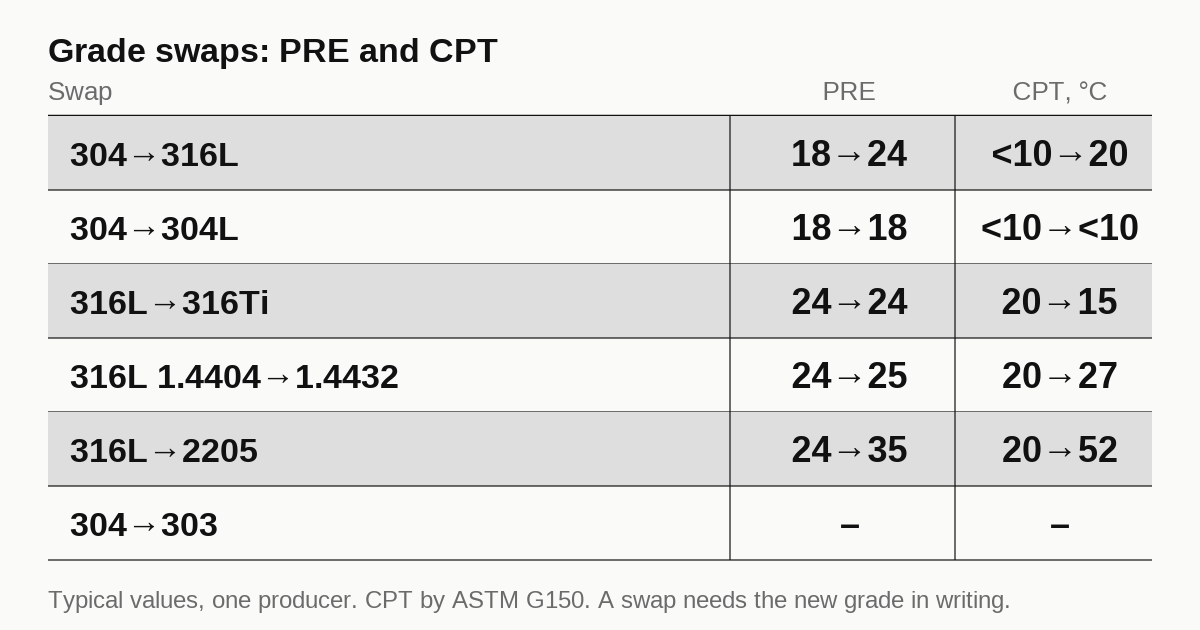
A grade swap is a change to your drawing, so approve it in writing or refuse it. This post lists the swaps shops and mills propose most often and what each one changes. It then gives the questions to ask at four points: before the RFQ, in the RFQ, when you review quotes and before shipment. It is part of our guide to stainless steel grade selection.
Values are one producer’s typical figures or published limits, labelled as such.
The swaps and what changes
| Swap proposed | What changes | Fact we found |
|---|---|---|
| 303 for 304 | Pitting resistance and weldability fall | BSSA: 303 pitting resistance significantly lower than 304, weldability poor, not approved for drinking water contact in Europe |
| 304 for 316L | Chloride margin falls | ASSDA quotes Nickel Institute limits of 200 ppm for 304 and 1000 ppm for 316; PRE 18 against 24 |
| 304 for 304L, or back | Resistance after welding | Outokumpu: 304 yes in the delivered state and no after welding unless multi-certified; 304L yes and yes |
| 316L (1.4404) for 316L (1.4432) | Molybdenum and pitting resistance | PRE 24 and 25, typical CPT 20 and 27 °C, same UNS number |
| 316L for 316Ti | Pitting resistance and surface | Typical CPT 15 against 20 °C; titanium carbides can streak a polished surface |
| 316L for 2205 | Strength, magnetism, cut time | PRE 24 and 35, CPT 20 and 52 °C, machining index 100 and 55; duplex is magnetisable |
| Dual-certified bar for the named grade | Which standard is met in full | Trade source: primary standard in full, secondary on chemistry and mechanical properties only |
Source: BSSA 303 page; ASSDA (Nickel Institute chloride limits); Outokumpu grade table and Supra data sheet (typical values, CPT by ASTM G150); this site’s grade reference (316Ti streaks); Tubing China on dual certification. Typical values, one producer; heats vary.
An upgrade is a swap too. A 316L part replaced by 2205 changes the strength, the weld procedure and the magnetic behaviour, and the drawing may need a design check. Outokumpu’s table lists duplex grades as magnetisable.
Stage 1: before the RFQ
- State the environment. Send chloride level, temperature, welding, heat service, magnetism limit and any food or body contact. Why: a swap can only be judged against the service. Good looks like: a short paragraph on the drawing or in the RFQ.
- Decide which alternates you would accept. Write “no alternates” or list them with the conditions. Why: it stops the argument after the quote. Good looks like: one line per allowed swap, such as “304L accepted for 304 on unwelded parts only”.
- Name one designation system. Use the AISI name, the UNS number or the EN number, not a mix. Why: three names can mean three bars. Our designations guide shows how 316L covers three EN grades.
- Name the bar specification and condition. Why: the grade name does not say what product arrives. Good looks like: for example ASTM A276, which lists conditions A, H, T, S and B, with Condition A named.
Stage 2: in the RFQ
- Ask for the quote in the named grade first. Why: a base quote you can compare. Good looks like: a line item for the grade you named.
- Ask each shop to price any alternate as a separate line. Why: the saving is visible and the choice is yours. Good looks like: base price, alternate price and the reason for the alternate.
- Ask for the cycle time in each grade. Why: ask whether a swap toward 303 is proposed for cut time, because the saving may be small on your part. Good looks like: hours or minutes per part for each grade.
- Ask how the shop buys the bar. Why: stock bar is often dual-certified. Good looks like: the shop says which certificate type and which grade the bar will carry.
Stage 3: reviewing quotes
- Compare grade line by line. Why: a low quote can be a different grade. Good looks like: every quote shows the same grade, bar specification and certificate type.
- Check the reason for any swap. Why: ask whether “not available” is a lead time or a metallurgical reason. Good looks like: a written reason and the lead time for the named grade.
- Test the swap against the service. Why: it is your risk, not the shop’s. Good looks like: you have checked the swap against the table above and the guide to 303 against 304 against 316L where it applies.
Stage 4: before shipment
- Approve in writing against a drawing revision. Why: an email thread is hard to audit. Good looks like: revision letter, part number, lot and the words “valid for this order only”.
- Read the certificate. Why: it is the only proof of what arrived. Good looks like: an EN 10204 type 3.1 certificate, which Outokumpu’s ordering guide lists as the manufacturer’s inspection document and which Project Materials’ summary says shows test results for the delivered lot, with the grade, heat number and chemistry.
- Match heat number to part marking. Why: it ties the part to the certificate. Good looks like: the heat number on the part or the label and on the certificate.
- Decide on a test. Why: a borderline swap may need proof. Good looks like: a stated method, such as ASTM G48 or G150, a temperature and an acceptance criterion, as the G48 guide describes.
Need a quote for this part? Get a quote for your stainless parts
Red flags
- The shop proposes a swap after the order, not in the quote.
- The certificate shows a different grade from the one on the drawing.
- Three designations appear on one callout and nobody says which controls.
- The reason for the swap is cut time and the part is wet, welded or in contact with food or the body.
- The mill or shop will not name the primary standard of a dual certificate.
Example of a written approval
This is wording to adapt, not a legal form: “Approved alternate for part number [number], revision [letter], lot [number]: grade [alternate], UNS [number], bar to [specification], Condition [letter], in place of [named grade]. Valid for this order only. The certificate shall show the alternate grade, the heat number and the chemistry. Any further change needs a new written approval.”
The RFQ fields
Send these in the first message so no shop has to guess:
- The drawing as PDF and a STEP file, with the revision.
- The grade, designation system and bar specification.
- The environment, welding, heat service, magnetism limit and any food or body contact.
- The alternates you would accept, or “none”.
- Quantity, tolerance, finish and the documents to return, including certificate type.
- Delivery term and destination, and whether you need an NDA first.
If you want a quote on the same written scope, send the drawing through the RFQ form. We read it, tell you if something important is missing and send one itemised quote within 24 business hours, with the work placed with a partner shop that cuts stainless. The decision order behind the grade is in our guide to stainless steel grade selection.
Sources
- Outokumpu, Steel Grades, Properties and Global Standards, CPT, machining index, IGC resistance, magnetisability, ordering concepts
- Outokumpu, Supra range data sheet, PRE of the 316 family
- BSSA, chemical compositions of AISI and UNS austenitic stainless steel grades, 316Ti titanium limit and carbon limits
- BSSA, Stainless Steels to Behold: 303, 303 pitting, weldability and drinking water note
- ASSDA, Chlorine and chloride: same element, very different effect, Nickel Institute chloride limits
- Tubing China, dual and multiple certification of stainless steel products, supplier article, directional
- Project Materials, EN 10204 certificate types, directional summary of types 2.1 to 3.2
- ASTM A276/A276M, Stainless Steel Bars and Shapes (ASTM store, 2017 edition page; a later edition is active), scope and conditions
Standards texts were not read in full. Check the current edition before you cite one in a contract.
Frequently asked questions
Can a shop swap the stainless grade without telling me?
It should not, and your drawing should say so. A grade is part of the specification, so a different grade is a change that needs your written approval against a new drawing revision. Check the certificate that arrives: it must show the grade you ordered or the alternate you approved, with the heat number.
Is it safe to swap 316L for 304 to save money?
Only if the service allows it. In Nickel Institute guidance quoted by ASSDA, 304 is limited to about 200 ppm chloride in continuous exposure and 316 to about 1000 ppm. A part sized for 316L chloride exposure can pit in 304. Ask what the environment is before you accept.
What does dual-certified 304 and 304L bar mean?
One bar certified to both grades on the same certificate. It is common supply practice, but a trade source notes it is not recognised by the individual standards bodies and that only the primary standard is met in full. Ask which grade is primary and read the certificate for both.
Do I need to retest after an approved grade swap?
Not always, but decide it before you approve. Where the swap changes pitting, magnetism or welding behaviour, ask for the heat analysis and consider a sample test with a stated method such as ASTM G48 or G150, and keep the result with the approval.
Need a quote for this part?
Send the drawing. We read it, send one itemised quote within 24 business hours and place the work with a partner shop that cuts stainless.
Get a quote for your stainless partsFigures in this guide are published specification limits or published typical values for the alloy, not measurements of any part. Machinability is rated against free-machining carbon steel B1112 at 100 and PREN is chromium plus 3.3 times molybdenum plus 16 times nitrogen. The conventions are set out in thereference section and the editorial standards.