How to choose a stainless steel grade when the one that cuts easily is the one you cannot use
November 21, 2026
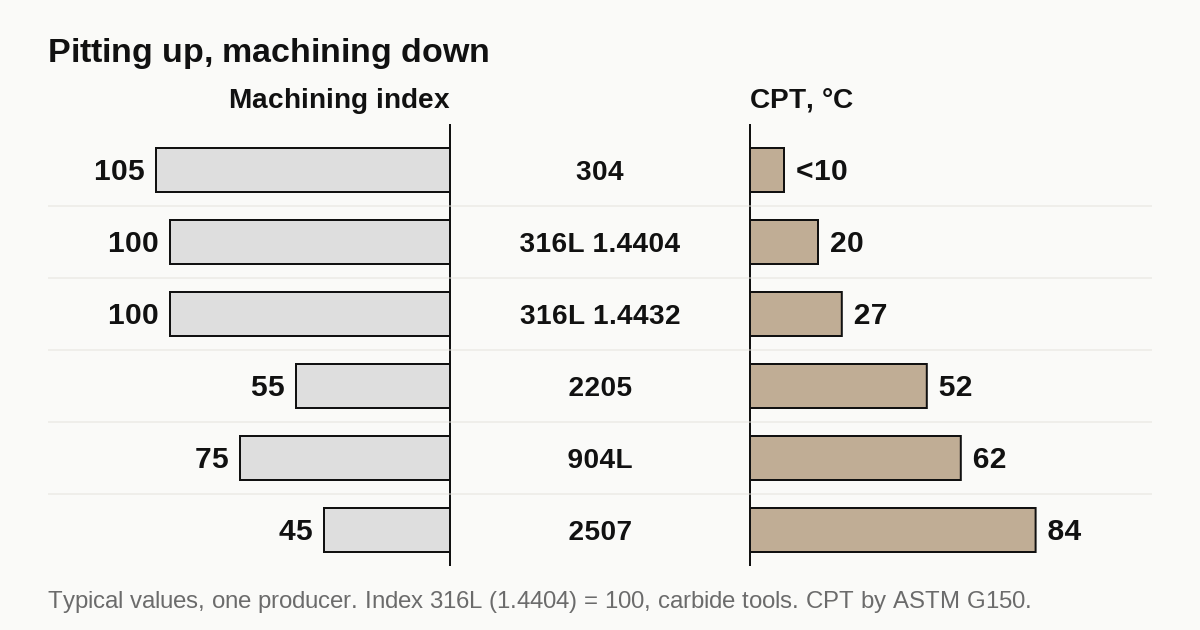
Choose a stainless steel grade in this order: the environment (chloride, temperature, crevices, food or body contact), then welding and heat, then strength, then magnetism and documents. Cut time comes last. The easy-cutting grades are rarely the survivors of the first two steps. This guide is for a design or sourcing engineer who has to put a grade on the print, and it leads to one decision: which grade, on which bar specification, with which proof if the grade alone is not enough.
Grade values below are published typical values for the alloy, not a promise from any shop. Where we found no public figure, we say so.
Last reviewed: October 2026. Figures carry the source and its test method; confirm the current standard edition and your service conditions before you rely on them.
- The grade decision at a glance
- Start with the environment
- The grade that cuts easily
- Reading PREN and CPT
- Welded parts and the L grades
- 316L is not one grade
- Heat service and stabilised grades
- Beyond 316L
- Magnetism on the drawing
- Name the bar specification
- Proving pitting resistance
- Swaps proposed by a shop
- Checklist for the drawing
- Send the RFQ
The grade decision at a glance
The table gives a starting grade for six common situations, the point at which to step up and what the step costs in the cut. The cut-time column uses one producer’s machining index for carbide tools, where its 316L bar (EN 1.4404) is set at 100.
| Situation | Start with | Step up when | Cut time |
|---|---|---|---|
| Dry indoor part, no weld, no food or body contact | 303, or 416 where magnetism is fine | Any wash-down or damp service | Fastest of all |
| Indoor or mild outdoor, light moisture | 304 or 304L | Chloride is present or crevices form | Index 105 |
| Welded assembly | 304L or 316L | Long hot service or seawater | Index 105 and 100 |
| Chloride, food or medical washdown | 316L | Warm chloride, tension or seawater | Index 100 |
| Warm chloride or seawater immersion | 2205 duplex or 904L | Hot seawater: 2507 or a 6Mo grade | Index 55 and 75 |
| Need strength above austenitic | A hardenable or duplex family | See the grade reference | Slower, set by condition |
Source: our synthesis of the sources listed below. Machining index and the other typical values come from the Outokumpu grade table (a bar and plate producer); no public source gives one rating that covers every producer and heat treatment. This guide uses that index, 316L (1.4404) = 100. Our grade reference uses free-machining carbon steel B1112 = 100, and the two scales are not comparable.
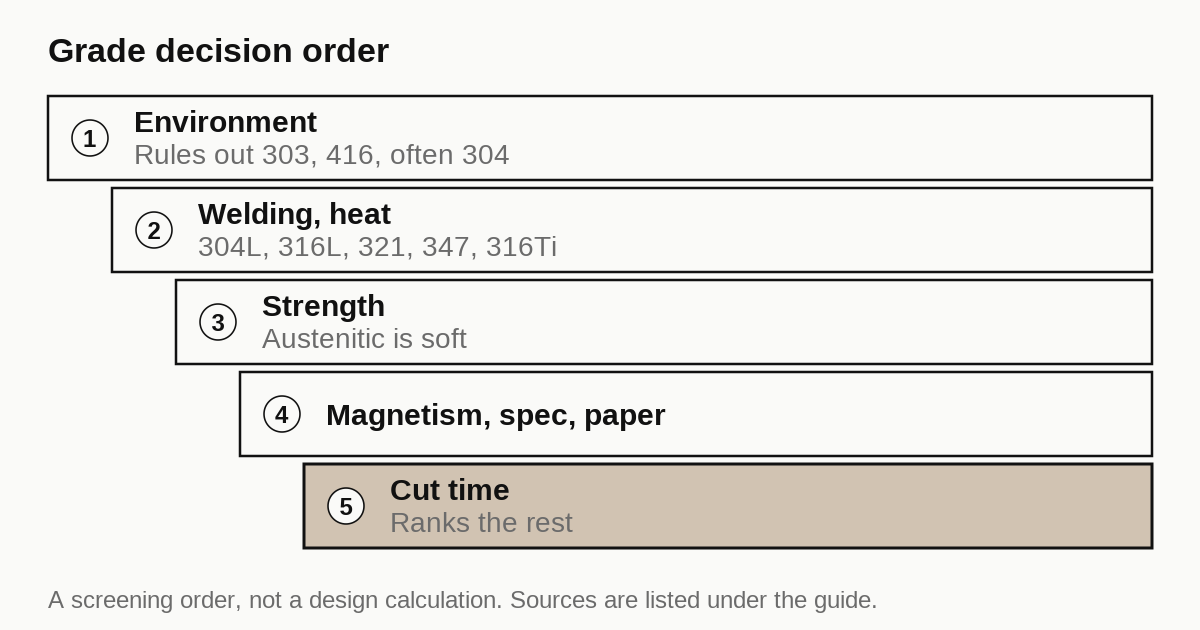
The figure shows the order. Each step can rule grades out, and cut time only ranks the grades that remain. The site’s grade selector is a shorter version: five questions on environment, contact, welding, hardness and sliding. Where the table says 303 or 416, read the next section before you write it.
Read more: 303 vs 304 vs 316L: machining and corrosion
Start with the environment
The grade is an answer to a service condition, so write the condition first. The questions that rule grades out are chloride, temperature, crevices, welding and contact with food or the body.
Chloride sets the largest step. The Australian Stainless Steel Development Association (ASSDA) quotes Nickel Institute guidelines for continuous exposure at neutral pH and ambient temperature: 200 ppm chloride for 304, 1000 ppm for 316 and 3600 ppm for 2205 duplex. The figures allow for crevices such as bolt heads and flanges, and they assume a passivated surface. Higher temperature lowers the limit, and temperatures above 60 °C are not recommended for 304 or 316 because chloride stress corrosion cracking can fail the part suddenly. A second ASSDA page puts the cracking risk for 316 under tensile stress at above about 50 °C. We take the lower number when a part is both warm and loaded.
Three conditions change the answer at the same chloride level:
- Crevices. A gasket, a washer or a threaded joint starts attack at a lower temperature than open surface pitting, so a design with crevices needs the higher grade.
- Immersion, splash or spray. The guideline above is for continuous exposure, so say which of the three applies to the part, not only the water chemistry.
- Food or body contact. These add rules about what may leach and what the surface can be cleaned to. Our food and medical industry pages list the questions.
We found no public table that turns a service description into a grade for every combination, and the guideline above is for one case only. That is why the drawing should state the environment as well as the grade.
Read more: crevice corrosion and stress cracking in stainless parts
The grade that cuts easily
A free-machining grade has sulphur added so that the chip breaks. Outokumpu’s machining guide gives the usual range as 0.15 to 0.35 percent sulphur and names the cost: the sulphides improve chip-breaking, but degrade weldability, toughness, corrosion resistance and hot workability. The British Stainless Steel Association (BSSA) describes 303 the same way, with fair pitting resistance that is significantly lower than 304, poor weldability and a note that 303 is not approved for drinking water contact or jewellery within Europe, with higher chromium and nickel leaching than normal austenitic grades.
The gain is large. Our grade reference rates 303 at 78 and 304 at 45 against free-machining carbon steel at 100. BSSA states a 60 percent machinability index improvement over 304. Published ratings come from different tests, so treat them as an ordering and ask the shop for the cycle time on your part.
303 therefore belongs to a narrow set of parts: dry, indoor, not welded, not in contact with food or the body, many small features, threads and cross holes. Outside that set, the time saved at the machine returns as a failed audit or a rusted part. The linked guide below compares 303, 303Se, 416, 430F and the treated alternatives of 304 and 316.
Cut time is one line of nine on a stainless quote, so a cheaper grade rarely gives a cheaper part by itself. Our guide to a stainless steel machining quote shows where the grade appears on the other lines.
Read more: free-machining stainless steel grades compared
Reading PREN and CPT
Two numbers rank pitting resistance. The pitting resistance equivalent number, PRE or PREN, is computed from composition: chromium plus 3.3 times molybdenum plus 16 times nitrogen. The critical pitting temperature, CPT, is measured: the temperature at which pits start in a standard test. Outokumpu’s data sheets print the formula and say their PRE values are calculated from typical composition.
| Grade (EN number) | PRE, typical | CPT, °C (ASTM G150) | Machining index (1.4404 = 100) |
|---|---|---|---|
| 304 (1.4301) | 18 | below 10 | 105 |
| 316L (1.4404) | 24 | 20 ± 2 | 100 |
| 316L (1.4432) | 25 | 27 ± 3 | 100 |
| 316Ti (1.4571) | 24 | 15 ± 2 | 95 |
| 904L (1.4539) | 34 | 62 ± 3 | 75 |
| 2205 (1.4462) | 35 | 52 ± 3 | 55 |
| 2507 (1.4410) | 43 | 84 ± 2 | 45 |
Source: Outokumpu grade table (CPT by potentiostatic test at +700 mV against a saturated calomel electrode in 1 M NaCl on a P320 ground surface; index for carbide tools) and the Outokumpu Supra and Ultra range data sheets (PRE). The 304 PRE is our sum from the grade table’s typical chromium. One producer’s typical values; heats vary.
The chart at the top of this guide plots the same trade. Two cautions apply. CPT depends on the method: Outokumpu says it is not an inherent material property and that results from different methods must not be compared. For one super austenitic grade the same alloy gave 65 °C by ASTM G48 Method E and 85 °C by ASTM G150. And PRE alone does not predict service: it ignores crevices, temperature, surface finish, stress and the sulphides in free-machining grades. The PREN calculator computes the number from a composition.
Read more: PREN explained: the pitting number and what it misses
Welded parts and the L grades
When a part is welded, heat can precipitate chromium carbides at the grain boundaries and leave the metal next to the weld open to intergranular attack. The low-carbon “L” grades limit carbon to 0.030 percent, against 0.08 percent for the standard grades, in the BSSA tables for bar to ASTM A276. Outokumpu’s data sheet says the lower carbon content minimises carbide precipitation from welding heat and gives improved resistance to intergranular corrosion.
Outokumpu’s grade table records the result as two letters per grade, for the delivered condition and the welded condition, tested to EN ISO 3651-2. 304L and 316L show yes and yes. Standard 304 and 316 show yes and no, with a footnote that the steel may be multi-certified as yes and yes. That footnote is why dual-certified bar exists: a heat that meets both sets of limits can carry both names.
For a machined part the decision is short:
- Welded after machining, or welded into an assembly: write the L grade.
- Never welded: the L grade protects nothing, but dual-certified bar is often the stock that exists, so accept it and check the certificate.
- Sustained service in the sensitising range: the L grade only delays sensitisation, so see the stabilised grades below.
Read more: 304 vs 304L: when the low carbon grade matters
316L is not one grade
Molybdenum is what separates 316 from 304, and the specification allows a wide band of it. The BSSA limits for 316 and 316L give 16 to 18 percent chromium and 2.00 to 3.00 percent molybdenum, before nitrogen. Our own arithmetic on those limits gives a PREN range of about 23 to 28, so two compliant bars can differ by several points.
Outokumpu lists three EN grades that all carry the name 316L and the UNS number S31603, with different typical chemistry and results.
| EN grade | Mo, typical % | Ni, typical % | PRE | CPT, °C |
|---|---|---|---|---|
| 1.4404 | 2.1 | 10.1 | 24 | 20 ± 2 |
| 1.4432 | 2.6 | 10.7 | 25 | 27 ± 3 |
| 1.4435 | 2.6 | 12.6 | 26 | 21 ± 2 |
Source: Outokumpu Supra range data sheet (typical composition and PRE) and Outokumpu grade table (CPT, ASTM G150). The same alloy name, three different results.
So “316L” on its own leaves the bar open. If your chloride margin is thin, write the EN number or a minimum molybdenum and say which designation system you mean. 316Ti adds titanium (5 times carbon plus nitrogen, at least, in the BSSA table) and shows a lower typical CPT of 15 ± 2 °C in the same table. The grade reference notes that titanium carbides can show as streaks on a polished surface, which is why 316Ti is a poor choice for cosmetic parts.
Read more: 316 vs 316L vs 316Ti: which one to put on the print and UNS, AISI and EN numbers on a drawing
Heat service and stabilised grades
Outokumpu’s Supra sheet says a low carbon content extends the time required for significant sensitisation, names 550 to 850 °C as the critical interval for heat treatment, and says steels with a titanium addition have better resistance to intergranular corrosion after such operations. Where a part sits in that range for long periods, stabilised grades are the next step. They tie the carbon up with titanium or niobium. In the BSSA table 321 carries titanium at 5 times carbon as a minimum and 347 carries niobium plus tantalum at 10 times carbon. Supra data sheets describe titanium-stabilised grades as improving corrosion resistance at elevated temperatures.
Outokumpu’s grade table shows 321 (1.4541) and 316Ti (1.4571) at yes and yes for intergranular corrosion resistance, with a typical CPT for 321 of below 10 °C. That tells you what the stabilised grades are for. They solve a heat problem and not a chloride problem, and 321 sits in the same typical CPT class as 304, below 10 °C. The same Supra sheet warns that annealing titanium-stabilised grades above 1070 °C may impair their resistance to intergranular corrosion, which is a heat treatment point for the shop and the forging source.
We found no public rule that fixes the temperature at which a part must move from 304L or 316L to a stabilised grade, because it depends on time at temperature and on the medium. State the service temperature and duration on the drawing and ask the shop and the mill to propose the grade.
Read more: 321 and 347: stabilised grades for heat service
Beyond 316L
When warm chloride or seawater takes 316L past its limit, the ladder runs through 904L, duplex 2205 and then 6Mo and 2507. ASSDA recommends duplex such as 2205 or 6Mo grades for severe hot chloride, and 904L, 2205 or super duplex where strong reducing acids are present. Outokumpu’s typical values in the table above show the step: CPT of 62 °C for 904L, 52 °C for 2205 and 84 °C for 2507, against 20 °C for 316L (1.4404).
ASSDA’s own table uses a different test, a plate under a PTFE washer in 10 percent ferric chloride, and gives critical pitting temperatures of 3 °C for 304, 10 °C for 316, 42 °C for 904L, 33 °C for 2205 and 78 °C for 2507. It adds critical crevice temperatures of below -10, -10, 12, 13 and 38 °C in the same order, and says crevice temperatures are at least 20 °C below pitting temperatures. The order of the grades agrees with Outokumpu’s, but the numbers do not, so never mix the two sets. Our marine stainless guide, linked below, lists figures from yet other tests for the same reason. ASSDA also reports that in seawater at ambient temperature crevices form on 304 at a gap of 0.9 mm, on 316 at 0.4 mm and on 904L, which it says resembles 2205, at 0.15 mm.
Each step costs in the cut. Outokumpu’s index falls from 100 for 316L to 75 for 904L, 55 for 2205 and 45 for 2507. Duplex is also stronger. Outokumpu quotes EN 10088-2 minimum 0.2 percent proof strength for cold-rolled strip of 500 MPa for 2205 against 240 MPa for 316L, and a stronger grade can allow a thinner section, which offsets part of the cost. We found no public figure for the net price change, because it depends on the part. The 904L and 6Mo guide below covers the super austenitic route.
Read more: 904L and 6Mo stainless: machining super austenitic grades and marine stainless parts: 316L, duplex and pitting in seawater
Need a quote for this part? Get a quote for your stainless parts
Magnetism on the drawing
Austenitic stainless is normally non-magnetic, but the word “normally” matters. Outokumpu’s grade table describes austenitic grades as non-magnetisable with a typical magnetic permeability of 1.05 to 1.2, and adds that small amounts of ferrite or martensite from composition or cold deformation increase magnetisability. Cold work at a machined surface can therefore leave a correct 316L part weakly magnetic, as our 316L magnetism guide below explains.
Ferritic, martensitic and duplex grades are magnetisable by nature. If a part must be non-magnetic, for an instrument, a sensor housing or a sensitive environment, say so with a number, because “non-magnetic” has no single meaning. Outokumpu’s Supra sheet notes that stable austenitic grades with higher nickel content are designed to minimise martensite formation during cold work, which is the lever for parts that must stay non-magnetic after forming.
A magnet check at receiving is a weak test, because a pass-fail magnet cannot tell harmless surface magnetism from a wrong grade. Use the certificate for the grade and a stated permeability limit for the property.
Read more: is 316L magnetic? why machined parts pick up magnetism
Name the bar specification
A grade name does not say what product you will receive. ASTM A276 covers hot-finished and cold-finished stainless bars and shapes (rounds, squares and hexagons, plus shapes such as angles and channels) in five conditions: annealed (A), hardened and tempered at low (H) or high (T) temperature, strain hardened (S) and severely cold worked (B). Its scope sends free-machining types to ASTM A582, which is why a drawing that asks for 303 on A276 has mixed two standards. ASTM A479 covers stainless bar and shapes for boilers and other pressure vessels, and its abstract refers to heat treatment and a corrosion test for the austenitic grades. The ASTM store pages show A276/A276M-25 and A479/A479M-26 as the active editions as of October 2026.
| Item | A276 | A479 | A582 |
|---|---|---|---|
| Covers | Hot or cold finished bars and shapes | Bars and shapes for boilers and pressure vessels | Free-machining bars (named in the A276 scope) |
| Forms | Rounds, squares, hexagons, angles, tees, channels | Rounds, squares, hexagons, angles, tees, channels | Bars designed for optimum machinability (A276 note) |
| Conditions or heat treatment | A, H, T, S, B | Normalised, tempered, annealed and quenched conditions named in the abstract | Not read |
| Edition active, October 2026 | A276/A276M-25 | A479/A479M-26 | Not checked |
Source: ASTM store abstract pages for A276 and A479. We did not read the standards’ full texts, which are paywalled; the A582 column rests on the A276 scope only. Confirm clauses in the current edition.
Ask for an EN 10204 type 3.1 certificate, which Outokumpu’s ordering guide lists as the manufacturer’s inspection document, or type 3.2 where a third party inspects. The certificate should show the grade you ordered, not an equivalent.
Read more: ASTM A276 vs A479 stainless bar: which spec to order
Proving pitting resistance
When the grade is borderline and the cost of failure is high, ask for a test instead of a bigger grade. Outokumpu describes the two usual methods. ASTM G48 Method E exposes specimens for 24 hours in 6 percent ferric chloride with 1 percent hydrochloric acid at 5 °C steps and is slow and affected by edge attack. ASTM G150 measures electrochemically in 1 M sodium chloride at +700 mV against a calomel electrode while the temperature rises 1 °C a minute, and takes two to three hours. Outokumpu also says a CPT value cannot be used directly to predict performance in a real application.
So a test proves something narrow: that this heat, in this surface condition, passes a stated criterion at a stated temperature. Write the method, the temperature and the pass criterion into the order, and say whether the test is on the bar or on the finished, passivated part. A bar that passes and a part that was then blasted with iron-contaminated media can still rust.
Read more: ASTM G48 pitting test: when to ask for it on stainless
Swaps proposed by a shop
A shop under schedule pressure may propose a swap: 303 for 304, 304 for 316L or the mill’s dual-certified bar for the grade you named. Some swaps are harmless and some change the service. A swap from 304 to 316L raises PRE from 18 to 24 and the typical CPT from below 10 °C to 20 °C in Outokumpu’s table. A swap from 304 to 303 lowers pitting resistance and weldability, according to BSSA.
Treat every swap as a change to the drawing. Ask what changes for corrosion, welding, magnetism and food or medical limits. Get the new grade in writing against a new drawing revision. Check that the certificate shows the grade that actually arrives. Outokumpu’s ordering guide shows a multi-certified example, 1.4404 plus 1.4401, so a certificate can carry two names. Read it for the grade you ordered.
Read more: stainless grade substitution: what to ask before you approve a swap
Checklist for the drawing
Put these on the print or in the RFQ so that the grade is quoted and checked against the real service:
- The grade name and one designation system (AISI, UNS or EN number), not a mix.
- The bar specification and condition: A276, A479 or A582, and the condition letter.
- The environment: chloride level, temperature range, crevices, wet and dry cycling.
- Welding: whether the part is welded, and whether the L or a stabilised grade is needed.
- Heat service: the temperature and time if it is above ordinary room use.
- Magnetism: a permeability limit if the part must stay non-magnetic.
- Food or body contact, with the rule or audit that applies.
- The certificate type (EN 10204 3.1 or 3.2) and the heat number on the part.
- Any pitting test, with method, temperature, pass criterion and the stage it applies to.
- The rule on substitutions: no change of grade without a written revision.
Read more: what to put in a stainless RFQ so quotes are comparable
Send the RFQ
If you want a grade checked against your service and a quote on the same written scope, send the drawing, the environment and the quantity through the RFQ form. We read it, tell you if something important is missing and send one itemised quote within 24 business hours, with the work placed with a partner shop that cuts stainless. You deal with one contact.
Sources
- Outokumpu, Steel Grades, Properties and Global Standards, designations, CPT, machining index, IGC resistance, ordering concepts
- Outokumpu, Supra range data sheet, 316 family composition, PRE, stabilised grades
- Outokumpu, Ultra range data sheet, PRE of 904L, 2205 and 2507
- Outokumpu, Testing stainless steel for resistance to pitting corrosion, ASTM G48 and G150, limits of CPT
- Outokumpu, Machining stainless steel bar: a short guide, sulphur and free-machining trade
- ASSDA, Chlorine and chloride: same element, very different effect, Nickel Institute chloride limits
- ASSDA, Crevices and corrosion, CPT and CCT table, crevice gaps
- ASSDA, 316: the first step up, 316 limits and the next grades
- BSSA, chemical compositions of AISI and UNS austenitic stainless steel grades, composition limits, bar against flat product
- BSSA, Stainless Steels to Behold: 303, sulphur, pitting, weldability, drinking water note
- ASTM A276/A276M, Stainless Steel Bars and Shapes (ASTM store, 2017 edition page; a later edition is active), scope and conditions
- ASTM A479/A479M, Stainless Steel Bars and Shapes for Use in Boilers and Other Pressure Vessels (ASTM store, 2017 edition page; a later edition is active), scope
Values are as published when we read them in October 2026, from one producer and two industry bodies. Standards texts were not read in full.
Frequently asked questions
Which stainless steel grade should I choose for a machined part?
Start from the environment, not the grade: chloride level, temperature, crevices, welding and food or body contact. Nickel Institute guidelines quoted by ASSDA give continuous chloride limits of 200 ppm for 304, 1000 ppm for 316 and 3600 ppm for 2205 at neutral pH and ambient temperature. Rank the grades that survive by cut time.
Is 316L always better than 304 for a machined part?
For pitting it is better, with a typical critical pitting temperature of 20 °C against below 10 °C in one producer's table. It also cuts a little slower and costs more. In a dry indoor part with no chloride the extra molybdenum buys nothing, so 304 or 304L can be the right call.
When do I need duplex instead of 316L?
When warm chloride, seawater or tensile stress takes 316L past its limits. ASSDA says 316 can crack under tension in hot chloride above about 50 °C and points to 2205 or 6Mo grades for severe cases. Duplex cuts much more slowly: one producer rates 2205 at 55 against 100 for 316L.
Why not use 303 for every part because it cuts so fast?
The sulphur that breaks the chip also lowers pitting resistance and weldability. BSSA describes 303 pitting resistance as significantly lower than 304 and weldability as poor. It suits dry indoor parts with many small features. Keep it away from chloride, welding and parts that need a clean passivated surface.
Does the L grade matter if the machined part is never welded?
Not for welding, because the low carbon limit only helps where heat input could sensitise the metal. It can still matter for stock availability and for any later weld repair. Many mills certify one bar to both the standard and the L grade, so check the certificate shows what you asked for.
Should the drawing name a grade or the environment?
Both. Write the grade, one designation system and the bar specification so the shop can quote. Write the environment as well, covering chloride, temperature, welding and food or body contact, so that a shop proposing a swap can test the swap against the real service.
Need a quote for this part?
Send the drawing. We read it, send one itemised quote within 24 business hours and place the work with a partner shop that cuts stainless.
Get a quote for your stainless partsFigures in this guide are published specification limits or published typical values for the alloy, not measurements of any part. Machinability is rated against free-machining carbon steel B1112 at 100 and PREN is chromium plus 3.3 times molybdenum plus 16 times nitrogen. The conventions are set out in thereference section and the editorial standards.