PREN explained: how the pitting number is worked out, what it ranks and what it cannot tell you
November 21, 2026
PREN, the pitting resistance equivalent number, is chromium plus 3.3 times molybdenum plus 16 times nitrogen, in percent by mass. It ranks how well a stainless steel resists pitting in chloride, and it is worked out from composition, not measured. This post is part of our guide to stainless steel grade selection. It is for a buyer or engineer who sees a PREN on a data sheet, or is asked to write one into a specification, and wants to know what it can carry.
The values below are one producer’s typical figures or our own arithmetic on published limits, and we say which.
The formula and its variants
The common form is PREN = %Cr + 3.3 x %Mo + 16 x %N. Wikipedia notes that other forms exist, with a nitrogen factor anywhere from 16 to 30, and a form for tungsten-bearing grades that adds 0.5 times the tungsten to the molybdenum term. Outokumpu’s data sheets use the 16 factor and call the result PRE. Before you compare two numbers, check which formula produced each. We found no standard in the pages we opened that defines PREN: the formula comes from producer data sheets and a definition page, and we did not read ASTM A240 or A276.
| Term | What it is | Measured or calculated | Typical use |
|---|---|---|---|
| PREN or PRE | Cr + 3.3 Mo + 16 N | Calculated from composition | Ranking grades in one family |
| CPT | Critical pitting temperature | Measured in a test | Ranking grades by test result |
| CCT | Critical crevice temperature | Measured in a test | Judging crevice risk |
Source: Wikipedia, Pitting resistance equivalent number (definition and variants); Outokumpu and ASSDA pages listed below for CPT and CCT.
Wikipedia also states that PREN alone is not an indicator of corrosion resistance and that it should be calculated for each heat, because composition varies within the specified limits.
A worked example from typical composition
The arithmetic is short. Outokumpu publishes typical composition for each grade and a PRE beside it. The table redoes the sum so you can see where each number comes from.
| Grade (EN number) | Cr % | Mo % | N % | Sum | PRE as published |
|---|---|---|---|---|---|
| 304 (1.4301) | 18.1 | 0 | 0 | 18.1 | 18 |
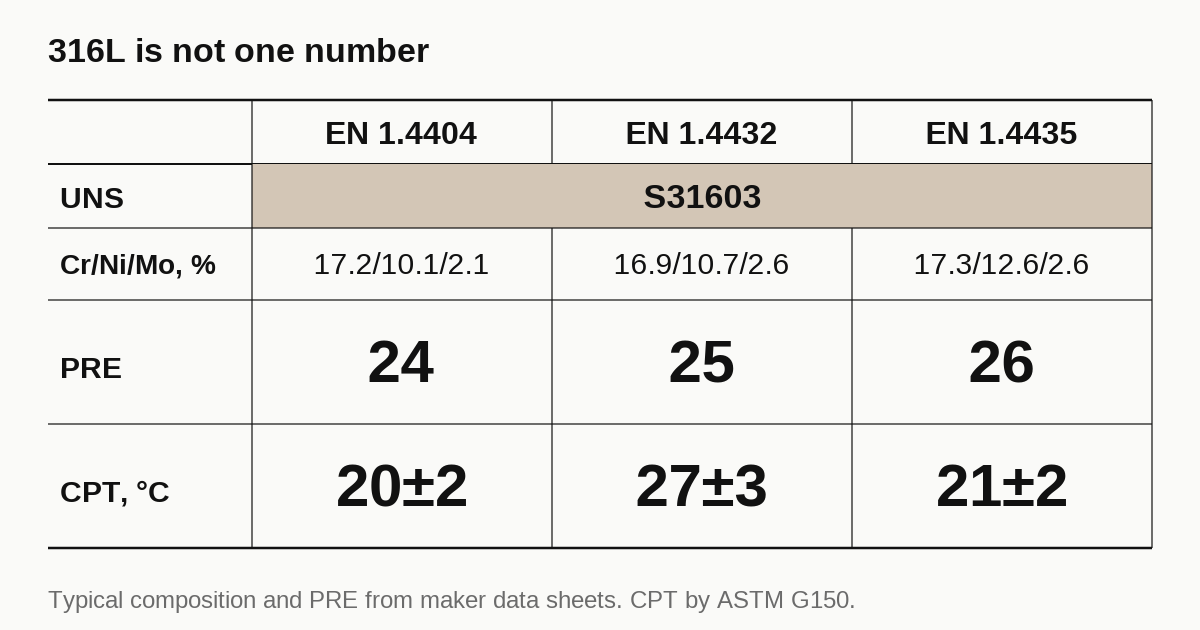
| 316L (1.4404) | 17.2 | 2.1 | 0 | 24.1 | 24 |
| 316L (1.4432) | 16.9 | 2.6 | 0 | 25.5 | 25 |
| 316L (1.4435) | 17.3 | 2.6 | 0 | 25.9 | 26 |
| 904L (1.4539) | 19.8 | 4.3 | 0 | 34.0 | 34 |
| 2205 (1.4462) | 22.4 | 3.1 | 0.17 | 35.4 | 35 |
| 2507 (1.4410) | 25.0 | 4.0 | 0.27 | 42.5 | 43 |
Source: Outokumpu Supra and Ultra range data sheets, typical composition and PRE; the sum column is our arithmetic. The 304 row uses the grade table’s typical chromium and our sum. Typical values, one producer, not a limit.
Three grades share the name 316L in the table and differ by two points. That is the first lesson: PREN belongs to a composition, not to a name.
Typical against specification limits
A data sheet gives typical values. A purchase order gets the specification limits, and they spread wider. The British Stainless Steel Association (BSSA) tables for 316L give 16 to 18 percent chromium and 2.00 to 3.00 percent molybdenum, with nitrogen at 0.10 percent maximum. Taking chromium and molybdenum alone, our arithmetic gives the lowest compliant bar a PREN of about 22.6 and the highest about 27.9. A bar at the low end and a bar at the high end are both 316L, and the spread is almost as large as the six-point gap between 304 and 316L in the table above.
The same holds for duplex. Our grade reference lists 2205 limits of 22 to 23 percent chromium, 3 to 3.5 molybdenum and 0.14 to 0.20 nitrogen, which give a PREN of about 34 to 38 by our arithmetic, around the producer’s typical 35. The PREN calculator works the sum from a composition range or from a heat analysis.
CPT: the measured companion
Where PREN is calculated, the critical pitting temperature is measured. Outokumpu’s grade table lists typical CPT from an electrochemical test in 1 M sodium chloride on a ground surface (ASTM G150): below 10 °C for 304, 20 ± 2 for 316L (1.4404), 27 ± 3 for 1.4432, 52 ± 3 for 2205 and 84 ± 2 for 2507. The order follows PRE closely, and the table also shows the limit of the number: 1.4404 and 1.4435 differ by two PRE points but by one degree of CPT, while 1.4432 is one PRE point above 1.4404 and seven degrees higher in CPT.
CPT depends on the test. Outokumpu says it is not an inherent material property and that it varies with environment, method and specimen preparation. It adds that CPTs from different methods must not be compared. For one super austenitic grade it reports 65 °C by ASTM G48 Method E and 85 °C by ASTM G150. ASSDA’s own table, from a plate under a PTFE washer in 10 percent ferric chloride, gives 3 °C for 304, 10 °C for 316, 33 °C for 2205 and 78 °C for 2507. The order matches, the values do not, so quote the method every time you quote a CPT. The G48 guide covers when to ask for the test itself.
Need a quote for this part? Get a quote for your stainless parts
What PREN does not see
PREN is a ranking of bulk composition. It leaves out most of what makes a machined part fail.
- Crevices. ASSDA says critical crevice temperatures run at least 20 °C below critical pitting temperatures, with 316 at -10 °C against 10 °C. A joint with a gasket or thread fails before the open surface.
- Stress corrosion cracking. This depends on tensile stress and temperature, not on PREN. ASSDA puts the risk for 316 under tension at above about 50 °C in chloride.
- Surface condition. Outokumpu’s CPT values are for a surface ground to P320 and the data sheet says other surfaces give other values. Machining marks, embedded iron and blast media change the result on a real part.
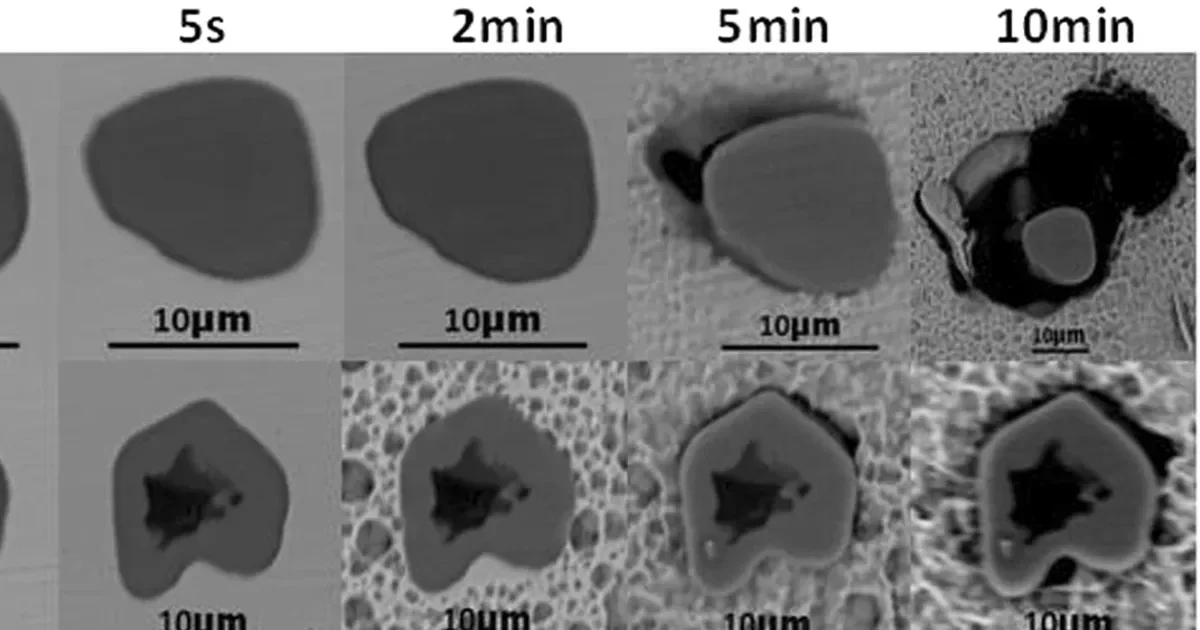
- Inclusions. The image at the top of this post, from a published study of 304, shows oxide inclusions with attack opening around them in a ferric chloride solution. Bulk chemistry cannot show where inclusions sit.
- Sulphides. Free-machining grades carry sulphur that the formula ignores. Our grade reference rates 303 at PREN 18 against 19 for 304, while BSSA describes 303 pitting resistance as significantly lower than 304. The number says they are close, and the service says they are not.
None of this makes PREN useless. It orders grades inside one family quickly, which is why it works as a first screen. The crevice corrosion guide covers the failure modes it leaves out.
How to write it in an RFQ
Write the grade and bar specification first, and treat PREN as a second line. A PREN minimum can be useful on a bar order where heats vary, but only if it matches the specification so that compliant heats are not rejected. Examples, to adapt to your own service data:
- “Material: 316L, UNS S31603, ASTM A276 Condition A. State the EN number if molybdenum matters.”
- “PREN minimum 24, calculated per heat from the certificate analysis as Cr + 3.3 Mo + 16 N.”
- “Pitting test: ASTM G48 Method E on a sample from the delivered bar, 24 hours at the stated temperature, no pitting at the agreed magnification.” Fill in the temperature and acceptance criterion from your own service, and agree the method with the shop first.
If you want a grade checked against your service and quotes on the same scope, send the drawing through the RFQ form. We reply within 24 business hours.
What to write in your spec
- The grade name and one designation system, with the EN number if molybdenum matters.
- The bar specification and condition.
- If PREN is used: the formula, the per-heat basis and a minimum inside the specification limits.
- If a test is used: the method, temperature, duration and acceptance criterion.
- The environment, so that a shop proposing a different grade can test it against the service.
The decision order for all of this is in our guide to stainless steel grade selection.
Sources
- Outokumpu, Steel Grades, Properties and Global Standards, typical composition and CPT by ASTM G150
- Outokumpu, Supra range data sheet, 316 family composition and PRE
- Outokumpu, Ultra range data sheet, 904L, 2205 and 2507 composition and PRE
- Outokumpu, Testing stainless steel for resistance to pitting corrosion, CPT method dependence
- ASSDA, Crevices and corrosion, CPT and CCT table
- BSSA, chemical compositions of AISI and UNS austenitic stainless steel grades, 316L limits
- BSSA, Stainless Steels to Behold: 303, 303 pitting resistance against 304
- Wikipedia, Pitting resistance equivalent number, formula variants and caveats (definition only)
Typical values are one producer’s. Check the heat analysis on your certificate before you rely on a PREN. Standards texts (ASTM A276, ASTM G48) were not read in full; check the current edition before you cite one in a contract.
Frequently asked questions
What does PREN mean for stainless steel?
PREN is the pitting resistance equivalent number: chromium plus 3.3 times molybdenum plus 16 times nitrogen, all in percent by mass. A higher value means more resistance to pitting in chloride. It ranks grades within the same family, and it is calculated from composition, not measured on the part.
What PREN does 316L have?
It depends on the bar. One producer's typical values give 24 for EN 1.4404, 25 for 1.4432 and 26 for 1.4435, all named 316L. Our arithmetic on the chromium and molybdenum limits alone gives about 23 to 28. Calculate it from the heat analysis on your certificate.
Is a higher PREN always better for a machined part?
For pitting in chloride, yes, within one family. It says nothing about crevice attack, stress corrosion cracking, surface finish or the sulphides in free-machining grades. Higher PREN grades also cut more slowly, so choose the lowest value that covers the service with a margin.
Should I put a minimum PREN on the drawing?
Only with care. Name the grade and bar specification first. If you add a PREN minimum, say it is calculated per heat from the certificate, state the formula, and check it against the specification limits so compliant heats are not rejected. A pitting test with a stated method and temperature is often clearer.
Need a quote for this part?
Send the drawing. We read it, send one itemised quote within 24 business hours and place the work with a partner shop that cuts stainless.
Get a quote for your stainless partsFigures in this guide are published specification limits or published typical values for the alloy, not measurements of any part. Machinability is rated against free-machining carbon steel B1112 at 100 and PREN is chromium plus 3.3 times molybdenum plus 16 times nitrogen. The conventions are set out in thereference section and the editorial standards.