Free-machining stainless steel: how 303, 303Se, 416 and 430F compare, and what each gives up
November 21, 2026
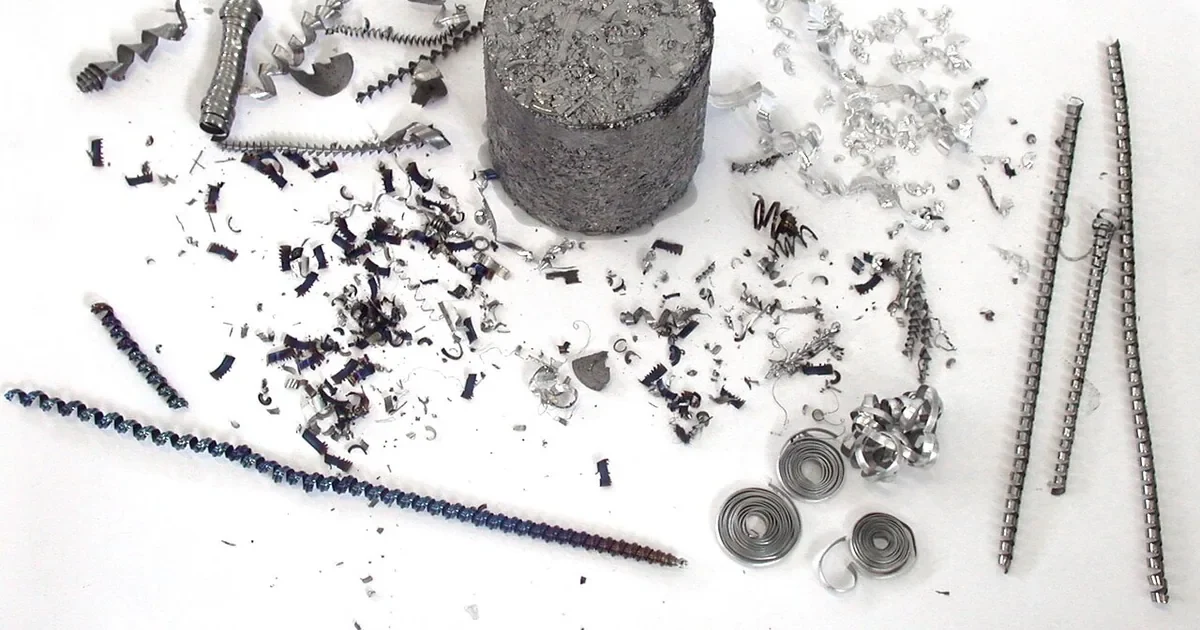
Free-machining stainless steel is stainless with sulphur, or selenium, added so the chip breaks short and the tool lasts. The common grades are 303, 303Se, 416 and 430F, and each pays for the gain in corrosion resistance, weldability or both. Pick the free-machining grade only for a part that is dry, not welded and not in contact with food or the body, and look at treated 304 or 316 when it is not. This post is part of our guide to stainless steel grade selection.
Grade values are published typical values for the alloy, not a promise from any shop.
Decision table
| Criterion | 303 | 303Se | 416 | 430F | Treated 304 or 316 |
|---|---|---|---|---|---|
| UNS | S30300 | S30323 | S41600 | S43020 | S30400 or S31600 |
| Family | Austenitic | Austenitic | Martensitic | Ferritic | Austenitic |
| Additive | S 0.15 min | Se 0.15 min, S 0.060 max | S 0.15 min | S 0.15 min | Inclusions modified |
| Magnetic, annealed | No | No | Yes | Yes | No |
| Hardens by heat treatment | No | No | Yes | No | No |
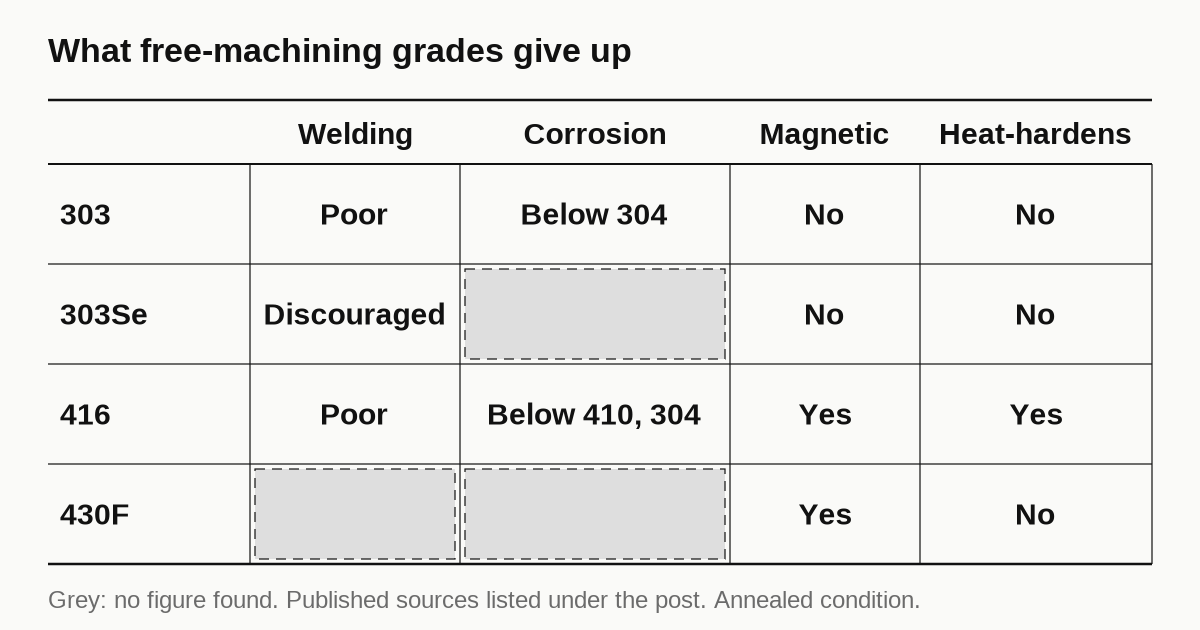
| Welding | Poor | Discouraged | Poor | Not found | As the base grade |
| Corrosion | Below 304 | Not found | Below 410 and 304 | Not found | As the base grade |
Source: BSSA composition tables for austenitic, ferritic and martensitic grades; BSSA pages on 303 and 416; AZoM on 303Se; Outokumpu machining guide for treated grades; magnetism and hardening from our grade reference for 303, 416 and 430, and by family for 303Se and 430F (Outokumpu: austenitic grades are non-magnetic when annealed, ferritic grades are magnetisable). “Not found” means we found no statement in the pages we opened.
How the additive works
Outokumpu’s machining guide describes the classic method: alloy the steel with 0.15 to 0.35 percent sulphur so that sulphides form in the material. The sulphides improve machinability and particularly chip-breaking, and they degrade weldability, toughness, corrosion resistance and hot workability. In the BSSA tables 303 carries sulphur at 0.15 percent minimum, 303Se carries selenium at 0.15 minimum with sulphur capped at 0.060, and 416 and 430F carry sulphur at 0.15 minimum.
AZoM describes 303Se as giving a very brittle chip at high speeds and feeds. It says the grade is widely used in screw and general machining. The point for a buyer is that the additive does one job at the machine and a different job in service. A sulphide that breaks a chip is also a particle at the surface of the finished part.
Cut-time gain
The gain is real and the published figures are not uniform. BSSA states a 60 percent improvement in machinability index for 303 over 304. Our grade reference rates 303 at 78, 416 at 85 and 304 at 45 against free-machining carbon steel at 100, and BSSA’s 416 page gives about 85 to 90 percent, the highest of any stainless steel. Treat the ratings as an ordering.
We found no public rating for 303Se or 430F on the same scale, and none for treated grades beyond the producer’s statement below. Cycle time on a part depends on its features, and we found no public figure that splits the gain by feature. Ask the shop for the cycle time on your drawing in each grade and compare it with what the grade will cost you in service, as the 303 against 304 against 316L guide does for the three common grades.
Corrosion
Sulphur costs corrosion resistance. BSSA describes 303 pitting resistance as fair but significantly lower than 304, and 416 as lower than 410 and well below 304 and 316. The same BSSA 303 page notes that 303 is not approved for contact with drinking water or for jewellery within Europe, and has higher leaching of chromium and nickel than normal austenitic grades. 416 is a martensitic grade with about 12 to 14 percent chromium, so its base resistance is modest before the sulphur is counted.
For 303Se and 430F we found no statement comparing pitting resistance with 303 or 304 in the sources we opened. AZoM calls the corrosion resistance of 303Se good, without a number or a test. Do not read that as parity with 304. If the part sees chloride, moisture with chloride or a cleaning regime that uses chloride, use a standard grade.
Welding and heat treatment
BSSA lists 303 weldability as poor and 416 as poor, with the advice to machine first and heat treat afterwards. AZoM says high-temperature welding of 303Se is discouraged because selenium tends to precipitate at the weld boundary, and that low-temperature welding with an AWS E/ER312 filler is possible. We found no weld statement for 430F in the pages we opened.
Where a part is welded into an assembly, the free-machining grade is rarely right, and the cost of getting this wrong is cracking or a weld that fails after the part is machined and finished. If the geometry needs a weld and also needs easy cutting, ask whether the weld can sit on a separate component in a standard grade.
Magnetism and hardening
303 and 303Se are austenitic and non-magnetic when annealed. 416 and 430F are magnetic. 416 hardens by heat treatment, and BSSA lists shafts, valve parts, bolts and screw-machined parts among its uses. 430F does not harden by heat treatment. Our grade reference notes that 416 should be passivated in citric acid and not nitric. If a part must be non-magnetic, 416 and 430F are out, and the bar specification guide shows how to name the product so the right bar arrives.
The alternative: treated 304 and 316
A mill can control the inclusions that every steel contains and change them from hard, abrasive particles to softer, more lubricating ones. Outokumpu’s guide says this lets standard grades such as 304 and 316 reach machining characteristics approaching the free-machining steels, essentially without sacrificing other characteristics, and its chip-breaking charts show a treated 304L better than the standard grade while 303 still breaks chips best at low feeds. Outokumpu sells these as its Prodec grades.
For a buyer the practical point is to ask. A part that needs 304L or 316L for corrosion or welding and also has many small features may cut well enough in a treated bar to avoid a grade change. We found no public cost comparison of treated bar against standard bar, so ask the mill or stockist for the price and the lead time.
Need a quote for this part? Get a quote for your stainless parts
Which grade when
Choose 303 when the part is dry, indoor, not welded and not in contact with food or the body, and has many small features, threads or cross holes.
Choose 303Se when the same applies and the shop recommends it and gives the reason in writing. AZoM notes a very brittle chip and discourages high-temperature welding.
Choose 416 when the part must be hard or magnetic and stays dry: shafts, valve parts and similar.
Choose 430F when a magnetic, ferritic part is wanted and hardening is not needed.
Choose treated 304 or 316 when the part needs corrosion resistance or welding and a faster cut would still help.
Choose a standard grade when the part is wet, chloride-exposed, cleaned, welded or body-contact.
What picking wrong costs
A free-machining grade picked too freely moves cost from the machine to the field: a rusted shaft, a pitted valve part or a failed audit. Picking a standard grade where free-machining would have done adds cycle time and tool wear, which shows on the quote. The first mistake is the more expensive one, because the failure appears after delivery.
What to write in the RFQ
- The grade, with the UNS number or EN number, and the condition.
- The bar specification: ASTM A582 for free-machining types, ASTM A276 for the standard grades. ASTM A276 states that free-machining types are covered by A582, so a drawing for 303 on A276 mixes the two.
- Whether the part is welded, passivated, cleaned with chloride or in contact with food or the body.
- Whether magnetism is acceptable.
- A request for the cycle time on the drawing in the free-machining grade and in the standard grade.
- The rule on swaps: no change of grade without a written revision.
If you want quotes in both grades on the same scope, send the drawing through the RFQ form. We reply within 24 business hours. The decision order for the whole choice is in our guide to stainless steel grade selection.
Sources
- BSSA, chemical compositions of AISI and UNS austenitic stainless steel grades, 303 and 303Se limits
- BSSA, chemical compositions of AISI and UNS ferritic stainless steel grades, 430F limits
- BSSA, chemical compositions of AISI and UNS martensitic and precipitation hardening stainless steel grades, 416 limits
- BSSA, Stainless Steels to Behold: 303, pitting, weldability, machinability and drinking water note
- BSSA, Stainless Steels to Behold: 416 (1.4005), machinability, corrosion and weldability of 416
- Outokumpu, Machining stainless steel bar: a short guide, sulphur and inclusion-modified grades
- AZoM, Stainless Steel Grade 303Se (UNS S30323), trade article dated February 2013, directional
- ASTM A276/A276M, Stainless Steel Bars and Shapes (ASTM store, 2017 edition page; a later edition is active), scope, free-machining types go to A582
Standards texts were not read in full. Check the current edition before you cite one in a contract.
Frequently asked questions
Which stainless steel grades are free-machining?
The common ones are 303 and 303Se (austenitic), 416 (martensitic) and 430F (ferritic). Each carries added sulphur or, in the Se types, selenium so the chip breaks short. ASTM A276 sends these free-machining types to A582, so a drawing for 303 should name A582, not A276.
Can I use 303 in food, marine or medical parts?
Usually not. The sulphur that eases cutting lowers pitting resistance, and BSSA calls 303 significantly lower than 304 and not approved for drinking water contact within Europe. For wet, chloride, cleaned or body-contact parts use a standard grade such as 304L or 316L, and confirm the rule that applies to your part.
Is there a free-machining 316?
Not as a named A582 grade in the sources we opened. A producer can modify the inclusions in standard 304 or 316 so they cut closer to free-machining grades, and Outokumpu says this is done essentially without sacrificing other characteristics. The cut-time gain is smaller than for 303. Ask the mill what it supplies.
Can free-machining stainless be welded?
Poorly. BSSA lists 303 weldability as poor, and AZoM says high-temperature welding of 303Se is discouraged because selenium collects at the weld boundary. If the part is welded, choose a standard grade such as 304L or 316L, and do not rely on a weld procedure written for another grade.
Need a quote for this part?
Send the drawing. We read it, send one itemised quote within 24 business hours and place the work with a partner shop that cuts stainless.
Get a quote for your stainless partsFigures in this guide are published specification limits or published typical values for the alloy, not measurements of any part. Machinability is rated against free-machining carbon steel B1112 at 100 and PREN is chromium plus 3.3 times molybdenum plus 16 times nitrogen. The conventions are set out in thereference section and the editorial standards.