ASTM A276 against A479: choosing the bar specification for machined stainless parts
October 15, 2026
A drawing says 316L bar. The shop asks which specification. The buyer does not know. This small question decides which tests the mill ran, which heat treatment the bar received and whether the paperwork will satisfy a customer audit. ASTM A276 and A479 are the two stainless bar specifications you will meet most, and they overlap enough that many bars carry both on the certificate.
This guide explains what each covers, how they differ in practice and how to write the callout for a machined stainless part.
What each specification covers
ASTM A276 is the standard specification for stainless steel bars and shapes. It covers hot finished and cold finished bars in many grades, including austenitic, ferritic, martensitic and duplex types, and it is the default material callout for machined bar parts. The standards glossary describes it as the usual callout for machined bar stock.
ASTM A479 is the standard specification for stainless steel bars and shapes for use in boilers and other pressure vessels. It lists many of the same grades, and adds provisions for elevated temperature service and for grades used under the pressure codes.
Both rely on ASTM A484, the general requirements specification for stainless bars, billets and forgings, which sets the shared rules for tolerances, finish, sampling, testing and certification.
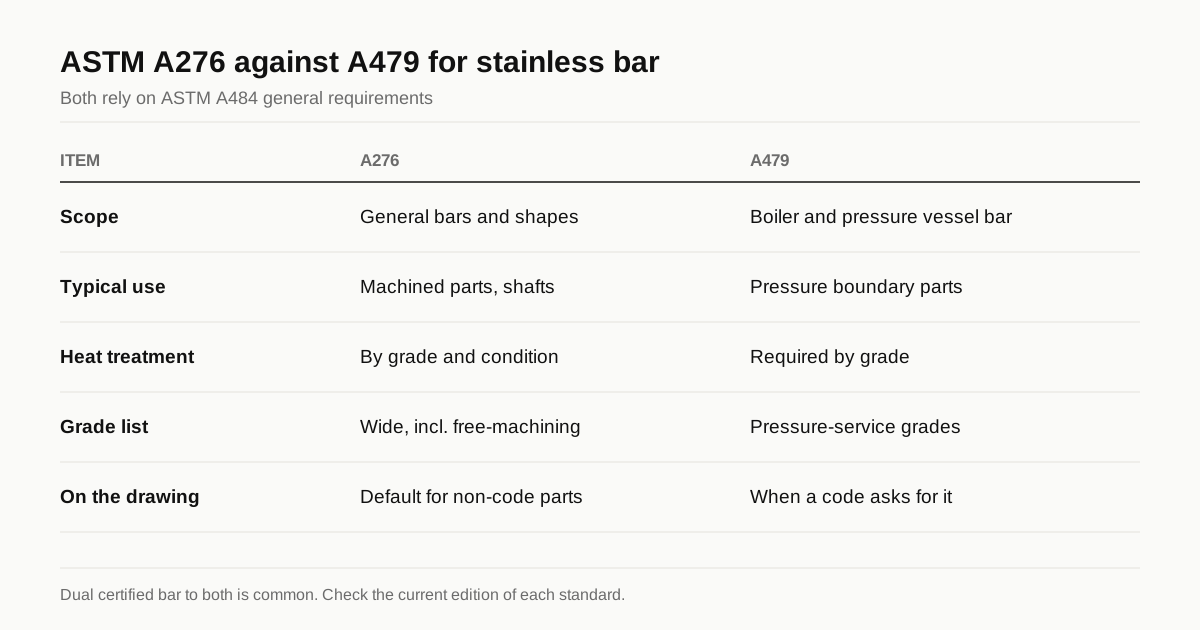
| ASTM A276 | ASTM A479 | |
|---|---|---|
| Scope | General stainless bars and shapes | Bars and shapes for boilers and pressure vessels |
| Typical use | Machined parts, shafts, fittings, fasteners stock | Pressure boundary parts, flanges, vessel components |
| Grades | Wide range, includes free-machining and hardenable grades | Austenitic and duplex grades for pressure use, fewer free-machining grades |
| Heat treatment | Condition A (annealed) and other conditions by grade | Heat treatment specified by grade, anneal required |
| High-temperature grades (H) | Covered | Covered, with defined grain size provisions |
| Common reference | General engineering and customer drawings | Pressure codes such as ASME Section II |
Grade lists differ between the two and between editions. Check the current document for your grade.
Product forms and conditions
Bar comes in conditions that affect machining and mechanical properties.
| Condition | Meaning | Machining note |
|---|---|---|
| Hot finished | Rolled or forged, then annealed, rough surface | Needs more stock removal |
| Cold finished | Drawn or ground after annealing, tight size | Better size and finish, slightly stronger |
| Condition A | Annealed | The normal condition for austenitic bar |
| Condition S | Strain hardened (for some austenitic grades) | Higher strength, more cold work, may be magnetic |
| Centreless ground | Precision ground diameter | Preferred for shafts and Swiss turning |
State the finish and tolerance of the bar. Cold finished and ground bar costs more but reduces the stock to remove and gives straighter, rounder bar. Size tolerances for bar are set by A484 and differ by finish and diameter range, so check the current edition or name a tighter tolerance on the purchase order.
For free-machining stainless bar such as 303 and 416, a separate standard, ASTM A582, covers the material. Hardenable precipitation grades such as 17-4 PH use ASTM A564. The comparison of those two is in the 17-4 PH against 15-5 PH guide.
Testing and what the certificate shows
The specification sets what the mill must test and report. Typical elements:
- Chemical analysis by heat, which proves the grade.
- Tensile test: yield, tensile strength, elongation and reduction of area, by lot.
- Hardness for some grades and conditions.
- Heat treatment record with temperature.
- Grain size for H grades.
- Intergranular corrosion test only when specified by the purchaser, for example ASTM A262.
- Supplementary requirements (S1 and later) if the buyer adds them, for example ultrasonic testing or ferrite checks.
For a machined part, ask for an EN 10204 type 3.1 certificate with the heat number, as explained in the RFQ checklist, and make sure the bar is traceable to the parts. A certificate that lists a specification the bar was not tested to has no value.
Why the pressure spec matters
Pressure vessel and piping codes, such as the ASME Boiler and Pressure Vessel Code, accept materials listed in their material section. For bar, the listed specification is usually the SA version of A479, and the code defines allowable stresses by grade. Using a bar certified only to A276 in a coded pressure part may not be acceptable to the inspector.
Note three points:
- The design owner decides. The machine shop does not choose the specification for a pressure boundary part. The drawing or purchase order states it.
- Dual certification is common. Many stockists sell bar certified to both A276 and A479, which satisfies either requirement at little or no extra cost. Ask for it when unsure.
- We do not claim any pressure code compliance for our partner shops. They state their own approvals.
Which specification to write on the drawing
| Situation | Suggested callout |
|---|---|
| General machined part, no code | 316L bar to ASTM A276, Condition A |
| Part in a pressure vessel or coded system | Material to ASTM A479 (or SA-479 when the code requires it) |
| Customer requires either | A276/A479 dual certified |
| Free-machining stainless | 303 or 416 to ASTM A582 |
| Hardenable precipitation grade | ASTM A564 with the H condition |
| Duplex bar | ASTM A276 or A479 with the UNS number, plus any G48 test |
| Forged blank | ASTM A182 for forged fittings, or A473 for forgings |
Include the grade as a UNS number, for example S31603 for 316L, the bar form, the condition, the size tolerance and the certificate type. A callout that reads “stainless bar” invites the stockist to supply whatever is cheapest.
Need a quote for this part? Get a quote for your stainless parts
Cost and lead time
The specification choice has a small cost effect for common grades in dual certified bar. Greater effects come from:
- unusual sizes or conditions that are not stocked,
- extra tests such as intergranular corrosion tests,
- ground bar compared with hot finished bar,
- supplementary requirements,
- small order quantities from a mill rather than a stockist.
These are covered in the cost drivers guide. Bar and plate comparisons come up in the same discussion.
Common mistakes
- Writing only the grade. A drawing that says 316L without a specification leaves the standard open.
- Mixing specification numbers. Plate, pipe, forgings and bar each have their own standard. Check the number against the product form.
- Assuming 316L bar and 316L plate share a spec. Plate falls under ASTM A240 and pipe under A312.
- Ignoring the condition. Condition S bar, strain hardened, can arrive magnetic and tougher to cut. See the 316L magnetism guide.
- Treating the certificate as a formality. Check the heat number against the bar markings, and the chemistry against the specification limits.
Reading a bar certificate against the specification
The certificate from a mill or stockist is a short document that holds a great deal of information. Reading it takes two minutes and answers the questions that matter.
- Header. The specification and edition, for example ASTM A276 and a year, and the grade or UNS number. Check they match your purchase order.
- Heat number. The number that links the bar to its chemistry and tests. It should match the stamp or tag on the bar or the bundle.
- Chemistry. The values for carbon, chromium, nickel, molybdenum and so on, which must sit inside the limits of the grade. For a 316L order, carbon should be 0.030 percent or below and molybdenum between 2.0 and 3.0 percent.
- Mechanical properties. Yield, tensile, elongation and sometimes hardness, which must meet the minimum for the condition ordered.
- Heat treatment. The temperature and the cooling method for the anneal.
- Conformance statement. The mill states that the product meets the specification. The signature and date give it weight.
- Additional tests. Any intergranular corrosion test or ferrite measurement you requested.
A certificate that lists a different grade, a different specification or an unclear heat number is a rejection reason. The mill test certificate topic in the RFQ checklist shows how to request the right level.
Dual certification in practice
When a stockist supplies bar certified to both A276 and A479, the certificate lists both specifications and the bar meets the stricter of the two requirements on each point. The extra requirement usually costs little because most mills already control the bar to pressure vessel standards. If a drawing names one standard and the stockist holds bar that meets both, the bar is fine for either. The buyer should still ask which specification the certificate names, because a purchasing system may check for it.
Orders that go wrong
Three patterns repeat.
The wrong product form. A drawing says 316L to A276, and the shop buys plate or tube cut into blanks. Check the product form. Bar, plate and pipe each have their own specification, and a part machined from plate may not satisfy a bar requirement.
The missing condition. A drawing says 304 bar and the shop buys cold drawn Condition S bar, which is stronger and may arrive magnetic. State Condition A where it matters.
The late request for tests. A customer asks for an intergranular corrosion test after the bar has been bought and cut. The test must be run on a mill sample, so the request has to come with the purchase order, not after delivery.
Clear callouts and an early conversation prevent all three.
Checklist before you request a quote
- Name the grade by UNS number.
- Name the bar specification, A276 or A479, or ask for dual certification.
- State the condition and bar finish.
- State the certificate type and any extra tests.
- Say if the part goes into a pressure boundary and which code applies.
- Allow stock for the bar tolerance and straightness.
Naming the bar specification belongs to the fourth of five steps in the grade decision order, with magnetism and documents; see the guide to stainless steel grade selection.
When you send the drawing through the RFQ form, we send one itemised quote within 24 business hours and place the work with partner shops that buy and cut certified stainless bar. We own no machines.
Frequently asked questions
What is the difference between ASTM A276 and A479?
A276 is the general purpose specification for stainless bars and shapes. A479 covers stainless bars and shapes for boilers and other pressure vessels, with a defined heat treatment and extra requirements for elevated temperature use. Many bar suppliers list a grade as certified to both.
Can I use A276 bar for a pressure part?
Only if the design code accepts it. Pressure codes often name the material standard, and A479 is the usual one for bar. Ask the design owner or the code reference before substituting. A dual certified bar avoids the question.
Which spec should I put on a drawing for a non-pressure machined part?
ASTM A276 is the normal choice, with the grade and condition named, for example 316L, condition A. Add a certificate requirement and any extra tests. A479 is only needed where a code or customer asks for it.
Need a quote for this part?
Send the drawing. We read it, send one itemised quote within 24 business hours and place the work with a partner shop that cuts stainless.
Get a quote for your stainless partsFigures in this guide are published specification limits or published typical values for the alloy, not measurements of any part. Machinability is rated against free-machining carbon steel B1112 at 100 and PREN is chromium plus 3.3 times molybdenum plus 16 times nitrogen. The conventions are set out in thereference section and the editorial standards.