Is 316L magnetic? Why a non-magnetic grade can still attract a magnet after machining
October 20, 2026
A buyer checks a freshly delivered 316L part with a fridge magnet and it sticks. The first thought is that the shop used the wrong steel. Often the steel is correct. 316L is a non-magnetic grade in the annealed condition, but machining, drilling and forming push the surface toward a magnetic structure, and welds in 316L are never fully non-magnetic. Whether that matters depends on the application, and in a few applications it matters a great deal.
This guide explains why machined 316L can pick up magnetism, how much is normal, how to test it and how to write a drawing note that gets what you need.
Why 316L is normally non-magnetic
316L is austenitic stainless. Its face-centred cubic crystal structure, stabilised by nickel (10 to 14 percent) and nitrogen, is non-magnetic. The structure stays stable at room temperature after annealing, so annealed bar and plate have a relative permeability very close to 1, typically 1.002 to 1.02. A permeability of 1 means the material does not respond to a magnetic field any differently from air.
Chromium, nickel and molybdenum are not magnetic in this arrangement. That is why 316L is used near magnetic resonance equipment, in sensors and in instruments that must not disturb a magnetic field. See the grade reference for how the family compares: austenitic grades are non-magnetic, while ferritic, martensitic and precipitation hardening grades are magnetic.
Why a machined part can attract a magnet
Austenite in the 300 series is only metastable. Heavy deformation can transform some austenite into martensite (alpha prime), which is magnetic. Three effects add up in a machined part.
Strain-induced martensite. Cutting, drilling, tapping, cold drawing, bending and heavy knurling deform the surface layer. The more the metal deforms, the more martensite forms. 316L is far more stable than 304, because its nickel and molybdenum content suppress the transformation, but it is not immune.
Weld ferrite. Weld metal in 316 and 316L is designed to contain 3 to 10 percent delta ferrite to prevent hot cracking. Delta ferrite is magnetic. A welded 316L assembly always attracts a magnet at the weld.
Surface contamination. Iron from tools, brushes or blasting media on the surface is magnetic. It is not the metal itself but it makes the magnet stick. Passivation removes it, which is another reason for the finishing chain described in the citric versus nitric guide.
A fourth source is the bar. Cold drawn bar carries residual martensite through its section, and it can arrive already weakly magnetic.
How much magnetism is normal
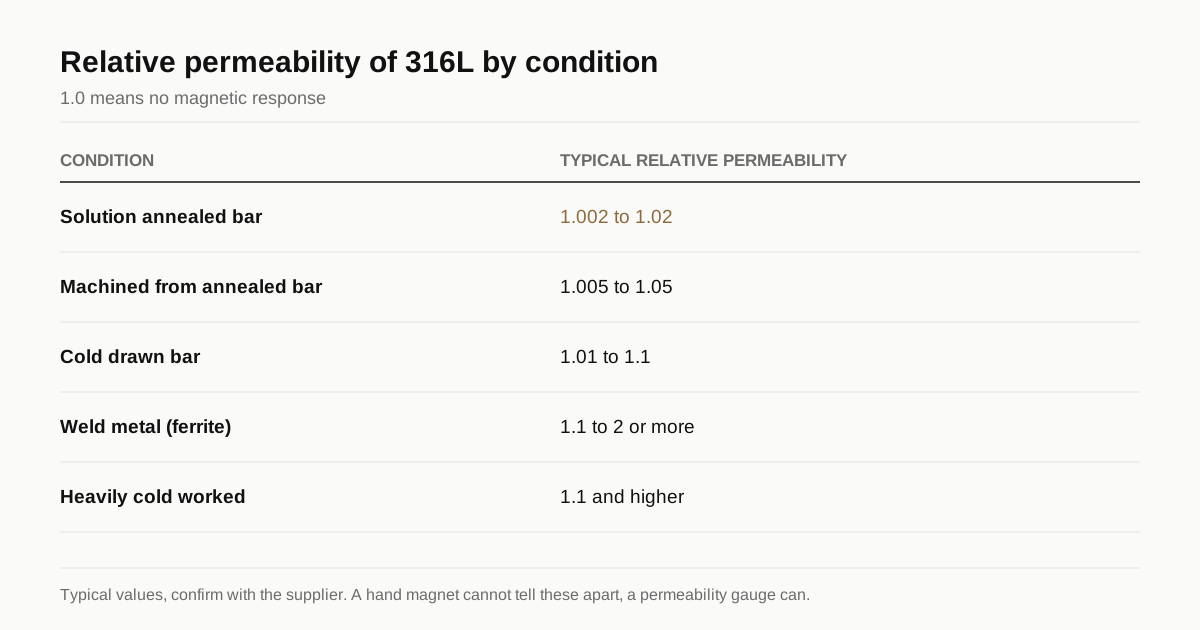
Typical published values for relative permeability, from the literature and specification practice:
| Condition | Typical relative permeability | Notes |
|---|---|---|
| Solution annealed 316L bar | 1.002 to 1.02 | Effectively non-magnetic |
| Machined from annealed bar | 1.005 to 1.05 | Slight rise at the surface |
| Cold drawn bar, light reduction | 1.01 to 1.1 | Depends on reduction |
| Heavily cold worked | 1.1 and higher | Noticeable pull |
| 316L weld metal | 1.1 to 2 or more | Ferrite number 3 to 10 |
| 304 heavily cold worked | Up to 10 or more | Less stable than 316L |
| 430 or 17-4 PH | Large | Magnetic by design |
Values vary with composition and processing. The point is the scale: a weak pull from a fridge magnet on machined 316L is normal, while a strong pull means something else is going on.
When the magnetism matters
For most mechanical parts, it does not. It matters in these cases:
- Medical devices used in magnetic resonance imaging. Implants and instruments are tested for magnetically induced displacement force and torque, for example under ASTM F2052 and F2213, and marked for MR safety under ASTM F2503. The standards define test conditions. Requirements come from the device maker and the regulator, and we make no medical claims.
- Sensors and instruments. Parts near magnetic sensors, mass spectrometers or Hall effect devices need low permeability.
- Electron beam and ion beam equipment. Vacuum chamber parts must not distort the beam path.
- Non-magnetic fixtures and tools. Gauges and tooling for use near magnets.
- Security and detection. Metal detectors and magnetic sorting lines.
- Customer acceptance tests. A buyer’s incoming test with a magnet can reject a good part.
How to test
A hand magnet is a crude indicator. It shows whether something is magnetic but not how much. Better options:
| Method | What it tells you | Typical use |
|---|---|---|
| Hand magnet | Pass or fail pull test | Quick screening only |
| Permeability indicator (go/no-go gauge) | Whether permeability is under a set limit | Incoming inspection, ASTM A342 methods |
| Magnetic balance or Gauss meter | Surface field or pull force | Process control |
| Ferrite meter (Fischer or similar) | Ferrite number in welds and cladding | Weld inspection |
| Vibrating sample magnetometer | Measured permeability | Laboratory, qualification |
Name the method on the drawing or purchase order, because results from a hand magnet and a permeability gauge differ.
How to get a part that stays non-magnetic
Options, from simplest to most demanding:
- Choose the right grade. 316L is safer than 304 or 303. For tighter requirements, nitrogen strengthened grades and high nickel grades are more stable. Nitronic 60 is another stable austenitic, see the Nitronic 60 guide.
- Specify the bar condition. Solution annealed bar, not cold drawn, if low permeability is needed.
- Reduce deformation. Avoid heavy knurling, rolling or cold forming on critical surfaces. Sharp tools and light finishing cuts reduce surface martensite, see the work hardening guide.
- Anneal after machining. A solution anneal at around 1040 to 1100 °C followed by rapid cooling converts martensite back to austenite and restores a permeability near 1. This also relieves machining stress, but it changes dimensions and may need a finish pass.
- Passivate or electropolish. Removes iron contamination and a thin layer of deformed metal. The passivation versus electropolishing guide shows the difference.
- Avoid or control welding. If welds are needed and non-magnetic behaviour matters, use a fully austenitic filler or a different design.
Need a quote for this part? Get a quote for your stainless parts
What to write on the drawing
For a requirement of non-magnetic behaviour, add a note such as:
- Material 316L, ASTM A276 condition A, solution annealed bar.
- Finished part relative permeability 1.02 maximum, measured per ASTM A342 or by a go/no-go gauge approved by the customer.
- Solution anneal after machining if required to meet the limit.
- Passivate per ASTM A967 after machining.
- No welding.
Without such a note, the shop has no basis for controlling magnetism and a magnet test at incoming inspection becomes a dispute.
Why a magnet check at receiving is a poor test
Many companies check incoming stainless with a pocket magnet. It is quick and it feels scientific. For machined 316L, it produces more false alarms than useful findings.
A magnet is a go or no-go test with an unknown threshold. The pull depends on the magnet strength, the part mass, the geometry and where the magnet touches. A thin edge of cold worked metal can attract a strong magnet while the bulk of the part is non-magnetic. A weld bead will always attract. A surface smear of iron from a tool will attract the magnet and then wash away in passivation.
If the check matters, define it. Name the magnet type, the contact position and the pass criterion in the purchase specification, or replace the magnet with a permeability gauge and a numerical limit. Two parties who agree on a gauge reading can settle a dispute. Two parties with different magnets cannot.
A worked example
A buyer orders 316L pins for a sensor and writes “non-magnetic” on the drawing. The shop turns the pins from cold drawn bar, tumbles them and passivates them. At receiving the buyer holds a small neodymium magnet to a pin and feels a light pull.
The pull comes from three possible sources. First, the cold drawn bar carries some martensite through its section. Second, the turning added a thin work hardened skin. Third, a trace of iron from the tumbling media may still sit on the surface. A permeability gauge would show whether the reading is 1.02 or 1.3. If it is under the buyer’s real limit, the pins are fine. If it is over, the cure is solution annealed bar and an anneal after turning, plus a clean passivation cycle.
Had the drawing said relative permeability 1.02 maximum, measured per a named method, the shop would have chosen annealed bar, quoted the anneal and measured the result. The cost of the conversation after the fact is higher than the cost of the one-line note.
Quick reference
| Question | Short answer |
|---|---|
| Is annealed 316L magnetic? | No, essentially non-magnetic |
| Can machining make it magnetic? | Slightly, through cold work |
| Are welds magnetic? | Yes, due to ferrite |
| Does a magnet identify the grade? | No |
| How do I get a lower reading? | Annealed bar, anneal after machining, passivate |
Related questions buyers ask
Two related questions come up often. The first is whether a magnet can tell 316L from 304. It cannot, since both are non-magnetic when annealed and both can pick up a little magnetism from cold work. A handheld analyser that reads molybdenum is the quick method. The second is whether non-magnetic stainless can be hardened. The austenitic grades cannot be hardened by heat treatment, only by cold work, which is exactly what raises their magnetic response.
Checklist before you request a quote
- Decide whether a magnetic pull matters for your application.
- If it does, state a permeability limit and the test method.
- Specify annealed bar and any anneal after machining.
- Avoid welds and heavy cold forming on critical features.
- Ask for the mill certificate and the shop’s method of checking permeability. See the RFQ checklist.
Magnetism belongs to the fourth of five steps in the grade decision order, with documents; see the guide to stainless steel grade selection.
Send the drawing through the RFQ form and state any magnetic limit. We send one itemised quote within 24 business hours and place the work with partner shops that cut stainless. We are not a laboratory.
Frequently asked questions
Is 316L stainless steel magnetic?
In the annealed state it is essentially non-magnetic, with a relative permeability close to 1. Cold work from machining, drawing or forming can create a small magnetic phase, so a finished part may attract a magnet weakly. Welds in 316L also contain some magnetic ferrite.
Does a magnet that sticks mean the part is not 316L?
Not necessarily. A weak pull on a cold worked or welded 316L part is normal. A strong pull points to a different grade, such as a ferritic or martensitic stainless, or to iron contamination on the surface. A magnet alone cannot identify the grade.
How do I specify a non-magnetic stainless part?
State a maximum relative permeability, for example 1.02, measured by a named method such as ASTM A342, and say whether the limit applies to the finished part. Ask for solution annealing after machining if the limit is tight.
Need a quote for this part?
Send the drawing. We read it, send one itemised quote within 24 business hours and place the work with a partner shop that cuts stainless.
Get a quote for your stainless partsFigures in this guide are published specification limits or published typical values for the alloy, not measurements of any part. Machinability is rated against free-machining carbon steel B1112 at 100 and PREN is chromium plus 3.3 times molybdenum plus 16 times nitrogen. The conventions are set out in thereference section and the editorial standards.