Sensitisation in stainless steel: how weld decay starts and which grades resist it
November 21, 2026
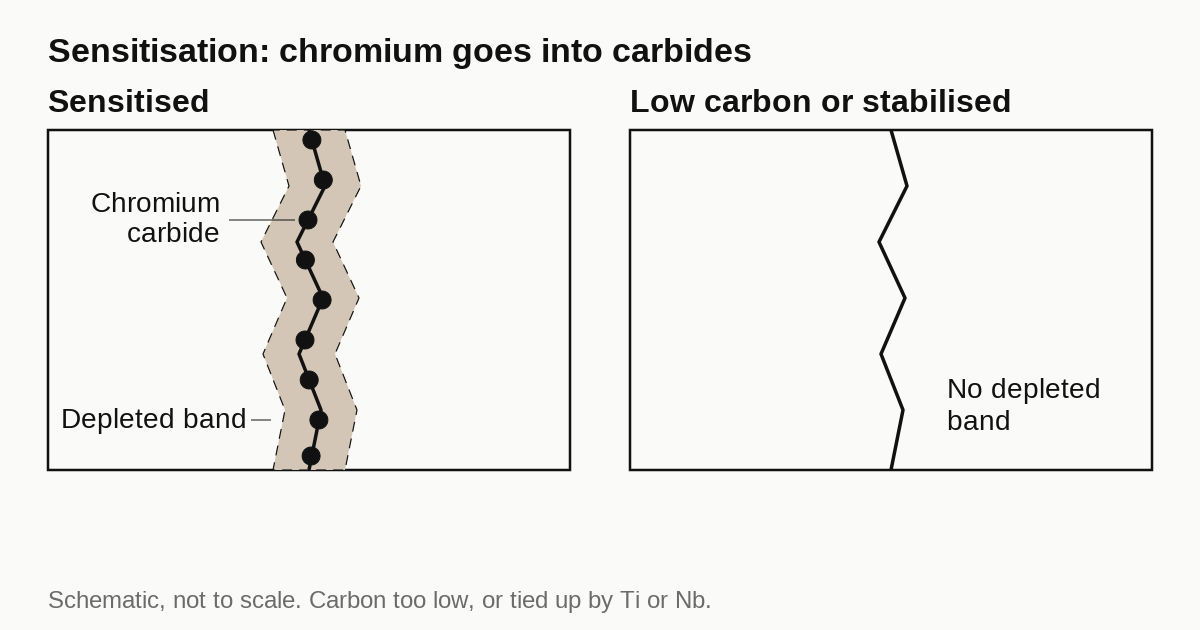
Sensitisation is the formation of chromium carbide at the grain boundaries of austenitic stainless steel when the metal is held in a temperature band where carbon moves to the boundaries. The carbide takes chromium from the metal next to it, and the chromium-depleted band is where corrosion starts. When it happens beside a weld, the result is called weld decay.
SSINA names welding, stress relief and hot forming as the common routes into the sensitising band; machining is not on its list. So it matters when a machined part is welded into an assembly, heat treated or used hot. If your part is 304 or 316, the grade choice decides the risk. The stainless grade selection guide sets out the wider trade.
How sensitisation happens
SSINA explains the mechanism in three steps. In austenitic grades, chromium carbide (Cr23C6) precipitates at the grain boundaries, producing a narrow zone of chromium depletion next to each boundary. That condition is called sensitisation. Chromium is the element that makes stainless corrosion resistant, so the depleted zone corrodes in preference to the grain, and if the carbides form a continuous network the corrosion can open a gap along the boundary. Grains can drop out of the surface.
The temperature band SSINA gives is 950 to 1450 °F, which is about 510 to 790 °C. Welding, stress relief and hot forming can all put steel into that band. AZoM, writing about the L and H grades, quotes a slightly different range of about 450 to 850 °C, so sources vary and the exact limits depend on carbon content and time. SSINA states that the time and temperature needed depend on alloy composition, above all on carbon.
Weld decay
Wikipedia gives the usual case: the material is heated to temperatures around 700 °C for too long, often during welding or an improper heat treatment, and when such zones form because of welding the resulting corrosion is termed weld decay. The same page lists the same cures as SSINA and adds two: lowering carbon in the weld filler metal to under 0.02 percent, and keeping welded parts thin enough that the metal cools too fast for carbide to form. Knifeline attack is a related case in niobium-stabilised steels such as 347, where cooling can leave the steel behaving like an unstabilised one in a thin zone.
The three defences
SSINA lists three approaches for austenitic grades:
- Reduce carbon. Keeping carbon below 0.030 percent moves the sensitisation curve to longer times. The L grades 304L, 316L and 317L are designed to resist sensitisation during typical welding, though not long-term exposure in the critical range in service. The more highly alloyed 904L and 6Mo grades have very low carbon, and intergranular attack is typically not a concern.
- Stabilise. Adding titanium, niobium (columbium) or tantalum forms carbides more stable than chromium carbide, so the carbon is not available to take chromium. Common stabilised grades are 321, 347, 20-Cb3 and 316Ti. A solution-annealed stabilised grade can still sensitise after long exposure in the range, which is why SSINA describes a stabilising heat treatment at 1500 to 1600 °F (about 815 to 870 °C) for several hours.
- Solution anneal. Heating to dissolve the carbides and cooling fast. SSINA says this is typically done at 1900 to 2150 °F (about 1040 to 1175 °C).
| Grade | Carbon limit, % max | Stabiliser limit | What it relies on | Source |
|---|---|---|---|---|
| 304 | 0.08 | none | nothing; can sensitise | SSINA |
| 304L | 0.03 | none | low carbon | SSINA |
| 304H | 0.04 to 0.10 | none | high carbon, for hot strength | BSSA |
| 316 | 0.08 | none | nothing; can sensitise | SSINA |
| 316L | 0.03 | none | low carbon | SSINA |
| 321 | 0.08 | Ti 5 × (C+N) | titanium stabilisation | SSINA |
| 347 | 0.08 | Cb 10 × C to 1.00 | niobium stabilisation | SSINA |
| 904L | 0.02 | none | very low carbon | SSINA |
Sources: SSINA, Composition/Properties, tables of chemical compositions; BSSA, chemical compositions of heat-resisting stainless steel grades (304H). Limits are the common-grade values on those pages; the governing specification (ASTM A240 or A276 for your product) rules. Opened 25 October 2026.
Why H grades are different
The H suffix marks a deliberately higher carbon range, 0.04 to 0.10 percent for 304H, 316H and 321H in the BSSA table, to keep strength at high temperature. AZoM notes that when these grades are used at about 450 to 850 °C they are subject to sensitisation. If the print says 304H, sensitisation is accepted as a trade for strength, and it is the designer’s call.
Need a quote for this part? Get a quote for your stainless parts
What about ferritic grades?
SSINA treats ferritic stainless differently. In ferritic grades, sensitisation occurs on cooling from above about 1700 °F (about 930 °C), and the diffusion in ferrite is so fast that the steel cannot be cooled quickly enough to avoid it. Most commercial ferritic grades therefore restrict carbon and nitrogen and add stabilisers such as titanium, tantalum or niobium. Healing is possible by holding at 1100 to 1200 °F for several hours.
How it is tested
ASTM A262 has practices developed to detect susceptibility to intergranular attack in austenitic stainless steels. Our A262 reference page covers which practice to call out. A different standard, ASTM A763, is used for ferritic grades.
What to write on the print
- Say how the part will be used. If it will be welded after machining or run hot, say so. The supplier cannot guess.
- Choose the grade for the exposure. L grade for typical welding, stabilised grade for long hot service, as above. The 304 against 304L article covers the L grade in more detail.
- Name the test only if you need one. Call out the A262 practice and the acceptance rule if a report is required.
- Read the certificate. The mill certificate shows carbon content. That number tells you more than the grade name.
Closing: the grade decides, so decide early
Sensitisation is a design question, answered by the grade and by how the part is joined and used. Choose it before quotes, because changing grade later changes bar stock and lead time. To have a drawing with a grade and a corrosion note quoted by partner shops that cut stainless, send an RFQ. For the wider choice between grades, return to the stainless grade selection guide.
Sources
- SSINA, Intergranular Corrosion, mechanism, temperature band, the three defences, ferritic grades and test standards. Opened 25 October 2026.
- SSINA, Composition/Properties, carbon and stabiliser limits. Opened 25 October 2026.
- BSSA, Chemical compositions of AISI (ASTM/ASME) and UNS heat resisting stainless steel grades, 304H, 316H and 321H carbon range. Opened 25 October 2026.
- Wikipedia, Intergranular corrosion (Weld decay redirects here), definition of weld decay, other cures and knifeline attack. Opened 25 October 2026.
- AZoM, Stainless Steels: L, H and Standard Grades, L and H grade purpose and the 450 to 850 °C range. Opened 25 October 2026.
Frequently asked questions
Does sensitisation affect a machined part that is never welded?
Only if the part meets the temperature range some other way, such as heat treatment, hot service or later welding of an assembly. SSINA names welding, stress relief and hot forming as the common routes into that range, and machining is not on its list. The risk is mostly a design and material choice, so say on the drawing how the part will be used.
Is 304L enough to prevent weld decay?
For typical welding, yes. SSINA says the low carbon grades are designed to resist sensitisation during typical welding but not during long-term exposure in the critical temperature range in service. If the part will sit hot for long periods, a stabilised grade such as 321 or 347 is the usual alternative.
Can sensitised stainless be fixed?
Yes, by solution annealing. SSINA says the carbide formation is readily reversed by a solution anneal, typically in the range of 1900 to 2150 °F (about 1040 to 1175 °C) followed by rapid cooling. Whether that is practical for a finished assembly is a question for the heat treater.
Need a quote for this part?
Send the drawing. We read it, send one itemised quote within 24 business hours and place the work with a partner shop that cuts stainless.
Get a quote for your stainless partsFigures in this guide are published specification limits or published typical values for the alloy, not measurements of any part. Machinability is rated against free-machining carbon steel B1112 at 100 and PREN is chromium plus 3.3 times molybdenum plus 16 times nitrogen. The conventions are set out in thereference section and the editorial standards.