304 against 304L: a small carbon difference and when it changes the choice
October 12, 2026
304 and 304L are the same alloy family with one number changed: the maximum carbon. That one change decides whether a welded or hot-formed part keeps its corrosion resistance. For a part that is machined from bar and never welded, the two grades are close to interchangeable, and a good part of the debate about which to order is wasted effort.
This guide sets out what the two grades share, where they differ, and a simple rule for deciding which to put on a drawing.
The chemistry in one table
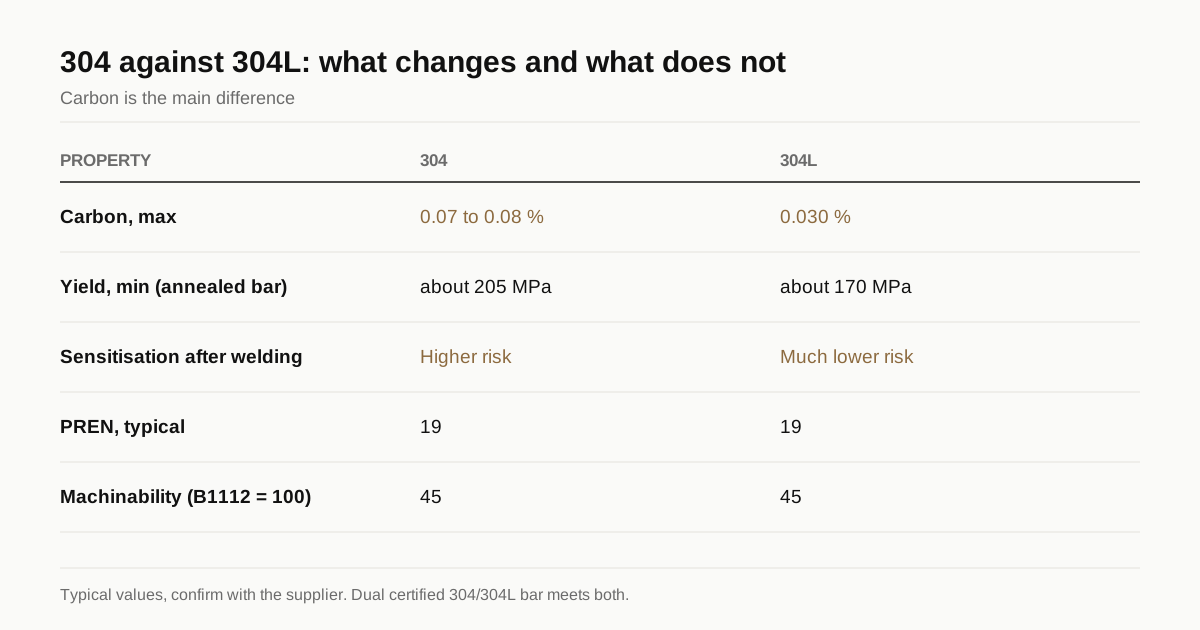
| Element | 304 | 304L |
|---|---|---|
| Carbon, max | 0.07 to 0.08 % | 0.030 % |
| Chromium | about 18 to 20 % | about 18 to 20 % |
| Nickel | about 8 to 11 % | about 8 to 12 % |
| Manganese, max | 2.0 % | 2.0 % |
| Typical PREN | 19 | 19 |
| Machinability (B1112 = 100) | 45 | 45 |
| UNS | S30400 | S30403 |
| EN number | 1.4301 | 1.4307 |
Exact limits differ by product standard, for example ASTM A276 for bar and ASTM A240 for plate, and by edition. Check the standard on your certificate. The corrosion resistance in chlorides is the same for both, because chromium, nickel and molybdenum content are essentially the same. See the grade reference for the full dataset.
Why carbon matters: sensitisation
When austenitic stainless is held between about 450 and 850 °C, chromium carbides form along grain boundaries. The metal next to the boundary loses chromium and becomes vulnerable to intergranular corrosion. This is called sensitisation. It happens in the heat affected zone beside a weld, in a part held in a hot furnace and in a part used continuously in that temperature range.
Lower carbon means fewer carbides can form in a given time. 304L, with carbon at or below 0.030 percent, resists sensitisation during welding far better than 304 at up to 0.08 percent. That is the reason the L grades exist.
The effect is time dependent. 304L is not immune. A part held in the sensitising range for hours will still sensitise. For long exposure at those temperatures, stabilised grades such as 321 and 347 are the usual answer, and 316L-type grades resist for similar reasons. A related story for the molybdenum grades is told in the 316 versus 316L versus 316Ti guide.
Strength: the cost of low carbon
Carbon contributes to strength in austenitic stainless. A lower carbon limit usually comes with a lower minimum yield strength in the standards.
| Property (annealed bar, typical specification minimum) | 304 | 304L |
|---|---|---|
| Tensile strength | about 515 MPa | about 485 MPa |
| Yield strength | about 205 MPa | about 170 MPa |
| Elongation | 40 % | 40 % |
| Hardness, max | about 201 HBW | about 201 HBW |
These are specification minimums. Actual mill results are well above them, and the difference between the grades in real bar is small. Most mills therefore sell dual certified 304/304L, where one heat meets 304 strength and 304L carbon. If the certificate shows both grades, the question of which to order largely goes away.
For design purposes, an engineer works from the specified minimum. A part in 304L with a design based on 304 yield can be under-designed by about 17 percent. Check before swapping.
Where the choice matters
Pick 304L when:
- The part will be welded and cannot be solution annealed afterwards. This includes weldments, tank fittings and pipe-welded assemblies. The stainless weldments guide covers machining of welded parts.
- The part will be hot formed or heated in the sensitising range for a limited time.
- A process or customer specification names 304L, for example in food and dairy equipment.
Pick 304 when:
- The design strength is based on 304 minimums and a dual certificate is not available.
- The part is machined from bar and not welded, and the customer specification names 304.
- Availability or lead time favours 304.
For a typical machined part in dry, mild service, either grade performs. A specification that says 304 or 304L, mill choice, gives the shop flexibility and usually the best price.
Machining: differences you will notice
On the published scale the two grades are rated the same, 45 against B1112 at 100. In shop practice:
- 304L is a little softer and gummier, which can make chip control and burr formation worse.
- Both work harden strongly. A rubbing tool leaves a hard skin. The work hardening guide shows how.
- Both take the same tooling and similar parameters.
- Neither is a free-machining grade. If the part is simple, dry and unwelded, 303 cuts roughly 70 percent faster. See the 303 against 304 and 316L guide.
Variation between heats of the same grade often exceeds the difference between 304 and 304L. Sulphur content within the allowed range, residual elements and cold work in the bar change how the metal cuts.
Dual certification and the supplier reality
Dual certification is common because the combined requirements are easy for a modern melt to meet. Carbon is held at 0.030 percent or below, and the strength comes from nitrogen and the rest of the chemistry. The bar then meets both ASTM A276 grades.
Practical consequences:
- A buyer who specifies 304 gets 304L-compatible bar from many stockists and is not penalised.
- A buyer who specifies 304L usually receives dual certified bar at the same price.
- The certificate matters more than the label on the bar. Read the carbon and yield values. See the RFQ checklist for the certificate level to request.
A drawing that says 304/304L, or 304 or 304L to ASTM A276, avoids the dispute. If strength is critical, say so and state the minimum yield.
Need a quote for this part? Get a quote for your stainless parts
Cost and availability
The two grades cost within a few percent of each other in bar form, and the price is driven by nickel on the metals market and by the size and finish of the bar. Neither is a cost saving over the other. The cost of a machined part is dominated by cycle time, as the cost drivers guide explains.
Specifying a rare variant such as 304 with a narrow sulphur band or 304L with a specific finish can add lead time. Keep the callout standard.
Decision rule
- Will the part be welded without a later anneal? Choose 304L.
- Is design strength based on 304 minimums? Choose 304, or dual certified 304/304L.
- Will the part see sensitising temperatures for long periods? Choose 321 or 347, not either 304 variant.
- Otherwise: accept either, or ask for dual certified bar.
What does not change between the two
Most of the properties a buyer cares about are identical or nearly so, and it helps to be clear about that so the choice does not absorb more attention than it deserves.
- Corrosion resistance in chlorides. Both have a PREN near 19, which is moderate. Neither is a marine or brine grade. For that, move to 316L or higher alloys, as the 316 versus 316L guide explains.
- Non-magnetic behaviour. Both are non-magnetic when annealed and both can pick up magnetism from cold work. The 316L magnetism guide describes the effect, and 304 is the less stable of the two families.
- Passivation and finish. Both take the same passivation and polish, and the same surface finish work.
- Cost. Both follow the nickel price and the bar size.
- Tooling. Both take the same inserts and parameters.
Questions that come up at incoming inspection
A few situations repeat on the receiving dock.
The certificate says 304 and the drawing says 304L. Check the carbon value on the certificate. If carbon is 0.030 percent or below, the bar meets 304L chemistry regardless of the heading. If the strength also meets 304 limits, the bar is dual certified and meets both. If carbon is 0.04 percent or higher, it is plain 304 and does not meet 304L.
The part will be welded by the customer. Say so on the order, because it decides the grade. A plain 304 part welded into an assembly without an anneal may sensitise in the heat affected zone.
A buyer wants 304L but the stockist has only 304. Ask for a certificate that shows carbon at or below 0.030 percent. Many stocked bars qualify. Where the stock is plain 304 with higher carbon, the lead time for 304L may be the real cost of the choice.
Hardness checks. Both grades read about the same on a hardness tester when annealed. A reading much higher than the specification limit suggests cold work, which affects machining and magnetism.
These questions come back to documents, so request a mill certificate and read it. The RFQ checklist lists what to ask for.
Checklist before you request a quote
- State grade as 304L, 304/304L or 304, and name the bar standard.
- Say whether the part will be welded.
- Give a minimum yield if the design depends on it.
- Ask for the mill certificate with carbon and yield values.
- Ask the shop if the bar in stock is dual certified.
The L grade is one step in a longer decision order; the guide to stainless steel grade selection puts it next to environment, strength and documents.
When you send the drawing through the RFQ form, tell us the weld and strength requirement. We send one itemised quote within 24 business hours and place the work with partner shops that cut stainless. We own no machines.
Frequently asked questions
Can I use 304L where 304 is specified?
Usually yes for corrosion, and often yes for strength, but check the drawing. 304L has a slightly lower minimum yield strength than 304 in many bar and plate specifications. If the part is strength critical, confirm the design values with your engineer.
What is dual certified 304/304L?
Material that meets both chemistry and strength limits of both grades at once, with carbon at 0.030 percent or less and the strength of 304. Mills sell it widely, so the question is often academic. Ask your supplier whether the bar is dual certified.
Does 304L machine better than 304?
Slightly softer and gummier in practice, but the published machinability rating is the same. The differences between heats matter more than the difference between grades. The choice should rest on welding and service, not machining.
Need a quote for this part?
Send the drawing. We read it, send one itemised quote within 24 business hours and place the work with a partner shop that cuts stainless.
Get a quote for your stainless partsFigures in this guide are published specification limits or published typical values for the alloy, not measurements of any part. Machinability is rated against free-machining carbon steel B1112 at 100 and PREN is chromium plus 3.3 times molybdenum plus 16 times nitrogen. The conventions are set out in thereference section and the editorial standards.