ASTM A262: which intergranular corrosion test to call out on a stainless part
ASTM A262 · Reference page · Last reviewed 25 November 2026
ASTM A262 is a set of five test practices that show whether an austenitic stainless steel has lost corrosion resistance along its grain boundaries. It does one job: it detects intergranular attack. A buyer picks the practice, the shop or mill runs it on a sample, and the report says pass or fail against the limit the buyer named.
| Item | What to know |
|---|---|
| Standard | ASTM A262, current listing A262-15 (2021) |
| Covers | Five practices: A (oxalic acid etch), B (ferric sulfate and sulfuric acid), C (nitric acid), E (copper, copper sulfate and 16 percent sulfuric acid), F (copper, copper sulfate and 50 percent sulfuric acid) |
| Material | Austenitic stainless steels |
| Does not test | General corrosion, pitting, stress corrosion cracking |
| Who chooses the practice | The buyer, on the drawing or PO |
| Edition note | ASTM subcommittee A01.14 lists proposed revisions, so check the store for a newer edition before you cite one in a contract |
As of October 2026 the ASTM store lists A262-15 (2021) as the active version. The older 2010 to 2015 editions are marked superseded.
Why intergranular attack happens
Austenitic stainless steel gets its corrosion resistance from chromium. If the metal sits in the sensitising range, which sources put at several hundred degrees Celsius, chromium carbides form along the grain boundaries and take chromium from the metal next to them. That strip of chromium-poor metal corrodes first in an acid, and the grains fall apart or the surface fissures.
Three routes lead there: welding, a slow cool through the range during heat treatment, and service at a sustained temperature in the range. This is why the low carbon grades 304L and 316L exist, and why stabilised grades such as 321 and 347 hold titanium or niobium to tie up the carbon. The guides on 304 against 304L and 321 and 347 cover the grade side. A262 is the test side: it checks that what the mill or the weld shop did left the metal sound.
The five practices side by side
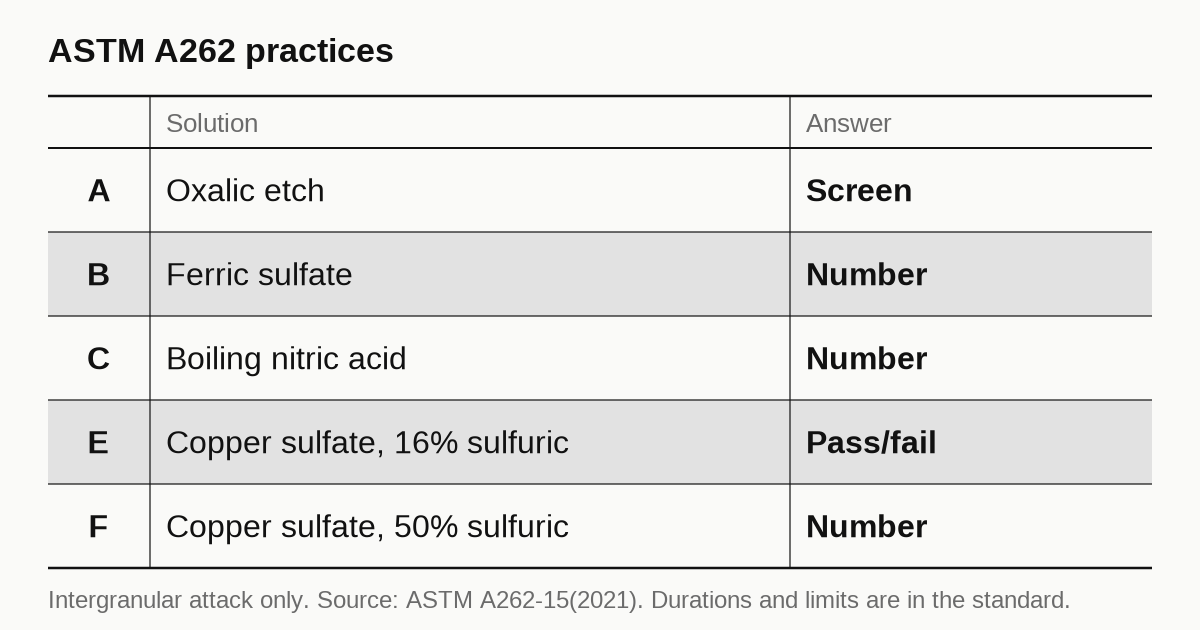
| Practice | Test | How the result is read | What it suits |
|---|---|---|---|
| A | Oxalic acid etch, electrolytic | Under a microscope the etched grain boundaries are classed as acceptable or suspect | A fast screen. Suspect samples go on to a hot acid test |
| B | Boiling ferric sulfate and sulfuric acid | Weight loss gives a corrosion rate | Quantitative test, used for grades that must meet a rate limit |
| C | Boiling 65 percent nitric acid, five periods of 48 hours | Weight loss after each period | Parts for strongly oxidising service, and a way to find chromium-poor zones and some intermetallic phases |
| E | Boiling copper sulfate and 16 percent sulfuric acid with copper | Bend the sample and look for cracks | Pass or fail, no number |
| F | Boiling copper sulfate and 50 percent sulfuric acid with copper | Weight loss | Molybdenum-bearing grades. The ASTM abstract names cast alloys, so check the scope for wrought parts |
The ASTM abstract states the structure of the standard: Practice A is a screening etch that sorts specimens into acceptable and suspect. Practices B, C and F give a quantitative weight-loss result. Practice E is judged by eye on a bent sample. The test solutions, durations and bend details above come from the standard’s abstract and from a testing laboratory’s summary. The full procedures are in the standard, so ask your lab for its method sheet.
Which practice for which part
Pick the practice from the duty, not from the grade name alone.
- Annealed bar, no welding, ordinary service. Usually no test. The mill certificate and the low carbon limit are enough for most work. See the mill certificate guide.
- Welded stainless parts. Practice E is the common pass or fail check on the heat-affected zone. If a customer wants a number rather than a bend result, name B or F where the standard allows it for the grade.
- Hot nitric acid or other strongly oxidising media. Practice C is the one aimed at that duty.
- Screening many samples. Practice A first, then a hot acid test only on the suspect ones.
- Duplex grades. A262 is written for austenitic steels. For harmful phases in duplex use ASTM A923, and for pitting use ASTM G48, see the G48 guide.
The standard also lists which grades each practice is accepted for. Check that table for the grade on your drawing before you name a practice, because a practice the standard does not accept for your grade gives a number that means nothing.
Send the drawing with the standards named Get a quote
Sensitising heat treatment
A low carbon grade passes a hot acid test as supplied. To see whether it stays sound after a weld or a hot process, the lab can run the test after a sensitising heat treatment, which holds the sample in the sensitising range for a set time. One laboratory summary says that many low carbon and stabilised grades, including 304L, 316L, 317L and 347, are sensitised before Practice A. The temperature and hold time come from the standard or the purchase order. Do not guess them: write them in or ask the lab to state what it used.
This choice changes the meaning of a pass. A test on as-received bar tells you the mill did its job. A test after sensitising tells you the grade resists the heat of a weld. Write which one you need.
What to write on the RFQ
A usable callout names the practice, the grade, the sample point and the report:
Intergranular corrosion test per ASTM A262 Practice E on 316L bar, one sample per heat, taken from the finished part or from a coupon with the same heat treatment. Report to show heat number, practice, solution, duration and result. Testing laboratory to hold ISO/IEC 17025 accreditation for this method.
Add the acceptance rule when the practice gives a number. A262 describes how to run the test, and the limit on corrosion rate comes from the customer or the product standard. Without a limit, a weight-loss practice gives a number nobody can accept or reject.
If a European buyer cites ISO 3651-2 instead, the practice is different. That standard covers ferritic, austenitic and duplex steels in sulfuric acid media with three methods, and the parties must agree which one applies. The result is valid only for the medium used. Ask the buyer which of the two they mean.
What a good report contains
- Customer, part number and the heat or lot number of the sample, so the report links to the mill certificate.
- Grade and condition, with any sensitising heat treatment stated.
- The practice, solution, temperature and duration actually used.
- The result in the form the practice gives: etch classification, corrosion rate with its unit, or bend observation.
- A statement of pass or fail against the limit you named.
- Laboratory name, accreditation scope, date and signature.
A report that says only “passed A262” without the practice letter is not usable, because the five practices answer different questions.
Common mistakes
- Citing “A262” without a practice letter.
- Ordering the test on bar for a part that is welded after machining.
- Expecting the test to rule out pitting or crevice attack. It does not.
- Using a pass from Practice A as if it were a corrosion-rate result.
- Forgetting that hot acid tests take many hours to days, which sets lead time. Leave room for it in the schedule.
- Mixing up the Practice E bend result with a number. It is pass or fail only.
How shops handle it
Most machine shops do not run A262 in house. They send samples to a corrosion laboratory or buy the test from the mill. Ask the shop whether the test is part of the quote, who runs it and whether the sample is cut from your part or from a coupon. The documentation pack guide shows where the report sits among the other papers, and the passivation test methods guide covers the checks that are quick enough to run at the shop.
We do not run tests or issue test reports. Ask the shop for the original report from the laboratory and check the laboratory’s accreditation scope for the method.
Next step
Put the practice letter, the sample point and the acceptance rule in the RFQ. The RFQ checklist shows where such a line goes, and the standards hub lists the other tests and rules for stainless parts.
Questions buyers ask
Does ASTM A262 test for pitting or crevice corrosion?
No. The standard says its tests detect intergranular attack only. They do not predict general corrosion, pitting or stress corrosion cracking. For chloride pitting the usual test is ASTM G48, covered in a separate guide on this site.
Do 304L and 316L need an A262 test?
Not by default. The low carbon limit already cuts the risk of sensitisation, and a part cut from annealed bar and never welded or heated rarely needs one. The test earns its place when the part will be welded, heat treated or used in a hot acid, and when the buyer wants proof for the lot.
Who chooses the practice?
The buyer, in the order or drawing. The standard gives the practices and what each one measures. A mill or lab will not pick the right one for your service on its own, so name it.
Is an A262 result on the bar enough for a welded part?
No. A test on the bar shows the bar as supplied. Welding and heat after machining can sensitise the part again. If the duty needs proof, specify the test on a sample taken after the last heat input.
Sources
- ASTM A262-15(2021), Standard Practices for Detecting Susceptibility to Intergranular Attack in Austenitic Stainless Steels (ASTM store listing)
- ISO 3651-2, Determination of resistance to intergranular corrosion of stainless steels, Part 2 (standards catalogue listing)
- G2MT Laboratories, ASTM A262 Practice A, B, C, E and F testing (testing laboratory summary)
Standards and rules are cited as references. They are not claims about this site or about any shop. Confirm the current edition and status with the issuing body.
Send the drawing with the standards named
Put the standard, the condition and the documents you need in the RFQ. We send one itemised quote for the finished parts, place the work with a partner shop that cuts stainless and reply within 24 business hours.
Get a quote