ASTM G48 pitting test: which method to name, which grades justify it and what the order must say
November 5, 2026
ASTM G48 is the pitting test a buyer names when a stainless part must survive chloride. It has six methods, it gives no pass mark of its own and a result is only useful if the order says which method, which temperature, which specimen and what counts as a failure. It is also the wrong tool for most parts. This guide covers when it earns its cost and what to write.
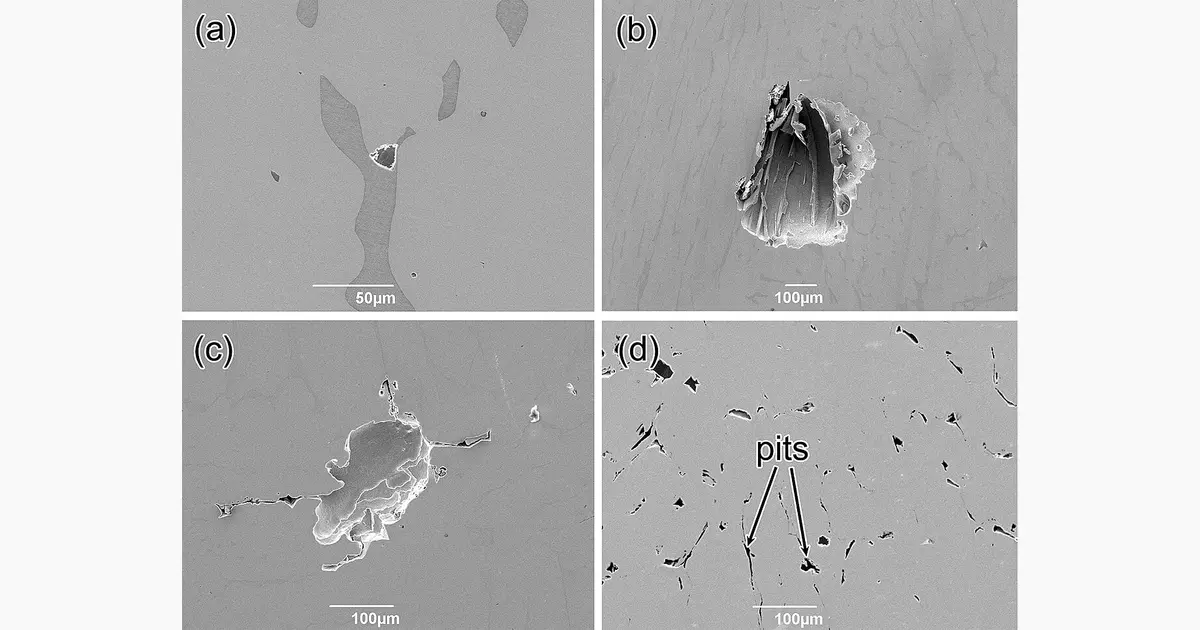
The figure shows pits on duplex stainless specimens after electrochemical testing in a published study. It is not a G48 result, but it shows the scale a lab looks at: the scale bars are 50 and 100 micrometres, and the pits are the dark cavities marked in the last panel.
The six methods in G48-25
The ASTM listing for G48-25, last updated 28 October 2025, describes tests of pitting and crevice resistance of stainless steels and related alloys in oxidising chloride environments. All six use ferric chloride solution.
| Method | What it tests | Typical use |
|---|---|---|
| A | Pitting at a fixed temperature | Relative pitting resistance, stainless and nickel base alloys |
| B | Crevice and pitting at a fixed temperature | Same, with a crevice former |
| C | Critical pitting temperature, nickel base and chromium bearing alloys | Ranking high alloy materials |
| D | Critical crevice temperature, nickel base and chromium bearing alloys | Ranking high alloy materials |
| E | Critical pitting temperature, stainless steels | Ranking stainless grades and lots |
| F | Critical crevice temperature, stainless steels | Ranking stainless grades and lots |
The listing says Methods A and B are designed to corrode Type 304 at room temperature, which is the practical limit of their use. A test that attacks 304 on a cold bench tells you little about 304 or 316L parts, and a great deal about whether a duplex or super austenitic part reached its expected resistance. The listing also says the tests can assess the effects of alloying additives, heat treatment and surface finish, and that last point matters for machined parts.
What the lab actually does
A stainless mill’s test notes describe Method E as a 24 hour exposure in 6 percent ferric chloride with 1 percent hydrochloric acid added to stabilise pH. A new specimen is used at each temperature in 5 °C steps, and the critical pitting temperature is the lowest temperature at which pitting is seen. That mill counts a pit as at least 25 micrometres deep. The mill is clear about the limits: the long test time, laborious preparation, edge attack that can shield surrounding surface and an unsuitable range for low alloyed and very highly alloyed grades. Its note also says results are only comparable within one method, and that critical pitting temperature is a relative measure that does not directly predict service performance.
For Method A, a published weld qualification study describes a 6 percent ferric chloride solution made from 100 g ferric chloride hexahydrate in 900 ml of water. It used specimens with a 25 by 50 mm test face ground to 1200 grit on the sides. It adopted 24 hours as the exposure after finding that 72 hours gave no clear benefit for duplex steels, and it treated a weight loss of 20 mg or visible pitting as a failure. Another supplier lists typical test temperatures of 25 °C for 2205 and 50 °C for 2507 and other super duplex grades. These are one supplier’s figures and the study is from 1994, so use them as orientation, not as a specification.
There is also an electrochemical alternative. ASTM G150 finds the critical pitting temperature in 1 M sodium chloride, heating at 1 °C a minute, in about 2 to 3 hours. For duplex material, ASTM A923 Method C is a separate ferric chloride test used with a sodium hydroxide etch and a Charpy test to detect harmful intermetallic phase. The 2205 duplex guide explains why that phase appears.
When a part needs it
| Part | Ask for G48? | Why |
|---|---|---|
| 304 or 316L general parts | Usually no | Methods A and B are harsh for these grades. Grade, finish and passivation decide the outcome |
| 316L in warm seawater or brine | Consider | The marine guide shows why critical pitting temperature matters at tropical sea temperature |
| 2205 duplex in chloride | Yes, at a stated temperature | Heat treatment and welding can drop resistance below the grade |
| 2507 super duplex | Yes | The 2507 cost guide lists it with Charpy |
| 904L, 6Mo | Yes, on a mill sample | See the super austenitic guide |
The test matters most where the shop can change the result: a weld, a heat treatment or a surface that was blasted or smeared. A finished part is rarely tested whole, because the test destroys a specimen.
Need a quote for this part? Get a quote for your stainless parts
What to put on the order
- Method letter and edition, for example ASTM G48-25 Method A, or E when a critical pitting temperature is wanted.
- Test temperature and exposure time. Both change the result, so state them and do not leave the lab to choose.
- Specimen. Say whether the specimen is cut from the mill bar of the same heat, a witness piece processed with the parts or a sacrificial production part. Say the surface condition: as machined, ground or passivated. The study above left the test face as prepared for service, whereas the mill grinds its samples before its electrochemical tests to rank grades, and a ground coupon and an as-machined face will not always rank alike.
- Acceptance criterion in writing, for example a weight loss limit in mg or g per square metre or no visible pits at a stated magnification. G48 has none of its own.
- Who pays and who reports. No public price survey for G48 testing exists, so ask the shop to quote it as a separate line and compare quotes on the same method and temperature.
The crevice and stress corrosion guide covers why a crevice at a thread or washer can start below the pitting temperature.
The guide to stainless steel grade selection covers when to ask for a test instead of a bigger grade.
To get quotes for duplex or super austenitic parts with a named corrosion test, send the drawing through the RFQ form and write the method, temperature and criterion in the notes. We send one itemised quote within 24 business hours and place the work with partner shops that cut stainless. We own no machines.
Sources
- ASTM G48-25, Pitting and Crevice Corrosion Resistance of Stainless Steels by Ferric Chloride (ASTM)
- ASTM A923, Detecting Detrimental Intermetallic Phase in Duplex Stainless Steels (ASTM)
- Outokumpu, Testing stainless steel for resistance to pitting corrosion (2023), producer note
- TWI, Ferric chloride testing for weld procedure qualification of duplex stainless steel weldments (1994)
- Langley Alloys, ferric chloride pitting test page, supplier figures, directional
- Wikimedia Commons, Pitting corrosion on duplex stainless steel specimens, image source

Standard editions are as listed on the dates above. Confirm the current edition and method letters with the laboratory before you order.
Frequently asked questions
What is ASTM G48?
ASTM G48 is a laboratory standard for the pitting and crevice corrosion resistance of stainless steels and related alloys in ferric chloride solution. Its current edition, G48-25, has six procedures, Methods A to F. A and B are fixed temperature pitting and crevice tests. C to F find the critical pitting or crevice temperature.
Does ASTM G48 give a pass or fail limit?
The standard describes procedures and leaves acceptance to the purchaser. Method A weight loss or visible pits must be compared with a criterion that the order states. A published weld qualification study used failure at 20 milligrams of weight loss or visible pitting. Agree your own criterion in writing before the test.
Should 316L parts be tested to ASTM G48?
Rarely. Methods A and B are designed to corrode Type 304 at room temperature, so they are harsh for routine austenitic grades. They suit duplex, super duplex and super austenitic parts where chloride pitting decides the grade. For 316L, specify the grade and passivation and use G48 only for a critical chloride service.
What is the difference between G48 Method A and Method E?
Method A exposes a specimen at one temperature and records weight loss or pits. Method E, for stainless steels, repeats the exposure in temperature steps to find the lowest temperature at which pitting starts, the critical pitting temperature. Values from different methods cannot be compared.
Need a quote for this part?
Send the drawing. We read it, send one itemised quote within 24 business hours and place the work with a partner shop that cuts stainless.
Get a quote for your stainless partsFigures in this guide are published specification limits or published typical values for the alloy, not measurements of any part. Machinability is rated against free-machining carbon steel B1112 at 100 and PREN is chromium plus 3.3 times molybdenum plus 16 times nitrogen. The conventions are set out in thereference section and the editorial standards.