2507 super duplex: what it costs to machine compared with 2205 and 316L
October 11, 2026
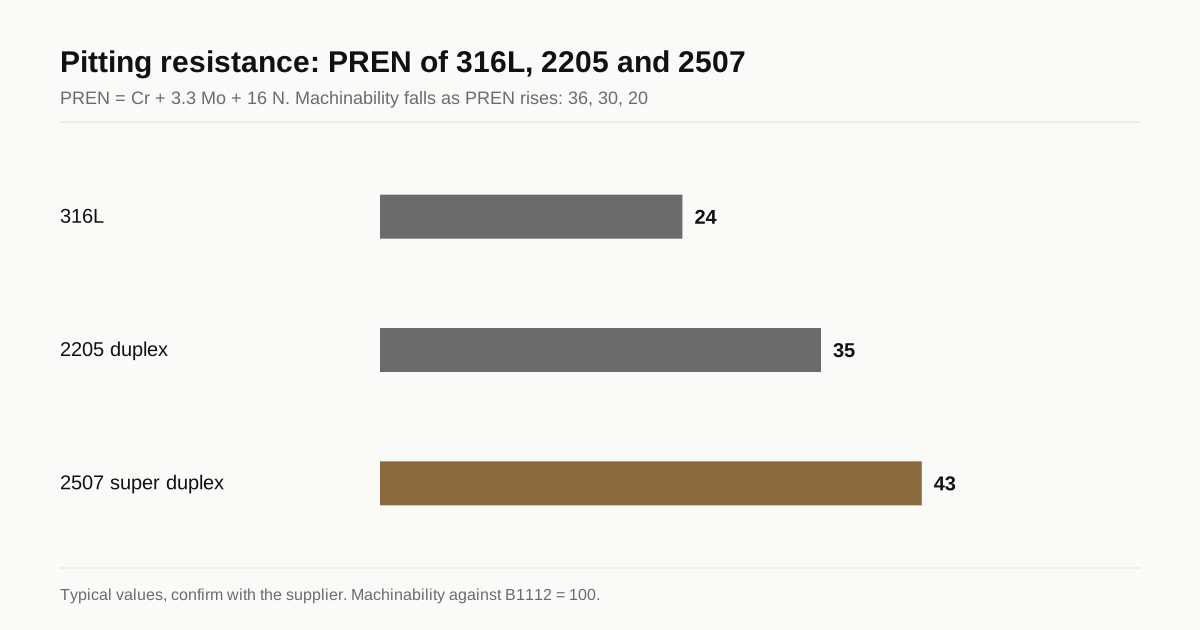
Super duplex is the grade engineers reach for when 2205 is not enough. With a PREN around 43, it is aimed at seawater, brine and hot chloride process streams where 316L fails and 2205 is marginal. It brings very high strength too, which lets designers thin out parts. The cost is paid in the machine. 2507 is one of the slowest and most tool-hungry stainless alloys, and a quote for it can surprise a buyer who has only priced 316L.
This guide compares 2507 with 2205 and 316L, puts planning ratios on the cost and explains the machining behaviour behind the numbers. The existing 2205 duplex guide covers the general duplex story.
What 2507 is
UNS S32750 is a duplex stainless with roughly equal ferrite and austenite, higher chromium, molybdenum and nitrogen than 2205. Typical nominal figures:
| 316L | 2205 | 2507 | |
|---|---|---|---|
| UNS | S31603 | S32205 | S32750 |
| Chromium | 16 to 18 % | 22 to 23 % | 24 to 26 % |
| Molybdenum | 2 to 3 % | 3 to 3.5 % | 3 to 5 % |
| Nitrogen | up to 0.10 % | 0.14 to 0.20 % | 0.24 to 0.32 % |
| Typical PREN | 24 | 35 | 43 |
| Yield strength, min (annealed) | 170 MPa | 450 MPa | 550 MPa |
| Machinability (B1112 = 100) | 36 | 30 | 20 |
PREN is calculated as Cr + 3.3 Mo + 16 N from nominal composition. The PREN calculator shows the figure for any composition. Super duplex is by convention the group with a PREN above 40. Values are published typical figures. Confirm with the standard, for example ASTM A276 or A479 for bar.
Why it cuts slowly
The same properties that make 2507 attractive in service make it hard to cut.
- High strength. Cutting forces are far higher than in 316L, and heavy forces mean rigid setups and lower speeds.
- Work hardening. The austenite phase hardens quickly under a rubbing tool, just as in 316L, but on top of a base that is already strong.
- Two phases. The tool alternates between hard and tough phases, which drives notch wear at the depth-of-cut line and edge chipping.
- Tough chips. Chip breaking is difficult, and long chips damage tools and surfaces.
- Heat. The grade has lower thermal conductivity than carbon steel, so heat stays in the cutting zone.
The practical effects: cutting speeds around half those used for 316L, short insert life, frequent insert changes mid-job and sometimes carbide grades and geometries chosen specially for the alloy. High pressure through-tool coolant helps a lot.
Planning ratios
The table gives planning ratios, not quotes. They assume similar geometry, a rigid setup and a shop that knows the material.
| Item | 316L | 2205 | 2507 |
|---|---|---|---|
| Material cost per kg (relative) | 1.0 | 1.3 to 1.6 | 1.6 to 2.2 |
| Cycle time (relative) | 1.0 | 1.5 to 2.2 | 2.0 to 3.5 |
| Tool cost per part (relative) | 1.0 | 1.5 to 2.5 | 2.5 to 4 |
| Scrap risk on first run | Low | Medium | High without experience |
| Typical delivered part price (relative) | 1.0 | 1.6 to 2.2 | 2.2 to 4 |
Figures vary widely. Small parts with shallow features land at the low end, and deep drilled or thin-walled parts land at the high end. The ratios between the grades are the point: a part that costs 100 in 316L may cost 160 to 220 in 2205 and 220 to 400 in 2507. The cost drivers guide shows which features multiply cycle time in any stainless grade.
When 2507 is the right choice
- Hot seawater and brine. Above about 30 °C, 2205 can pit in seawater and 2507 is the usual step up.
- Chlorinated or acidic process streams. Heat exchangers, scrubbers and process pipe fittings.
- Offshore oil and gas. Subsea manifolds, valve bodies and fittings. The industry standard NORSOK M-650 qualifies material suppliers for this service, and buyers should check whether it applies.
- Chloride stress corrosion risk at high temperature. 2507 resists it better than 2205.
- High strength with corrosion resistance. Where thin walls save weight.
For marine parts specifically, see the discussion of seawater service in the marine stainless guide.
When it is not worth it
- Moderate chloride service. If 2205 has no history of pitting, 2507 adds cost without benefit.
- Dry or indoor parts. 304 or 316L does the job.
- High temperature service. Above about 250 to 300 °C, super duplex suffers 475 °C embrittlement and sigma phase formation, so it is not a hot-service material.
- Parts with heavy welding without a qualified procedure. Weld heat can upset the phase balance.
- Tiny, intricate features. Cost grows quickly with small tools in a hard alloy.
Specification points to include
Super duplex is a specialist grade, and the drawing should say so.
| Item | Why it matters |
|---|---|
| Grade and UNS | S32750 (2507) rather than “super duplex”, which also includes S32760 |
| Product standard | ASTM A276 or A479 for bar, A182 for forgings |
| Supply condition | Solution annealed and quenched |
| Phase balance | Ferrite content range, typically 35 to 55 %, if needed |
| Corrosion test | ASTM G48 Method A pitting test, at a stated temperature |
| Impact test | Charpy at low temperature for subsea use |
| Certificate | EN 10204 type 3.1 with heat number |
ASTM G48 is the usual test for pitting resistance, and a buyer can ask that the mill sample, or the finished part, passes at a stated temperature. State the test temperature and acceptance criterion. An informed buyer who names the test gets better material than one who names only the grade.
Need a quote for this part? Get a quote for your stainless parts
Handling and finishing
- Avoid heat. Do not stress relieve at conventional austenitic temperatures. Say so on the drawing, and see the duplex guide for the heat sensitivity of the family.
- Passivation. A passivation treatment to ASTM A967 is standard. Citric acid methods work well and avoid nitric acid handling, see the citric versus nitric guide.
- Surface finish. Super duplex can achieve fine finishes but needs sharp, fresh tools. Specify Ra clearly.
- Contamination. Keep it away from carbon steel tools and fixtures, as for any stainless.
What shops mean when they quote high
A quote for 2507 often arrives with a note that sounds like caution. The reasons are practical and worth understanding, because they show where a buyer can reduce cost.
Tool consumption is the largest hidden line. Where a 316L part might use one insert edge, a 2507 part can use several. Carbide inserts for duplex cost the same as for any stainless, but they are changed far more often. Shops price that in, and they price in the risk of an insert failing in the middle of a deep feature and scrapping the part.
Setups need to be stiff. Light fixturing that works for 316L chatters on 2507. Heavy fixtures and short tool stick-out raise setup time.
Slower cutting means longer machine time. The machine hour rate is the same, so a part that runs three times longer costs about three times more in machine time.
Rework is expensive. A scrapped 2507 part costs more than a scrapped 316L part, and shops without experience add margin for that risk.
Ways to bring the price down include simplifying features, avoiding deep small holes, relaxing tolerances on non-critical dimensions, allowing a larger edge break and ordering in larger batches so the setup cost spreads. Offering bar in a size close to the finished diameter also reduces both material and cutting time.
Quality tests that match the risk
A part in 2507 is bought for corrosion resistance, and the quality plan should test that property, not only the dimensions. Typical requests:
- Phase balance. A ferrite count by point counting or a magnetic ferrite meter, with limits such as 35 to 55 percent ferrite. Too much ferrite lowers toughness and too little lowers strength and stress corrosion resistance.
- Pitting test. ASTM G48 on a sample, at a temperature chosen for the service.
- Impact test. Charpy V-notch at a stated low temperature, common for subsea and cold service.
- Positive material identification. A handheld analyser check of each part confirms the alloy and catches a mix-up with 2205 or 316L. Say if you want it.
- Intermetallic phase check. For critical parts, a micrographic examination for sigma phase.
Each test adds cost, so match the list to the consequence of failure. A pump casing in an offshore system carries a longer list than a bracket in a heat exchanger room.
Lead time
Super duplex bar is stocked less widely than 316L and 2205. Common diameters may be available from stockists within days. Unusual sizes, forged blanks and heats with special tests can take weeks or months from the mill. Cutting itself is slow too. Ask for lead time on both material and machining, and place the material order early.
Substitutes to ask about
If the price is a concern, ask the designer whether a lower cost route exists. A 2205 part with a corrosion allowance sometimes does the work of a thin 2507 part. A 316L part with a coating or a different design may avoid duplex altogether in a mild service. A cladded or overlaid part, with 2507 only where it touches the fluid, can cut cost on a large casting or block. These choices belong to the design owner, not to the shop, but a buyer who raises them early can save a lot.
Checklist before you request a quote
- Confirm 2205 is not sufficient for the service.
- Name S32750 and the product standard.
- State test requirements, G48 temperature and Charpy if needed.
- Mark critical features and finishing requirements.
- Ask the shop about experience with duplex and super duplex.
- Expect a quote of two to four times the 316L price for the same geometry.
When you send the drawing through the RFQ form, we send one itemised quote within 24 business hours and place the work with partner shops that cut duplex and super duplex. We own no machines.
Frequently asked questions
How much more does 2507 cost to machine than 2205?
As a planning range, expect cycle time and tool cost to run about 1.3 to 2 times those of 2205 on the same geometry, and well above 316L. The ratio depends on the shop, the features and the tooling. Material cost per kilogram is also higher.
When is 2507 worth using instead of 2205?
When 2205 has been shown to pit or crevice corrode in service, or when the environment is hot seawater, strong brine or chlorinated acid streams. For most chloride service 2205 is enough. 2507 is for the severe cases.
Can any stainless shop machine 2507?
Physically yes, economically only a shop that runs duplex regularly. Without rigid setups, high pressure coolant and tools suited to the alloy, tools fail early and parts are scrapped. Ask for experience with duplex before sending the drawing.
Need a quote for this part?
Send the drawing. We read it, send one itemised quote within 24 business hours and place the work with a partner shop that cuts stainless.
Get a quote for your stainless partsFigures in this guide are published specification limits or published typical values for the alloy, not measurements of any part. Machinability is rated against free-machining carbon steel B1112 at 100 and PREN is chromium plus 3.3 times molybdenum plus 16 times nitrogen. The conventions are set out in thereference section and the editorial standards.