Marine stainless parts: why 316L pits in seawater and when duplex is worth the machining cost
October 22, 2026
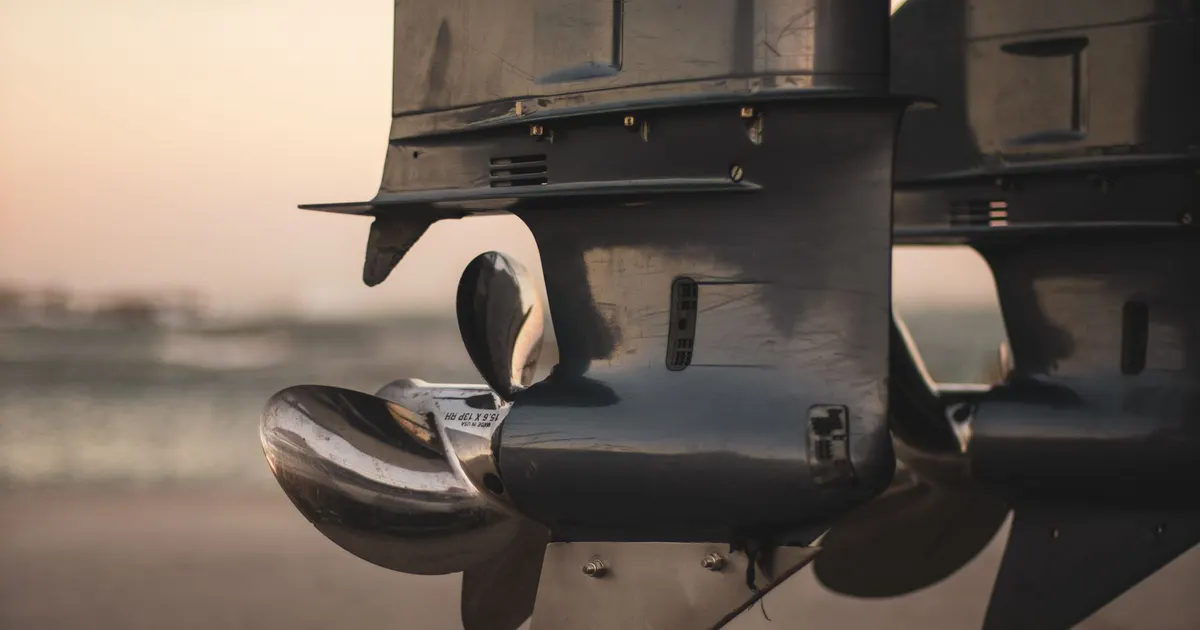
Seawater is the test that separates stainless steel grades quickly. It holds about 19,000 mg per litre of chloride and it is warm in summer and in the tropics. It supports marine growth that makes crevices and it often meets another metal in a galvanic couple. A 316L part that looks fine on a drawing and survives a salt spray test can start pitting in a few months underwater, while the same part in splash zone or atmospheric service lasts for years.
This guide ranks the usual marine stainless grades, explains the failure modes that matter for machined parts and says what to write on a drawing. It supports the discussion of crevice corrosion and chloride attack in the duplex guide.
Ranking by pitting resistance
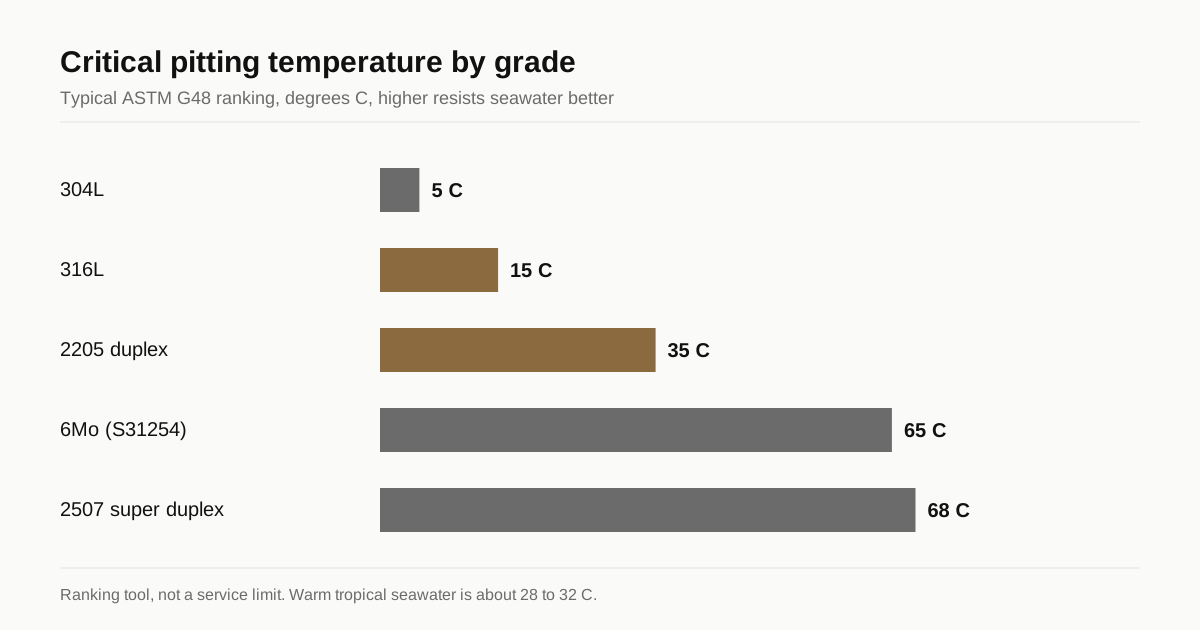
The pitting resistance equivalent number, PREN = Cr + 3.3 Mo + 16 N, ranks alloys by composition. The critical pitting temperature, measured in a standard ferric chloride test, gives a practical ranking. Published typical figures:
| Grade | PREN, typical | Critical pitting temperature, typical | Seawater use |
|---|---|---|---|
| 304L | 19 | below 10 °C | Not for seawater |
| 316L | 24 | about 15 °C | Splash and atmospheric, cool flowing water |
| 904L | 35 | about 40 to 50 °C | Seawater with care |
| 2205 duplex | 35 | about 35 °C | Seawater, pump parts, moderate temperature |
| 6Mo (S31254) | 43 | about 60 to 70 °C | Seawater cooling, heat exchangers |
| 2507 super duplex | 43 | about 65 to 70 °C | Hot seawater, subsea, high strength |
CPT values from the literature vary by test and by heat, so use them to rank grades. The PREN calculator computes the first number from composition. See the grade reference for the numbers in one table.
Seawater at tropical temperature is around 28 to 32 °C at the surface, which is above the CPT of 316L. That explains why 316L parts pit in warm waters even though the same grade is fine in colder climates.
Failure modes that matter for machined parts
Pitting. Local breakdown of the passive film. Pits start at inclusions, scratches and surface contamination, and grow in chloride. Deep pits can penetrate thin walls.
Crevice corrosion. Starts at lower temperature than pitting, in the gap between a part and another surface. Typical sites: under washers and nuts, thread roots, flange faces, gasket contact, O-ring grooves and under marine growth. The critical crevice temperature is often 15 to 25 °C below the critical pitting temperature. The crevice and stress corrosion discussion in the 2205 guide explains the chemistry.
Chloride stress corrosion cracking. Austenitic grades such as 316L crack under tensile stress in warm chloride, usually above about 50 to 60 °C. Duplex grades resist it much better.
Galvanic corrosion. When stainless is coupled to a less noble metal, such as aluminium or carbon steel, the less noble metal corrodes faster. Passive stainless is cathodic. Coupled to a more active metal in seawater, it can accelerate corrosion of the partner and, in crevices, lose its passivity. Keep stainless fasteners away from large areas of aluminium in wet service, or isolate them.
Erosion corrosion. High velocity flow and entrained particles remove the passive film. Pump impellers and valve trims are typical victims.
Microbial and fouling effects. Biofilms and barnacles create crevices and local chemistry changes. Static, fouled areas are worse than flowing, clean ones.
Choosing by service zone
| Zone | Typical conditions | Common choice |
|---|---|---|
| Atmospheric | Salt mist, rain, no immersion | 316L, finish and design matter most |
| Splash and tidal | Wet and dry cycles, oxygen rich | 316L with good finish, or duplex for critical parts |
| Immersed, flowing, cool | Constant flow and oxygen | 316L possible, 2205 safer |
| Immersed, stagnant or fouled | Crevices, low oxygen | 2205, 6Mo or 2507 |
| Warm seawater (above 25 °C) | Tropical, cooling water | 6Mo or 2507 |
| High load plus seawater | Shafts, fasteners, hydraulics | 2205, 2507 or 17-4 PH in H1150 with coating |
| Subsea oil and gas | High pressure, cathodic protection | Super duplex to NORSOK or equivalent |
This is a starting guide. Real selection depends on temperature, flow, design and the maintenance plan. Where life matters, use data from a corrosion engineer.
17-4 PH and 416 are not seawater grades unless protected, and H900 condition carries a stress corrosion risk. Cathodic protection can cause hydrogen embrittlement of high strength steels in seawater, which affects 17-4 PH in high strength conditions. This is a design issue to raise with the engineer. See the 17-4 PH guide.
Cost: what duplex does to the quote
Moving from 316L to 2205 or 2507 raises both material and machining cost. Planning ranges against 316L at 1.0 for the same geometry:
| Grade | Material cost | Cycle time | Delivered part price |
|---|---|---|---|
| 316L | 1.0 | 1.0 | 1.0 |
| 2205 | 1.3 to 1.6 | 1.5 to 2.2 | 1.6 to 2.2 |
| 6Mo | 2 to 3 | 1.3 to 2 | 2.5 to 4 |
| 2507 | 1.6 to 2.2 | 2 to 3.5 | 2.2 to 4 |
Ranges are indicative and move with metal prices and part features. Compare to the cost of a failed part: a pump shaft that corrodes and snaps, or a fastener that pits and leaks, usually costs far more than the premium. The 2507 cost guide goes through the machining side.
Design and finishing choices that help
- Avoid crevices. Use continuous welds instead of lap joints, seal gaps, avoid threads in the splash zone without sealant and keep washers and gaskets to a minimum.
- Smooth, clean surfaces. Lower roughness resists pitting better. A bead blasted or machined surface with embedded iron is a pit starter. See the bead blasting guide.
- Passivate or electropolish. Passivation to ASTM A967 after machining removes free iron. Electropolishing gives a smoother, more resistant surface. See the passivation versus electropolishing guide.
- Remove heat tint. Weld and laser heat tint lowers pitting resistance until pickled or polished.
- Isolate dissimilar metals. Use insulating sleeves and washers.
- Pick fasteners deliberately. A4 (316) fasteners in submerged service are marginal. Duplex fasteners give better life.
- Mind threads. Galling and crevices come together at thread roots. See the threading guide.
Need a quote for this part? Get a quote for your stainless parts
What to write on the drawing
- Grade by UNS number and product standard.
- Condition, annealed for austenitic and duplex.
- Surface finish and cleanliness: passivated per ASTM A967, no embedded iron.
- For critical parts, a pitting test on the mill sample: ASTM G48 at a stated temperature.
- Heat limits for duplex: no stress relief or hot work outside the stated cycle.
- Marking and traceability requirements.
- Galvanic isolation instructions if the part meets other metals.
State the intended environment in the RFQ so the shop understands what the part has to survive.
Fasteners, shafts and the parts that fail first
In marine hardware, a handful of part types account for most of the stainless failures, and each has a typical answer.
Fasteners. Bolts, studs and nuts sit in crevices by design, under washers and in threaded holes, with the thread roots as extra crevices. In immersed service 316 fasteners often corrode in the thread. Duplex fasteners or a coated design improve life. Galling of stainless nuts on stainless bolts is the second problem, so use a different grade for the nut or a lubricant that suits the service.
Propeller and pump shafts. Shafts see stress, rotation, fretting at the seals and crevices at the bearings. Duplex grades and 17-4 PH in a well chosen condition are used, and corrosion fatigue is the failure mode to guard against. Surface finish and residual stress matter.
Rudder and steering parts. Pins, bushings and stocks sit in poorly flushed spaces where seawater stagnates. Duplex helps, and bushing materials should be chosen to avoid galling and galvanic problems.
Valves and fittings. Seawater valves use bronze, duplex or super duplex bodies and stems depending on the line. Bar machined parts for them need the heat treatment and tests described earlier.
Deck hardware. Cleats, hinges and rails sit in the splash and atmospheric zone. 316L with a smooth, passivated, regularly rinsed surface is usually adequate, and tea staining is a cosmetic issue that a smoother finish reduces.
Maintenance matters as much as the grade
A stainless part in the marine environment lasts longer if the owner washes it with fresh water, because salt deposits that dry in the sun concentrate chloride. Parts that are never rinsed fail early even in a decent grade. Where parts cannot be rinsed, such as inside bilges, the grade needs more margin. Say in the RFQ what the maintenance regime will be, because it feeds into the choice, and let the designer decide with real data on the water temperature, flow and cleaning routine.
A short case for testing a sample
Published pitting temperatures rank the grades, but they come from standard test solutions, not from your water. Where a part is expensive or the consequence of failure is large, a simple immersion trial is cheap insurance. Cut coupons from the same bar as the part, finish them the same way, and expose them in the real water or a close match for several weeks with a crevice former such as a washer clamped on one face. Compare grades side by side and examine them under magnification. A trial of a month will not prove a ten year life, but it shows which grade is marginal. It also shows whether the finish and passivation are adequate, which a table of numbers cannot.
Checklist before you request a quote
- Define the service zone, temperature and flow.
- Choose the grade by pitting and crevice risk, not by habit.
- Remove or seal crevices in the design.
- Specify finish, passivation and iron-free processing.
- Add a corrosion test for critical parts.
- Expect a price step for duplex and super duplex.
For the general order of grade questions behind a marine choice, see the guide to stainless steel grade selection.
Send the drawing through the RFQ form. We send one itemised quote within 24 business hours and place the work with partner shops that cut duplex and austenitic stainless for marine work. We own no machines.
Frequently asked questions
Is 316L suitable for seawater?
For splash and atmospheric exposure and for cool, flowing seawater, often yes. In warm, stagnant or crevice conditions, 316L can pit and corrode. Parts that stay submerged or sit in gaps under fouling, for example pump shafts and fasteners, often need duplex or super duplex.
What is critical pitting temperature?
It is the lowest temperature at which a pit starts in a standard test solution, commonly measured by ASTM G48. Typical published values are around 15 °C for 316L, 35 °C for 2205 and 65 to 70 °C for 2507. They are a ranking tool, not a service limit.
Why do stainless parts corrode in crevices underwater?
Inside a gap, oxygen runs out and the chemistry becomes acidic and rich in chloride, which breaks down the passive film. Gaps under washers, gaskets, threads and marine growth are typical. Design to avoid crevices and choose a grade with higher crevice resistance.
Need a quote for this part?
Send the drawing. We read it, send one itemised quote within 24 business hours and place the work with a partner shop that cuts stainless.
Get a quote for your stainless partsFigures in this guide are published specification limits or published typical values for the alloy, not measurements of any part. Machinability is rated against free-machining carbon steel B1112 at 100 and PREN is chromium plus 3.3 times molybdenum plus 16 times nitrogen. The conventions are set out in thereference section and the editorial standards.