904L and 6Mo super austenitic stainless: what the extra nickel and molybdenum buy and cost
October 14, 2026
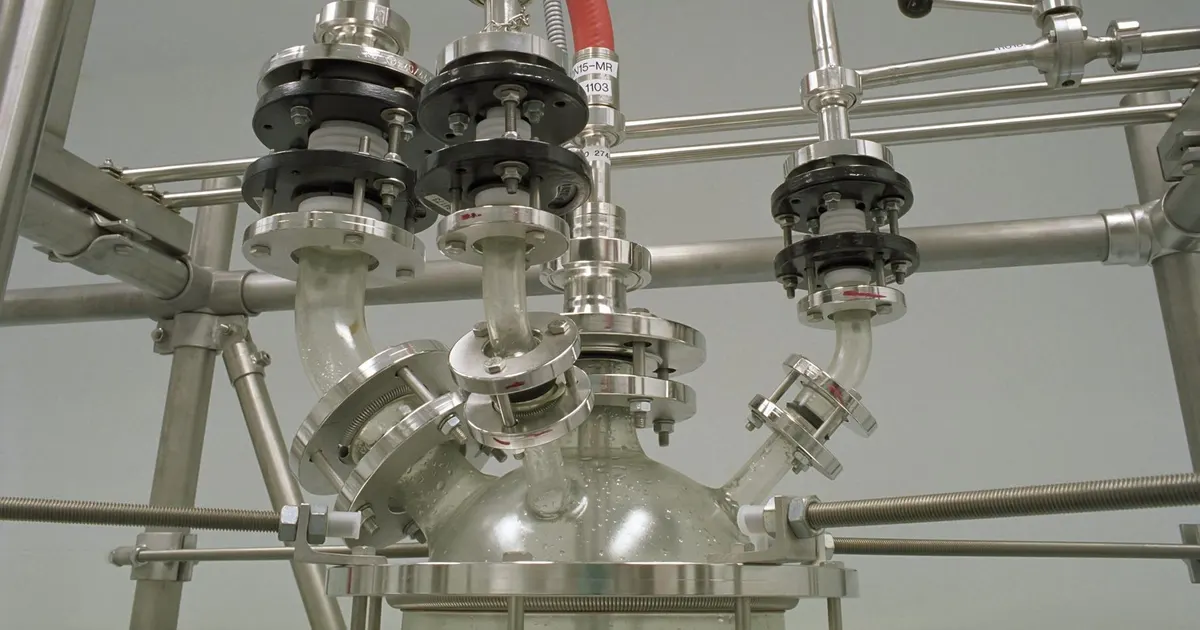
Some process environments eat 316L. Hot sulphuric acid, phosphoric acid with chlorides, flue gas scrubber liquors, bleach plant liquors and warm seawater all attack the standard grades. Duplex and super duplex handle many of these, but they are magnetic, strong and difficult to cut. A second route is the super austenitic stainless steels, which keep the tough, non-magnetic austenitic structure and add large amounts of nickel, molybdenum and nitrogen. 904L and the 6Mo grades are the best-known members of the family.
This guide explains what they are, where each fits, what to expect in the machine and what to write on the drawing.
The two families
904L (UNS N08904). A low carbon, high nickel grade with copper added for resistance to sulphuric acid. It is classed as a nickel-iron-chromium alloy rather than a conventional stainless steel, which affects the standard that covers it.
6Mo grades. The group of austenitic stainless steels with around 6 percent molybdenum. The best-known is UNS S31254. They carry nitrogen additions for strength and pitting resistance and are made under several trade names, which are not needed on a drawing, because the UNS number identifies the alloy.
| 316L | 904L | 6Mo (S31254) | |
|---|---|---|---|
| UNS | S31603 | N08904 | S31254 |
| Chromium | 16 to 18 % | 19 to 23 % | 19.5 to 20.5 % |
| Nickel | 10 to 14 % | 23 to 28 % | 17.5 to 18.5 % |
| Molybdenum | 2 to 3 % | 4 to 5 % | 6 to 6.5 % |
| Nitrogen | up to 0.10 % | up to 0.10 % | 0.18 to 0.25 % |
| Copper | none | 1 to 2 % | 0.5 to 1 % |
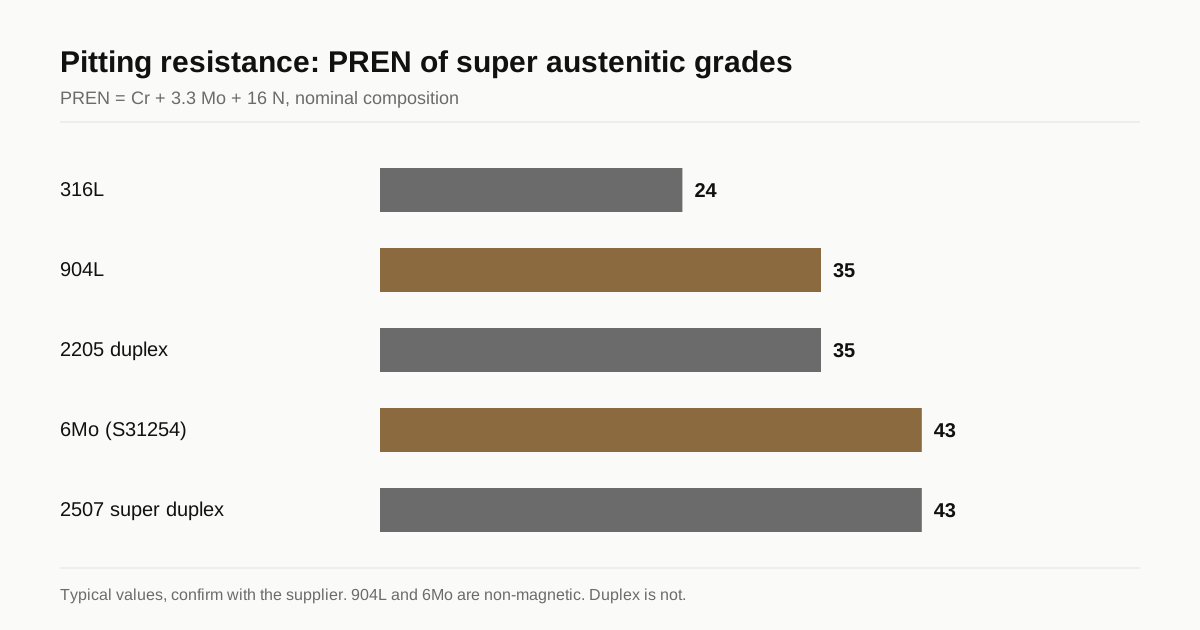
| Typical PREN | 24 | 35 | 43 to 44 |
| Machinability (B1112 = 100) | 36 | 33 | about 25 to 30 |
| Magnetic | No | No | No |
Published typical values. Composition limits vary by standard and edition, so confirm against the product specification. The PREN calculator shows the effect of each element.
What the alloying buys
- Pitting and crevice resistance. The PREN of 35 for 904L and around 43 for 6Mo compare with 24 for 316L and 35 for 2205. Super austenitics sit between 2205 and super duplex in chloride resistance.
- Acid resistance. High nickel and copper give 904L good behaviour in sulphuric acid across a wide concentration range, which is why it appears in acid handling. 6Mo does better in chloride bearing acids.
- Stress corrosion cracking. High nickel content gives much better resistance to chloride stress corrosion cracking than 316L. This is a real advantage over standard austenitic grades in warm chloride service. The crevice and stress corrosion discussion in the 2205 guide shows the contrast with duplex.
- Toughness and non-magnetic behaviour. Fully austenitic, tough at low temperatures and non-magnetic, unlike duplex.
- Moderate strength. Higher than 316L but lower than duplex. Yield strength of around 220 to 300 MPa in the annealed state, depending on grade.
Where they are used
| Environment | Typical parts | Grade often chosen |
|---|---|---|
| Sulphuric acid handling | Pump parts, valves, heat exchanger fittings | 904L |
| Flue gas desulphurisation | Scrubber internals, fasteners, spray nozzles | 6Mo |
| Seawater cooling | Heat exchanger tube sheets, pump shafts, fittings | 6Mo |
| Pulp and paper bleaching | Valves, fittings, wash press parts | 6Mo or 904L |
| Chemical process with chlorides | Reactor parts, instrument fittings | 904L or 6Mo |
| Offshore topsides, firewater | Piping fittings, instrument tubing | 6Mo |
They are not common in food, pharmaceutical or general machinery, where 316L is usually enough. A buyer who finds 904L or 6Mo on a drawing is probably dealing with a severe environment, and the drawing may carry extra requirements.
How they machine
Fully austenitic grades with this much nickel are among the harder stainless steels to cut, even though the published ratings look close to 316L.
Work hardening. High nickel makes the austenite very stable and very prone to work hardening. A rubbing or dwelling tool leaves a hard skin, and the next pass cuts into it. Steady feed is essential. The work hardening guide describes the mechanism.
Gummy, tough chips. Chips are stringy and tough, and chip control is a problem on turned and drilled features.
Tool wear. Notch wear at the depth of cut line and built-up edge are common. Tool life is shorter than in 316L.
Heat. Low thermal conductivity concentrates heat at the cutting edge. High pressure coolant through the tool helps.
Rigidity. Cutting forces are high. Thin parts and long overhangs need good support.
The consequence for a buyer is quote variation. A shop that cuts 904L regularly quotes confidently. A shop that does not will add a risk margin or decline. As a planning range, expect cycle time 1.3 to 2 times that of 316L for the same geometry. The cost drivers guide explains which features multiply the difference.
Bar standards and certificates
The grades are covered by different standards, which surprises buyers.
| Grade | Typical bar standard | Notes |
|---|---|---|
| 904L (N08904) | ASTM B649 | Nickel alloy standard, also B677 for pipe and B625 for plate |
| 6Mo (S31254) | ASTM A479, A276 | Austenitic stainless standards |
| Both | EN 10088 for European supply | 1.4539 for 904L, 1.4547 for S31254 |
Check the current editions and which form you need, for example solution annealed bar. Ask for an EN 10204 type 3.1 certificate with heat number and the chemistry, because the molybdenum and nitrogen values prove the grade. A part that should be 6Mo but is made from 316L looks identical, so the certificate is the only proof.
For corrosion critical service, ask for a pitting test on a mill sample, commonly ASTM G48 Method A or E at a stated temperature, plus an intergranular test where relevant. Name the test on the purchase order. The grade reference lists the standards that appear most often on drawings.
Need a quote for this part? Get a quote for your stainless parts
Welding, heat and sigma phase
These alloys are weldable with matching or overmatching filler metal, usually a nickel alloy filler for 6Mo, to keep corrosion resistance in the weld. For machined parts, the key points are:
- Heat exposure. Long exposure between about 600 and 1000 °C can form sigma phase and other intermetallic phases, which embrittle the metal and reduce corrosion resistance. Avoid stress relief in that range.
- Solution anneal. The correct heat treatment is a high temperature anneal followed by rapid quench, usually above 1100 °C for 6Mo. A part that has seen unplanned heat may need re-annealing.
- Welded assemblies. See the weldments guide for the machining side.
Cost: material and machining
Both the metal and the machining cost more than 316L. Nickel and molybdenum prices drive the material cost, so bar for these grades often costs several times 316L per kilogram, and the premium moves with metal markets. Small quantities in unusual sizes carry long lead times. A buyer should check availability early.
Planning ratio for a delivered machined part, against 316L at 1.0: 904L around 1.8 to 3, and 6Mo around 2.5 to 4. These ranges are indicative only and move with the part.
Choosing between them and the alternatives
- Chloride only, moderate temperature. 2205 duplex may do the job at lower cost. See the 2205 guide.
- Sulphuric acid with copper benefit. 904L.
- Seawater, hot chloride or chloride-bearing acid. 6Mo, or 2507 if strength and magnetic behaviour do not matter.
- Non-magnetic requirement with high corrosion resistance. Super austenitic grades keep the non-magnetic structure that duplex lacks.
- Extreme environments. Nickel alloys such as 625 or C-276 take over.
Passivation, pickling and surface care
High alloy austenitic parts keep their corrosion resistance only if the surface is clean. Three points apply.
Free iron. As for all stainless, iron from tools and handling must be removed. Passivation to ASTM A967 works for these grades, though the acid, time and temperature may differ from those used for 304 and 316L. For 6Mo grades, shops sometimes use nitric acid with a longer time or add a hydrofluoric acid pickle for scale. State the standard and let the shop propose the method, then ask for the acceptance test result.
Heat tint. Weld or laser heat tint lowers pitting resistance until it is removed by pickling or mechanical cleaning. Parts that carry any tint should be cleaned back to bright metal, and the bead blasting guide explains the contamination risks if blasting is the cleaning method.
Surface finish. A smooth, uniform surface resists pitting better than a rough one. Electropolishing is often used for the cleanest result.
Typical drawing notes for these alloys
- Material: UNS N08904 or UNS S31254, solution annealed, per the named product standard.
- Mill certificate with chemistry, mechanical results and heat treatment record, type 3.1.
- Positive material identification on each finished part.
- Passivated per ASTM A967, acceptance test as agreed.
- No contact with carbon steel tools or fixtures during processing.
- Packaging that keeps parts apart and clean.
Positive material identification matters more here than for common grades, because a 316L part can pass as 904L to the eye. A handheld analyser reads molybdenum and nickel in seconds and catches the mix-up.
Checklist before you request a quote
- State the exact UNS number, not only the common name.
- Name the product standard and supply condition.
- Request the certificate with chemistry and any pitting test.
- Say what the service environment is, so the shop understands the risk.
- Ask the shop about experience with high nickel austenitic grades.
- Expect longer lead times for bar.
The guide to stainless steel grade selection shows the step from 316L to 904L and duplex in one table.
When you send the drawing through the RFQ form, we send one itemised quote within 24 business hours and place the work with partner shops that cut high nickel stainless. We own no machines.
Frequently asked questions
What is a super austenitic stainless steel?
It is a fully austenitic grade with much more nickel, molybdenum and often nitrogen than 316L, giving a PREN of roughly 34 to 45. 904L and the 6Mo grades such as UNS S31254 are the common examples. They resist pitting, crevice corrosion and many acids better than 316L.
Is 904L harder to machine than 316L?
Yes. The published rating is 33 against 36 for 316L, but in practice 904L work hardens harder and wears tools faster because of its high nickel and copper content. 6Mo grades are tougher still. Expect longer cycle times and more tool cost.
What is the difference between 904L and 6Mo?
6Mo grades have more molybdenum, around 6 percent, and added nitrogen, so their pitting resistance is higher, with a PREN near 43 against 35 for 904L. 904L has copper, which helps in sulphuric acid. The better choice depends on the chemical environment.
Do I need a special bar specification for 904L?
Yes. 904L is a nickel-iron alloy and is covered by ASTM B649 for bar, not by A276 in the same way as 316L. 6Mo grades such as S31254 are covered by ASTM A479 and others. Check the standard for the form and the supplier.
Need a quote for this part?
Send the drawing. We read it, send one itemised quote within 24 business hours and place the work with a partner shop that cuts stainless.
Get a quote for your stainless partsFigures in this guide are published specification limits or published typical values for the alloy, not measurements of any part. Machinability is rated against free-machining carbon steel B1112 at 100 and PREN is chromium plus 3.3 times molybdenum plus 16 times nitrogen. The conventions are set out in thereference section and the editorial standards.