321 and 347 stainless: when titanium or niobium stabilisation is worth paying for
October 13, 2026
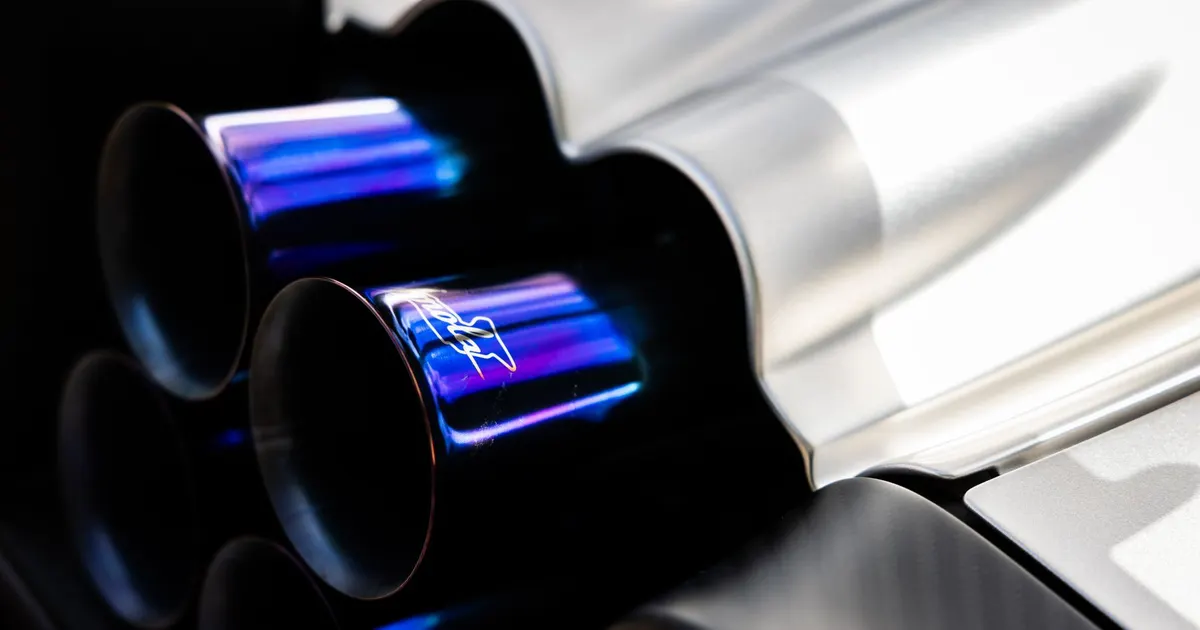
Stainless steel that lives in a hot environment, such as an exhaust manifold, a furnace part or a heat exchanger tube sheet, faces a corrosion problem that has nothing to do with chlorides. Held for long periods around 450 to 850 °C, standard austenitic stainless builds chromium carbides along grain boundaries and loses its resistance to intergranular attack. 321 and 347 exist to avoid exactly that. They cost more than 304 and cut worse, so the question for a buyer is whether the part actually sits in the range where they pay back.
This guide explains how stabilisation works, how the two grades differ, what to expect in the machine and how to write the callout.
How stabilisation works
In plain 304, carbon is free to combine with chromium at grain boundaries between roughly 450 and 850 °C. The carbide steals chromium from the metal around it, which then corrodes at the boundary. The low carbon grades such as 304L limit carbide formation by starving the reaction, which suffices for welding and short heat cycles.
Stabilised grades take a different route. They add a strong carbide former that grabs the carbon first.
- 321 adds titanium, at least five times the carbon content, with a maximum of 0.70 percent.
- 347 adds niobium (columbium), at least ten times the carbon content, with a maximum of 1.0 percent. Tantalum is often reported alongside niobium.
Titanium carbide or niobium carbide forms in preference to chromium carbide, so the chromium stays in solution. The effect lasts for the life of the part rather than for a single heat cycle, which is why stabilised grades are chosen for service above about 425 °C.
Grade comparison
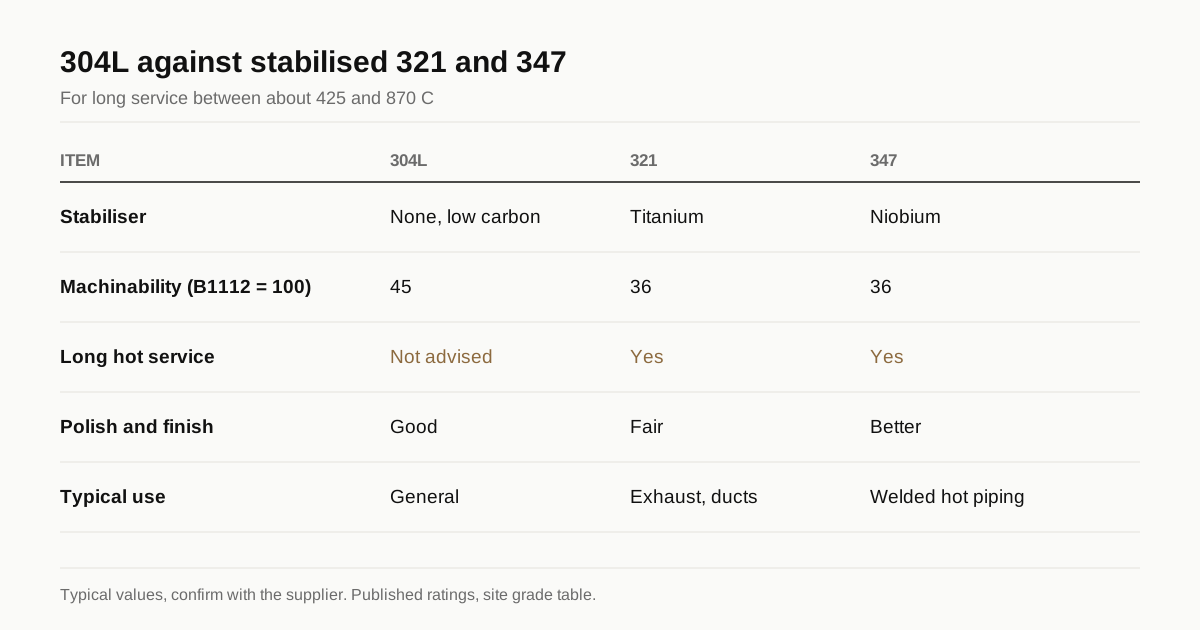
| 304L | 321 | 347 | |
|---|---|---|---|
| Stabiliser | None, low carbon | Titanium | Niobium (plus tantalum) |
| UNS | S30403 | S32100 | S34700 |
| EN number | 1.4307 | 1.4541 | 1.4550 |
| Typical PREN | 19 | 18 | 18 |
| Machinability (B1112 = 100) | 45 | 36 | 36 |
| Long service 425 to 870 °C | Not recommended | Yes | Yes |
| Weld without post-anneal | Yes | Yes | Yes |
| Polish and finish | Good | Fair, titanium particles | Better |
| Typical uses | General | Exhaust, aerospace ducts, expansion joints | Welded pressure parts, high temperature piping |
Numbers are published typical values from the site reference and the specifications. Check the product standard. High carbon variants, 321H and 347H, exist for creep strength at the top of the temperature range, and they carry a minimum carbon content and a specified grain size.
When the stabilised grades are the right call
Pick 321 or 347 when:
- The part runs continuously, or cycles often, between about 425 and 870 °C. Exhaust components, furnace fixtures, heat shields and expansion bellows are typical.
- The part is welded and then operates in that range without a final anneal.
- The environment has sulphur or other species that promote intergranular attack in sensitised metal, as in some refinery and chemical service.
- Specification demands it. Aerospace and pressure vessel codes often list 321 or 347 for hot parts, for example ASTM A276 or A479 bar.
Do not pick them just because the part is hot. Above about 870 °C, strength and oxidation resistance become the limit, and heat resistant grades such as 310 or alloys with more chromium take over. Below about 425 °C, there is no sensitisation issue and 304 or 304L is the economical choice. The 304 against 304L guide describes the low carbon case.
How they machine
Both grades behave as tough, work hardening austenitics, with a published rating of 36 on the B1112 scale against 45 for 304.
Tool wear. 321 contains hard titanium carbonitride particles that abrade carbide tools. Shops often see shorter tool life on 321 than on 304 or 316L.
Chips. Tough and stringy, similar to 316L. Chip control needs attention on turned and drilled features.
Work hardening. Strong, as in all austenitics. Light cuts or dwell in the cut leave a hard skin that damages the next pass. See the work hardening guide.
Surface finish. 321 can show a streaky or pitted look when polished, because titanium nitride inclusions pull out. If appearance or a low Ra target matters, 347 or 316L give a cleaner result. The surface finish guide shows what roughness each route achieves.
Bar quality. Titanium content varies within the allowed range and inclusions vary between heats. For critical parts, ask for the mill certificate and consider specifying inclusion limits.
None of this stops a normal stainless shop from cutting the grades. It affects the quote, because tool cost and cycle time are higher than for 304.
Welding and service life
Neither grade needs a post-weld anneal to avoid sensitisation, which is the point of stabilising. That is useful for large assemblies that cannot go in a furnace. A few cautions apply.
- Knife line attack. In some environments the narrow zone next to a weld in 321 can be attacked after high-temperature exposure. 347 resists it better, which is one reason for the niobium grade in welded service.
- Filler metal. 347 filler is commonly used for both 321 and 347 base metal, because titanium transfers poorly across a weld arc.
- Sigma phase. Long exposure around 600 to 900 °C can form sigma phase in austenitics, which embrittles the metal. This is a design question, not a machining one, but it is a reason to keep exposure within the expected range.
A machined part from welded stock follows the guidance in the stainless weldments article.
Intergranular corrosion tests
Buyers in regulated industries sometimes require evidence that the material resists intergranular attack. The usual test is ASTM A262, which has several practices: Practice E (copper-copper sulphate-sulphuric acid) is often used for stabilised and low carbon grades, and Practice C (nitric acid) for others. The test belongs on the purchase specification for the mill certificate or for a sample part, not on the machining shop’s plate. Call it out by number and say whether the sample is taken before or after any heat treatment.
Need a quote for this part? Get a quote for your stainless parts
Specifying the grade on a drawing
A clear callout gives the grade, the product standard, the condition and any test:
| Item | Example |
|---|---|
| Grade | 321 or 347, UNS S32100 or S34700 |
| Product standard | ASTM A276 or A479 bar, condition A (annealed) |
| Carbon variant | Standard or H grade, if creep matters |
| Test | ASTM A262 Practice E on the mill sample |
| Certificate | EN 10204 type 3.1 with heat number |
| Finish | As machined, or passivated per ASTM A967 |
Stainless bar standards are explained in the grade reference and the wider RFQ checklist.
Cost expectations
Stabilised grades cost more than 304 and 304L per kilogram, usually by a small to medium margin because of the titanium or niobium additions and smaller production runs. The larger cost increase comes from machining: shorter tool life, slower speeds and extra inspection on critical parts. Compare against the factors in the cost drivers guide.
If a drawing calls for 321 but the real service is below 425 °C, ask the design engineer whether 304L or 316L would meet the need. The saving can be real.
Typical parts and what to ask a shop
Stabilised grades show up in a fairly narrow set of products, and each has its own questions.
Exhaust and flue components. Flanges, collars, hangers and sensor bosses in engine and furnace exhaust systems. Ask about the temperature cycle and whether the part will be welded, because that decides between 321 and 347 and whether an H grade is needed.
Aerospace ducting and fittings. Flanges, couplings and clamps for engine bleed air and hot ducts. These parts usually come with strict documentation, a named specification and traceability. Ask which specification applies and whether the shop has made parts to it before.
Expansion joints and bellows hardware. Rings and end fittings that are welded into thin walled bellows. The thin sections want the stable behaviour of the stabilised grades.
Heat exchanger and refinery parts. Nozzles, tube sheet drilling and fittings in hydrocarbon service with sulphur. Here the corrosion test and the certificate matter most.
Furnace fixtures. Trays, hooks and supports. These often tip toward heat resistant grades such as 310 once the temperature rises, so check the real operating temperature.
For any of these, give the shop the temperature range, the cycle and the environment. A shop that knows the part is for a 600 °C exhaust understands why a cheaper grade will not do and will price the material and the cutting honestly. A shop that sees only a grade number may quote 304 and swap in whatever is on the shelf.
Lead time and stock
321 and 347 are less commonly stocked than 304L and 316L, especially in the larger diameters and in the H grades. A stockist may hold 321 in common sizes but need weeks for 347 or for a certified lot with an intergranular corrosion test. Ask about lead time early, and ask whether an approved substitute would be acceptable if the stock position is poor. The design owner should answer that question, not the shop.
Checklist before you request a quote
- Confirm the service temperature range and duration.
- Choose 321 or 347 and the standard, and consider the H variant if needed.
- State whether the part is welded and the filler.
- Specify a finish requirement if polish matters, since 347 polishes better.
- Request a mill certificate and any intergranular corrosion test.
Where heat service fits in the choice of grade is covered in the guide to stainless steel grade selection.
When you send the drawing through the RFQ form, we send one itemised quote within 24 business hours and place the work with partner shops that cut stabilised stainless. We own no machines.
Frequently asked questions
What is the difference between 321 and 347 stainless?
Both are 18 chromium, 10 nickel austenitic grades stabilised against sensitisation. 321 uses titanium and 347 uses niobium, sometimes with tantalum. 347 polishes and welds a little better. 321 is more common in Europe and in aerospace ducting and exhaust parts.
Is 321 harder to machine than 304?
Slightly. The published rating is 36 against 45 for 304, because titanium carbide and nitride particles wear tools. Chips are tough and the grade work hardens like other austenitics. A shop used to 304 can run it, but tool life will be shorter.
Why not just use 304L for hot parts?
Low carbon protects against sensitisation for short exposures such as welding, but not for long service at 425 to 815 C. In that range the carbon in 304L still slowly forms carbides over time. Stabilised grades tie up the carbon permanently.
Need a quote for this part?
Send the drawing. We read it, send one itemised quote within 24 business hours and place the work with a partner shop that cuts stainless.
Get a quote for your stainless partsFigures in this guide are published specification limits or published typical values for the alloy, not measurements of any part. Machinability is rated against free-machining carbon steel B1112 at 100 and PREN is chromium plus 3.3 times molybdenum plus 16 times nitrogen. The conventions are set out in thereference section and the editorial standards.