Stainless steel designations on a drawing: what AISI, UNS and EN numbers each name, and what none of them does
November 21, 2026
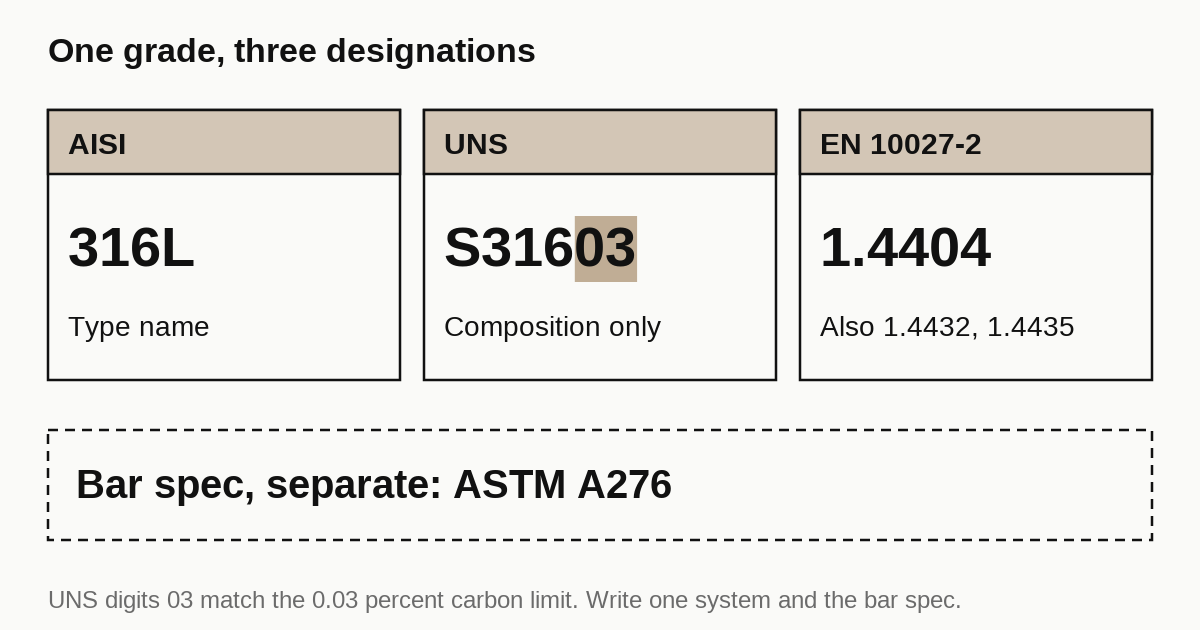
A UNS number names a composition, an AISI number names a type and an EN number names a grade in a European standard. None of them names the product, so a drawing also needs the bar specification and condition. Write one designation system for the grade and one standard for the product. This post is part of our guide to stainless steel grade selection.
The designations below are pointers for reading a drawing, not a full cross-reference. Japanese names such as SUS304 exist as well and this post does not cover them.
Three systems at a glance
| System | Who issues it | Example for 316L | What it names | What it does not name |
|---|---|---|---|---|
| AISI type | Historic US practice | 316L | A composition range | A specification or product form |
| UNS | ASTM International and SAE | S31603 | A composition | Form, condition or quality |
| EN steel number | European standards (EN 10027-2) | 1.4404 | A grade in the European system | Product form or the supplier’s process |
Source: BSSA tables for AISI; ASTM E527 store page and Wikipedia for UNS; Wikipedia for EN 10027-2.
BSSA says plainly that AISI designations are not specifications but steel grade composition ranges, and that the ranges should be checked in the appropriate standard. ASTM E527 describes the UNS as a unified identification of metals and alloys for which controlling limits are set in specifications published elsewhere. Wikipedia adds that the letter prefix marks the family (S for stainless steels), the first three digits often follow older three-digit schemes and the last two usually mark variants. S31603 is 316L, and its 03 matches the 0.030 percent carbon limit in BSSA’s table, the same convention Wikipedia describes for S31008.
The EN number is built differently. Wikipedia’s account of EN 10027-2 gives a first digit for the material type (only 1, steel, has been specified), two digits for the steel group, where 4x covers stainless and heat resisting steels, and a sequential number assigned by the certifying body. Read by that format, 1.4301 is group 43 and sequence 01.
Same UNS number, different product form
One UNS number can sit under different limits in different products. BSSA’s tables show S30400 twice: in flat product to the sheet and plate standard, carbon is 0.07 percent maximum and chromium 17.5 to 19.5 with nitrogen 0.10 maximum, and in bar to ASTM A276 carbon is 0.08 and chromium 18.0 to 20.0, with no nitrogen limit listed.
| Product | UNS | C max % | Cr % | N max % |
|---|---|---|---|---|
| 304 flat product | S30400 | 0.07 | 17.5 to 19.5 | 0.10 |
| 304 bar, A276 | S30400 | 0.08 | 18.0 to 20.0 | not listed |
| 304L flat product | S30403 | 0.030 | 17.5 to 19.5 | 0.10 |
| 304L bar, A276 | S30403 | 0.030 | 18.0 to 20.0 | not listed |
Source: BSSA, chemical compositions of AISI and UNS austenitic stainless steel grades. The page says the flat rows follow the sheet and plate standard and the bar rows follow A276. Edition of the standards not stated.
This is why a UNS number never replaces the standard. ASTM A276 itself covers hot-finished or cold-finished bars and shapes and lists five conditions, annealed (A), hardened and tempered at low (H) or high (T) temperature, strain hardened (S) and severely cold worked (B). The store page shows A276/A276M-25 as the active edition as of October 2026. Our A276 against A479 guide covers which bar standard to name.
One UNS number, several EN grades
The next trap runs the other way. Outokumpu’s Supra data sheet lists three EN grades that all carry UNS S31603 and the name 316L.
| EN grade | UNS | Mo, typical % | Ni, typical % | PRE, typical |
|---|---|---|---|---|
| 1.4404 | S31603 | 2.1 | 10.1 | 24 |
| 1.4432 | S31603 | 2.6 | 10.7 | 25 |
| 1.4435 | S31603 | 2.6 | 12.6 | 26 |
Source: Outokumpu Supra range data sheet, typical composition and PRE. One producer, typical values.
The grade table from the same producer gives typical critical pitting temperatures of 20 ± 2 °C for 1.4404, 27 ± 3 °C for 1.4432 and 21 ± 2 °C for 1.4435, measured by ASTM G150. A part that is correct as “316L, S31603” can arrive as any of them. The same happens at 304L: the table lists 1.4307 and 1.4306 under S30403, with typical nickel of 8.1 and 10.1 percent, and 316 appears as 1.4401 and 1.4436 under S31600. If the extra molybdenum or nickel matters to the service, write the EN number or a minimum and say which designation system controls.
The letter is not always S
The S prefix marks stainless steels, but the system is built on composition. Outokumpu’s table gives 904L as UNS N08904, with the EN number 1.4539. N is the prefix for nickel alloys and the grade is sold as a super austenitic stainless steel. A purchasing system that filters on S numbers will miss it. 316Ti is S31635 in the BSSA and Supra tables, and 17-4 PH is S17400 in BSSA’s table, where it appears as type 630. Check the full designation of any high-alloy grade rather than assuming the letter.
Common stainless grades as pointers
The table lists designations we found in the sources we opened, as a starting point for reading a drawing. Grades that share a row are close, not identical: limits differ by standard and product form, and the EN column has more than one entry where the producer lists several.
| Grade | UNS | EN number |
|---|---|---|
| 303 | S30300 | 1.4305 |
| 304 | S30400 | 1.4301 |
| 304L | S30403 | 1.4307 and 1.4306 |
| 316 | S31600 | 1.4401 and 1.4436 |
| 316L | S31603 | 1.4404, 1.4432 and 1.4435 |
| 316Ti | S31635 | 1.4571 |
| 321 | S32100 | 1.4541 |
| 416 | S41600 | 1.4005 |
| 430 | S43000 | 1.4016 |
| 17-4 PH (630) | S17400 | 1.4542 |
| 904L | N08904 | 1.4539 |
Source: Outokumpu grade table and Supra data sheet (EN and UNS), BSSA tables (UNS for 316Ti and 17-4 PH). Pointers only, not an equivalence. Our grade reference gives the numbers for 18 grades in one table.
Need a quote for this part? Get a quote for your stainless parts
How to write it on a drawing
Pick one system for the grade and one standard for the product. Examples, to adapt:
- “Material: 316L, UNS S31603, bar to ASTM A276, Condition A, EN 10204 type 3.1 certificate.”
- “Material: stainless steel EN 1.4432 only, bar to ASTM A276, Condition A.”
- Avoid: “SUS316 / 316L / 1.4404 per A276”. It names three grades in three systems and leaves the shop to choose which controls.
Outokumpu’s ordering guide lists EN 10204 type 3.1 as the manufacturer’s inspection document and type 3.2 as the version with third-party inspection. It also gives a multi-certification example, 1.4404 plus 1.4401, which shows that a certificate can carry two grades. Read the certificate for the grade you ordered.
Common misreadings
- “UNS is a specification.” It is not. ASTM E527 says it establishes no requirements for form, condition or quality.
- “316L is one grade.” It is one name over several EN grades, and the grades differ in molybdenum.
- “S means stainless in every case.” The nickel alloy prefix N covers 904L.
- “Same UNS number means same bar.” Bar and flat product carry different limits under one UNS number.
Related standards
| Standard | What it does | Edition or status |
|---|---|---|
| ASTM E527 | Numbering metals and alloys in the UNS | E527-23 active per the ASTM store listing |
| ASTM A276 | Stainless bars and shapes | A276/A276M-25 active per the ASTM store listing |
| EN 10027-2 | Steel numbers such as 1.4404 | Described through the Wikipedia summary; we did not read the standard |
| EN 10088-1 | List of stainless steels | Named in Outokumpu’s standards list; we did not read it |
Source: ASTM store pages (E527-16 and A276-17 pages listing later active editions), Wikipedia on EN 10027, Outokumpu grade table. ASTM and EN standards are paywalled and we did not read their full texts.
What to write in your spec
- The grade by one designation system: AISI name, UNS number or EN number.
- The EN number or a minimum alloy content if molybdenum or nickel matters.
- The bar specification and condition, for example ASTM A276 Condition A.
- The certificate type, EN 10204 3.1 or 3.2.
- A rule that a different designation or grade needs a written revision.
The decision order that sits behind this callout is in our guide to stainless steel grade selection. If you want a quote on the same written scope, send the drawing through the RFQ form. We send one itemised quote within 24 business hours and place the work with a partner shop that cuts stainless. The 316 against 316L against 316Ti guide shows the grade side of the same choice.
Sources
- ASTM E527, Standard Practice for Numbering Metals and Alloys in the Unified Numbering System (ASTM store, 2016 edition page; a later edition is active), scope of the UNS
- Wikipedia, Unified numbering system, structure and prefixes (definition only)
- Wikipedia, EN 10027, steel number structure (definition only)
- BSSA, chemical compositions of AISI and UNS austenitic stainless steel grades, UNS and limits by product form
- BSSA, chemical compositions of AISI and UNS martensitic and precipitation hardening stainless steel grades, 416 and 17-4 PH
- Outokumpu, Steel Grades, Properties and Global Standards, EN and UNS designations, CPT, ordering concepts
- Outokumpu, Supra range data sheet, the three 316L grades
- ASTM A276/A276M, Stainless Steel Bars and Shapes (ASTM store, 2017 edition page; a later edition is active), scope and conditions
Standards texts were not read in full. Check the current edition before you cite one in a contract.
Frequently asked questions
What is a UNS number on a stainless steel drawing?
A UNS number is a letter plus five digits that identifies an alloy composition, such as S31603 for 316L. ASTM International and SAE manage the system. ASTM E527 says it is not a specification and sets no requirement for form, condition or quality, so you still need a product standard such as ASTM A276 for bar.
Is UNS S31603 the same as EN 1.4404?
They are usually treated as counterparts, but not identical. Outokumpu lists three EN grades under S31603: 1.4404, 1.4432 and 1.4435. They differ in typical molybdenum and nickel and in pitting resistance, so write the EN number if the difference matters to your part.
Do all stainless UNS numbers start with S?
No. The S prefix marks stainless steels, but 904L carries N08904, a nickel alloy prefix, in Outokumpu's table. A search or a purchasing filter that looks only for S numbers will miss it. Check the full designation of any high-alloy grade rather than assuming the letter.
Which designation should I put on the drawing?
One system for the grade, one standard for the product. For example the grade as UNS S31603 or EN 1.4404, then the bar specification and condition. Avoid a mixed callout that lists several names, because the shop and the mill may read different ones.
Need a quote for this part?
Send the drawing. We read it, send one itemised quote within 24 business hours and place the work with a partner shop that cuts stainless.
Get a quote for your stainless partsFigures in this guide are published specification limits or published typical values for the alloy, not measurements of any part. Machinability is rated against free-machining carbon steel B1112 at 100 and PREN is chromium plus 3.3 times molybdenum plus 16 times nitrogen. The conventions are set out in thereference section and the editorial standards.