Machined or investment cast: which route wins on cost for a stainless part
November 19, 2026

Investment casting wins on cost when the shape is complex, the volume repays tooling and the as-cast tolerance is good enough everywhere except a few features. Machining from bar wins on low volume, tight tolerances and parts that must be sound through the whole section. Most cast stainless parts are machined on their critical features anyway, so the real question is which route removes more cost before that step. This post is part of our guide to a stainless steel machining quote.
Figures below come from the sources listed at the end, and where we found none, we say so.
Decision table
| Criterion | Machined from bar | Investment cast, then finish machined |
|---|---|---|
| Tooling | Fixtures only | Wax pattern tooling and ceramic process |
| Cost against volume | Flat per part, setup shared | Tooling repaid over the run |
| Tolerance | Individual tolerances per feature | General as cast, tight on machined features |
| Surface | Set by the cutting operation | Cast skin, finished where it matters |
| Geometry | Limited by tool access | Complex outer shape and internals |
| Grade | Wrought grade, bar standard | Cast designation with its own limits |
| Soundness | Wrought bar | Porosity possible, tested if needed |
| Change in design | Edit the program | New or modified tooling |
Source: our synthesis of the sources listed below. No public source gives a price comparison for stainless, so none is stated.
Tooling and volume
Casting moves cost from machine time to tooling and process. An Open University manufacturing page dated November 2017 says investment casting production runs of 50 to 10 million are not unusual. It also says that, because of high tooling, material and process costs, production is usually viable only when no suitable alternative exists, and that the case improves when casting removes a lot of machining.
We found no public tooling price list for stainless investment casting, and none for a break-even volume. Our own stock form guide mentions a low-thousands crossover for a moderately complex shape as a rule of thumb, and we found no public source to back that number. Treat it as a prompt to ask for both quotes. The quantity guide explains how setup behaves when volume changes.
Tolerance and finish
Cast parts carry looser general tolerances. A foundry page that says its table lists tolerances recommended by the Investment Casting Institute shows normal linear tolerances of ±0.010 inch for dimensions from half an inch to one inch and ±0.019 inch for three to four inches, with a premium band that is tighter. ISO 2768-1, read from the publisher’s preview pages, lets machined parts carry general classes f and m, for example ±0.2 mm in class m from 6 to 30 mm. The chart compares them at three sizes, converted to millimetres.
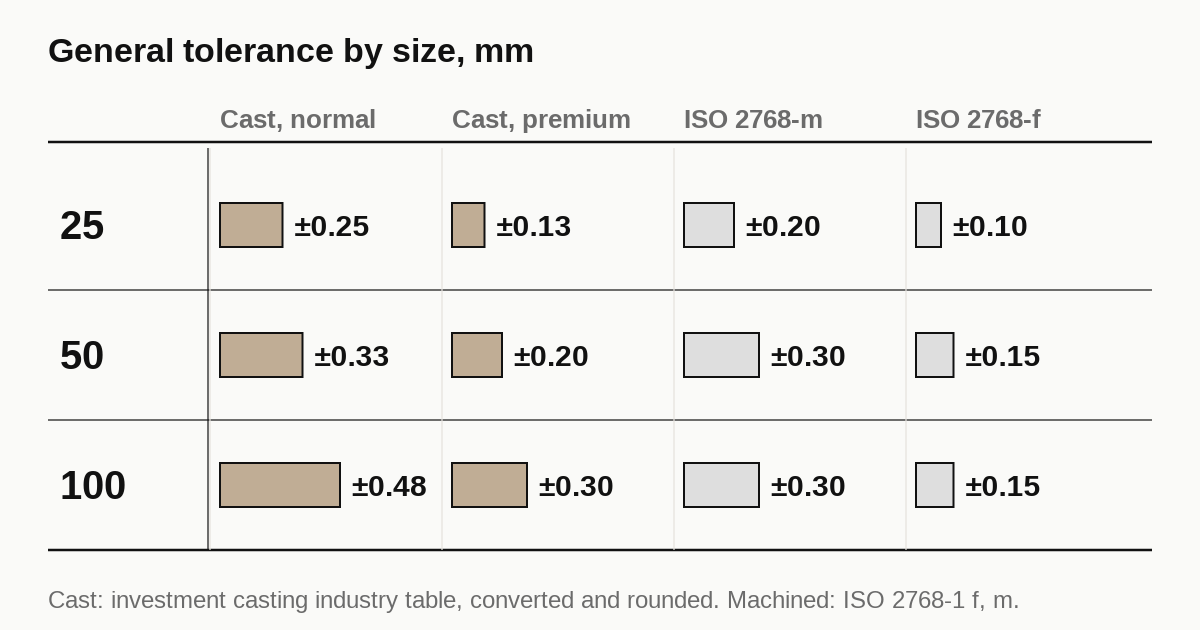
The chart compares general tolerances only. Machined features can carry individual tolerances much tighter than any general class, which is why cast parts are machined where they mate. Sources also disagree: the Open University page gives ±0.9 mm as a typical linear tolerance for a 100 mm ferrous casting and ±0.25 mm as the lowest-cost tolerance. Ask the foundry for its own capability.
Surface follows tolerance. The same page tabulates as-cast stainless at Ra 2.3 to 3.2 micrometres against 1.5 to 3.2 for a machined surface as typical ranges. Machined finish depends on the operation, so state Ra only on the surfaces that need it.
Grade and chemistry
Wrought and cast grades share names but not limits. A reference sheet for ASTM A351 CF8M, the cast counterpart of 316, lists carbon at 0.08 percent maximum, chromium 18 to 21, nickel 9 to 12 and molybdenum 2 to 3, with minimum tensile strength of 485 MPa, yield 205 MPa and elongation 30 percent. The site’s grade reference gives wrought 316L at 0.03 percent carbon maximum, chromium 16 to 18 and nickel 10 to 14.
| Property | Wrought 316L | CF8M cast |
|---|---|---|
| Carbon, max | 0.03 percent | 0.08 percent |
| Chromium | 16 to 18 percent | 18 to 21 percent |
| Nickel | 10 to 14 percent | 9 to 12 percent |
| Molybdenum | 2 to 3 percent | 2 to 3 percent |
Sources: the site’s grade reference for wrought 316L, a foundry data sheet for CF8M. The sheet carries a disclaimer and is directional; check the current A351 text.
ASTM A351 covers austenitic castings for valves, flanges, fittings and other pressure-containing parts, and its scope says the purchaser decides which grade is furnished. The higher carbon limit means a welded or heat-exposed cast part needs a grade check. Name the cast designation you want, not “cast 316”.
Need a quote for this part? Get a quote for your stainless parts
Porosity and leak-tight parts
A casting can contain shrinkage porosity. The Open University page says hot isostatic pressing can remove it where needed. A surface treatment firm says few manufactured products are free of porosity and that pressure testing can be done before sealing to find leaks and after sealing to confirm it. That firm sells sealing, so treat its view as directional.
ASTM A985, the general requirements for steel investment castings for pressure-containing parts (we opened the 2001 edition’s page; a later edition is active), says supplementary requirements apply only when the purchaser specifies them. For a part that holds fluid, write the pressure test, the test medium and the stage into the RFQ.
When to choose each route
Choose machining from bar when the volume is low or uncertain, a few features need tight individual tolerances, the part must be free of casting porosity or the design may change.
Choose investment casting when the outer shape or internal passages cost a lot of machine time, the volume repays tooling and a shop finish machines the critical features.
Quote both when the volume sits near the crossover and the part is a housing, body or bracket with a few precision features.
What picking wrong costs
Choosing casting too early means tooling that sits unpaid if volume does not arrive or the design changes. Choosing machining too long means paying for chips on a complex shape that a near-net blank would have saved. In both cases the cost is in the tooling or the chips, not in the shop’s rate.
What to write in the RFQ
- Annual volume and release schedule.
- Two routes requested: machined from bar and cast plus finish machined.
- General tolerance for each stage and the marked tight features.
- Cast designation and standard, or the wrought grade and bar specification.
- Pressure test, medium and stage, if the part holds fluid.
- Finish, passivation standard and documents to return.
- Tooling ownership and who pays for changes.
If you want comparable quotes on both routes, send the drawing and the volume through the RFQ form. We send one itemised quote within 24 business hours and place the work with partner shops that cut stainless. The guide to a stainless steel machining quote shows how to line the answers up.
Sources
- Open University, Manupedia: Investment casting, university page dated 1 November 2017, so some of it may be out of date
- Ruger Investment Casting, tolerances, foundry table attributed to the Investment Casting Institute
- ISO 2768-1:1989 preview pages (iTeh Standards), classes f and m
- ASTM A351/A351M, Castings, Austenitic, for Pressure-Containing Parts (ASTM store), scope and grade selection
- ASTM A985/A985M, Steel Investment Castings General Requirements (ASTM store, 2001 edition page), supplementary requirements
- ICAST Alloys, ASTM A351 CF8M data sheet, directional; the sheet carries its own disclaimer
- Surface Technology, pressure testing and impregnation, seller of sealing, directional
Standards texts were not read in full. Check the current edition before you cite one in a contract.
See also: ASTM A351 CF8M castings, on the cast grade and its specification.
Frequently asked questions
Is investment casting cheaper than machining stainless steel?
Only when the volume repays tooling and the shape removes enough machining. One university source says casting is usually viable when there is no suitable alternative or when it saves a lot of machining. We found no public tooling price list or break-even figure, so ask for both routes on your drawing.
Can an investment cast stainless part be as accurate as a machined one?
Not as cast. A foundry table attributed to the Investment Casting Institute lists normal linear tolerances of about ±0.25 mm at 25 mm, while machined features can carry individual tolerances far tighter. Cast parts therefore have the critical features finish machined, and the quote should show both stages.
Is CF8M the same as 316L?
No. CF8M is the cast counterpart of 316 and allows up to 0.08 percent carbon, against 0.03 percent for wrought 316L, with chromium of 18 to 21 percent. The chemistry ranges differ, so name the cast grade and check welding and corrosion needs against it.
Are investment castings leak-tight?
Not by default. Porosity can occur in castings, and hot isostatic pressing or sealing is used where it matters. Ask for a pressure test on the finished part and say at which stage it is done, before or after any sealing.
Need a quote for this part?
Send the drawing. We read it, send one itemised quote within 24 business hours and place the work with a partner shop that cuts stainless.
Get a quote for your stainless partsFigures in this guide are published specification limits or published typical values for the alloy, not measurements of any part. Machinability is rated against free-machining carbon steel B1112 at 100 and PREN is chromium plus 3.3 times molybdenum plus 16 times nitrogen. The conventions are set out in thereference section and the editorial standards.