Electropolishing stainless steel: what the process removes and what to put on the print
November 21, 2026
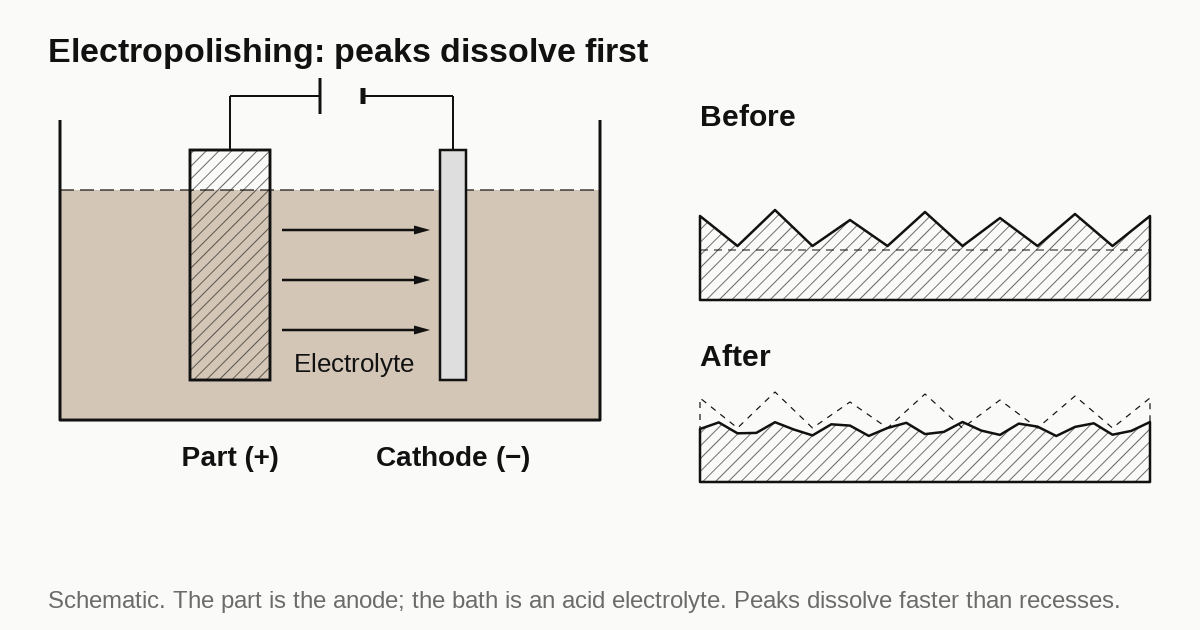
Electropolishing is an electrochemical process that removes a thin layer of metal from a part, levelling the micro-peaks on its surface and leaving it smoother and passivated. The part is the anode in an acid bath. It is a finishing option for stainless parts that must be easy to clean or free of burrs.
It is often confused with passivation, and the two do overlap. The passivation against electropolishing article compares them side by side. This page explains the process itself.
How the process works
Wikipedia describes a workpiece immersed in a temperature-controlled bath of electrolyte, where it serves as the anode. At the cathode a reduction reaction occurs, normally producing hydrogen. The electrolytes are most often concentrated acid mixtures such as sulphuric and phosphoric acid.
The levelling comes from one rule: the protruding parts of the surface profile dissolve faster than the recesses. Wikipedia calls this anodic levelling. Current density is higher at corners and burrs, so the same action deburrs small edges. Wikipedia adds that electropolishing is distinctly different from electrochemical machining.
In a laboratory study of stainless steels, the bath was a commercial sulphuric-phosphoric electrolyte run at a current density of 500 mA/cm² and 60 °C for 4 minutes. That is one laboratory setting, not a production recipe.
What it changes on the part
| Effect | What the sources say | Typical size | Source |
|---|---|---|---|
| Metal removed | A small amount from the surface, also removing small burrs or high spots | 20 to 40 µm deep on stainless (0.02 to 0.04 mm) | Wikipedia, unsourced figure |
| Surface roughness | Micro-peaks and valleys levelled | no figure given | Wikipedia |
| Passive film | Passivation occurs at the same time under proper operating conditions; free iron is removed | no figure given | ASTM B912 scope |
| Heat tint and oxide scale | Removed | no figure given | ASTM B912 scope |
| Inclusions | Chromium-poor segregations and non-metallic inclusions, especially manganese sulphides, dissolve | no figure given | Rokosz et al., 2020 |
| Residual stress and debris | Mechanical polishing can introduce cold deformation, residual stresses and debris; electropolishing does not | no figure given | Rokosz et al., 2020 |
Sources: Wikipedia, Electropolishing; DIN Media catalogue page for ASTM B912 (scope text); Rokosz et al., Materials (Basel), 2020. All opened 25 October 2026. The standard itself was not read.
Where it helps
- Cleanability and corrosion behaviour. Rokosz and co-authors report that most authors they review found electropolished steels had better corrosion properties than mechanically polished ones, with 316L the most studied alloy. Wikipedia lists food, medical, pharmaceutical and semiconductor work as users.
- Burrs and inaccessible areas. Wikipedia says the process can polish areas that are inaccessible by other polishing methods, and that the current concentrating at burrs deburrs them.
- Heat tint. B912 notes it also removes heat tint and oxide scale.
Where it does not help
Rokosz et al. cite a review by Ziemniak concluding that above about 450 °C in the presence of steam, mechanically polished surfaces resist corrosion better than electropolished ones. That is a niche, but it shows the result is not universal.
It also takes metal. Anything with a tight size has to be measured after the finish, or toleranced for it. A part electropolished to a tolerance that ignores 0.02 to 0.04 mm of removal can move out of size.
Wikipedia describes it as levelling micro-peaks and valleys, so treat it as a finish for the surface you machined, not as a repair for deep marks.
Need a quote for this part? Get a quote for your stainless parts
What the standards cover
Wikipedia lists ISO 15730 (electropolishing as a means of smoothing and passivating stainless steel), the ASME BPE standards for bioprocessing equipment, SEMI F19 for semiconductor applications and ASTM B912. B912 covers passivation of the 200, 300 and 400 series stainless alloys and the precipitation-hardened alloys by electropolishing, in SI units. Only the catalogue text of B912 was read here; the standards were not.
What to write on the print
Say the finish and then say what it applies to, because the shop cannot guess:
- The process. “Electropolish” with the specification the customer wants, such as ASTM B912 where passivation is the goal.
- Where. All surfaces, or named surfaces only.
- Sizes. Whether dimensions apply before or after electropolishing.
- Roughness. If a value is needed, give Ra and where it is measured. The surface finish article covers how to write it.
- Certificate. Whether you need one and what it must show.
Deburr and clean first. The deburring article covers the steps that come before the bath.
Closing: choose electropolishing for a reason
Choose electropolishing when the part has to be smooth, burr-free and easy to clean, and when the removal is accounted for in the tolerance. If all that is needed is free-iron removal, passivation alone may be enough. To have a drawing with an electropolishing note quoted by partner shops that cut stainless, send an RFQ. Then read passivation against electropolishing before you choose.
Sources
- Wikipedia, Electropolishing, process description, benefits and listed standards. Opened 25 October 2026.
- DIN Media, ASTM B 912, Standard Specification for Passivation of Stainless Steels Using Electropolishing, scope text. Opened 25 October 2026.
- Rokosz et al., Effect of Polishing on Electrochemical Behavior and Passive Layer Composition of Different Stainless Steels, Materials (Basel), 2020, via PubMed Central, inclusions, residual stress and the bath conditions of the laboratory study. Opened 25 October 2026.
Frequently asked questions
Is electropolishing the same as passivation?
No, but under ASTM B912 it can do the same job. That specification covers passivating stainless by electropolishing and notes that passivation happens at the same time as polishing when the process is run properly. Passivation alone removes free iron; electropolishing also levels the surface. The comparison article helps you choose.
How much metal does electropolishing take off?
Wikipedia gives a typical depth of 20 to 40 micrometres on stainless, a figure it does not source. That is 0.02 to 0.04 mm. The real amount depends on the finisher's bath, time and current, so ask for the value in writing and check it against any tight tolerance, thread or bore.
Can any stainless grade be electropolished?
ASTM B912 covers the 200, 300 and 400 series and the precipitation-hardened alloys, so the main families are in scope. It also notes that the quality of the result depends on the type of stainless, the electrolyte and the operating conditions. Ask the finisher about sulphur-bearing grades such as 303 before you commit.
Need a quote for this part?
Send the drawing. We read it, send one itemised quote within 24 business hours and place the work with a partner shop that cuts stainless.
Get a quote for your stainless partsFigures in this guide are published specification limits or published typical values for the alloy, not measurements of any part. Machinability is rated against free-machining carbon steel B1112 at 100 and PREN is chromium plus 3.3 times molybdenum plus 16 times nitrogen. The conventions are set out in thereference section and the editorial standards.