Passivation of stainless steel: what the passive layer is and what the bath does
November 21, 2026
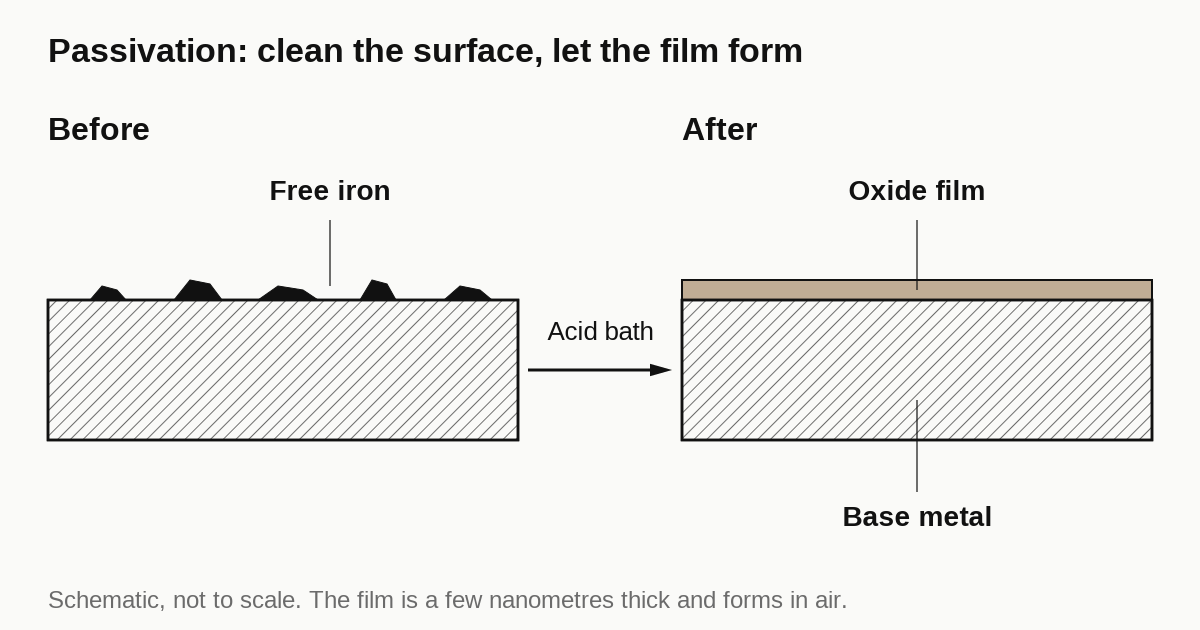
Passivation is a chemical treatment that cleans free iron off stainless steel so its own protective oxide film can form evenly. It adds nothing to the part, and SSINA says it does not alter critically dimensioned parts.
The word causes arguments because it names two things. One is the film that every stainless part carries. The other is the shop step that protects that film. This page keeps them apart. If you need the choice of acid, the citric against nitric comparison covers it.
The passive layer in one paragraph
SSINA, the US association of specialty steel producers, describes an extremely thin, transparent film on the surface of stainless steel that is tenacious, uniform and stable. That film is why stainless resists corrosion. It forms by itself, and repairs itself if damaged, in air because of the oxygen present, or in solutions that carry enough oxygen or other oxidising elements. SSINA adds that the basic passivation treatment for stainless steel is simply exposure of a clean surface to air.
The film is thin. In one 2020 laboratory study that profiled the surface of four stainless steels with X-ray photoelectron spectroscopy, the film on a mechanically polished 18Cr21Mn2NiN sample measured close to 6 nm. That is a figure for one alloy in one test, not a spec for your grade. The point is scale: the film is a few nanometres thick, far below any drawing tolerance.
Why a machined part needs help
A clean surface repairs itself. A contaminated one may not. Cutting tools, fixtures, grinding media and steel brushes can leave particles of iron on the part. Iron that is in contact with the stainless can rust and stain the surface, and the buyer then suspects the wrong grade.
ASTM A967, the passivation specification, names this contamination “free iron”. Its scope defines free iron as iron present on the surface, including iron contamination, iron tool marks, residual iron salts from pickling solutions, iron dust, embedded iron and iron oxide. The tests in the specification are written to confirm that free iron and other foreign matter are gone.
What the bath does
Two points from the sources matter more than the chemistry:
- It accelerates film formation on a clean surface. The A967 abstract says a chemical treatment is applied that will accelerate the formation of the passive film on a chemically clean stainless steel surface.
- It is a rinse-controlled, surface-only step. The parts are rinsed straight after the bath so the reaction stops. SSINA says nitric acid does not corrode stainless steel and does not alter critically dimensioned parts, which is why passivation is not a tolerance risk.
The specification covers three routes: immersion in nitric acid solutions, immersion in citric acid solution and electrochemical treatment. SSINA describes only the nitric route. Its standard bath is 10 to 15 percent nitric acid by volume in water, with an immersion time of about 30 minutes followed by a thorough water wash.
| Stainless series | Nitric acid, % by volume | Bath temperature | Time | Source |
|---|---|---|---|---|
| 300 series (austenitic), immersion | 10 to 15 | 65 °C (150 °F) | about 30 minutes | SSINA |
| 400 series (plain chromium), immersion | 10 to 15 | 50 °C (120 °F) | about 30 minutes | SSINA |
| 300 series, cold swabbing | 15 | 20 to 25 °C (65 to 80 °F) | 30 to 90 minutes | SSINA |
| Ferritic 400 series, cold swabbing | 12 | 20 to 25 °C (65 to 80 °F) | 30 to 45 minutes | SSINA |
Source: SSINA, Passivation, opened 25 October 2026. These are the general bath figures SSINA publishes, not the A967 method tables, which were not read. A finisher works to its own qualified process, so use the table to read a process sheet, not to write one.
What passivation does not do
- It does not remove heat tint. SSINA says nitric acid passivation will not remove heat tint. Scale and tint come off in an earlier step.
- It does not make a poor grade a good one. A967 states that it makes no recommendation about the suitability of any grade, treatment or acceptance criterion for an application. The grade choice is yours, and the grade selection guide is the place to start.
- It does not fix a dirty part. The abstract assumes a chemically clean surface, so oil and cutting fluid have to be cleaned off first.
Need a quote for this part? Get a quote for your stainless parts
How a lot is checked
The A967 abstract lists acceptance on two levels. First, a visual check: the passivated parts should show a chemically clean surface and no etching, pitting or frosting. Second, tests on each lot, from the list of water immersion, high humidity, salt spray, copper sulfate and potassium ferricyanide-nitric acid, with a separate free iron test. The standard also describes a damp cloth test and a boiling water immersion test.
The tests differ in severity and in which grades they suit, so name one on the print. The passivation test methods article compares them. Note that the catalogue copy we opened is the 2017 edition, which the catalogue marks as cancelled. The current revision was not read, so check which edition your customer calls out.
What to write on the print
One line is enough, and it should carry four things: the specification, the method, the acceptance test and the certificate.
Passivate per ASTM A967, [citric or nitric] method as agreed. Acceptance test per [named test]. Certificate with lot number required.
Fill the brackets before the drawing goes out. A bare word “passivate” lets each shop choose a different bath and a different test, and the certificates cannot be compared. If the part will also be electropolished, passivation against electropolishing explains why one step may cover both.
Closing: ask for it before you quote
Passivation costs a line on the RFQ and a lot test, not a redesign. Decide the method, the test and the certificate first, then ask for quotes. To have a drawing with a passivation note quoted by partner shops that cut stainless, send an RFQ. For the acid choice on your grade, read citric against nitric passivation first.
Sources
- SSINA, Passivation, film description, nitric bath figures, limits of the treatment. Opened 25 October 2026.
- AFNOR Editions, ASTM A967/A967M-17 catalogue page, abstract and scope text. The standard itself was not read and this edition is marked cancelled. Opened 25 October 2026.
- Rokosz et al., Effect of Polishing on Electrochemical Behavior and Passive Layer Composition of Different Stainless Steels, Materials (Basel), 2020, via PubMed Central, passive layer thickness by XPS. Opened 25 October 2026.
Frequently asked questions
Is passivation a coating?
No. Nothing is added to the part. The stainless already forms a thin transparent oxide film on its own in air. The bath removes free iron and other contamination left by machining so that film can form evenly. SSINA also notes that nitric acid does not alter critically dimensioned parts, so it is not treated as a dimensional step.
Does every machined stainless part need passivation?
No. It is a choice made per part. It matters most on freshly machined surfaces that will meet moisture, chloride or a customer audit, because tool steel and fixtures can leave iron behind. If the print does not call it out, the shop will not do it, so decide before the RFQ.
Does passivation remove heat tint or scale?
Not as a rule. SSINA states that nitric acid passivation will not remove heat tint, and the ASTM A967 abstract describes the treatment as acting on a chemically clean surface. Heat tint and scale are removed first by pickling, blasting or another step, then the part is passivated.
Need a quote for this part?
Send the drawing. We read it, send one itemised quote within 24 business hours and place the work with a partner shop that cuts stainless.
Get a quote for your stainless partsFigures in this guide are published specification limits or published typical values for the alloy, not measurements of any part. Machinability is rated against free-machining carbon steel B1112 at 100 and PREN is chromium plus 3.3 times molybdenum plus 16 times nitrogen. The conventions are set out in thereference section and the editorial standards.