How the stainless alloy surcharge sets the material line on a machined part quote
November 2, 2026
The alloy surcharge is the reason a stainless bar quote has a shelf life. Mills sell stainless on a base price plus a monthly surcharge that follows what nickel, chromium and molybdenum cost that month. A machined part made from 316L bar carries that surcharge inside its material line, so a part quoted in September can cost more or less to make in November without anyone changing the drawing.
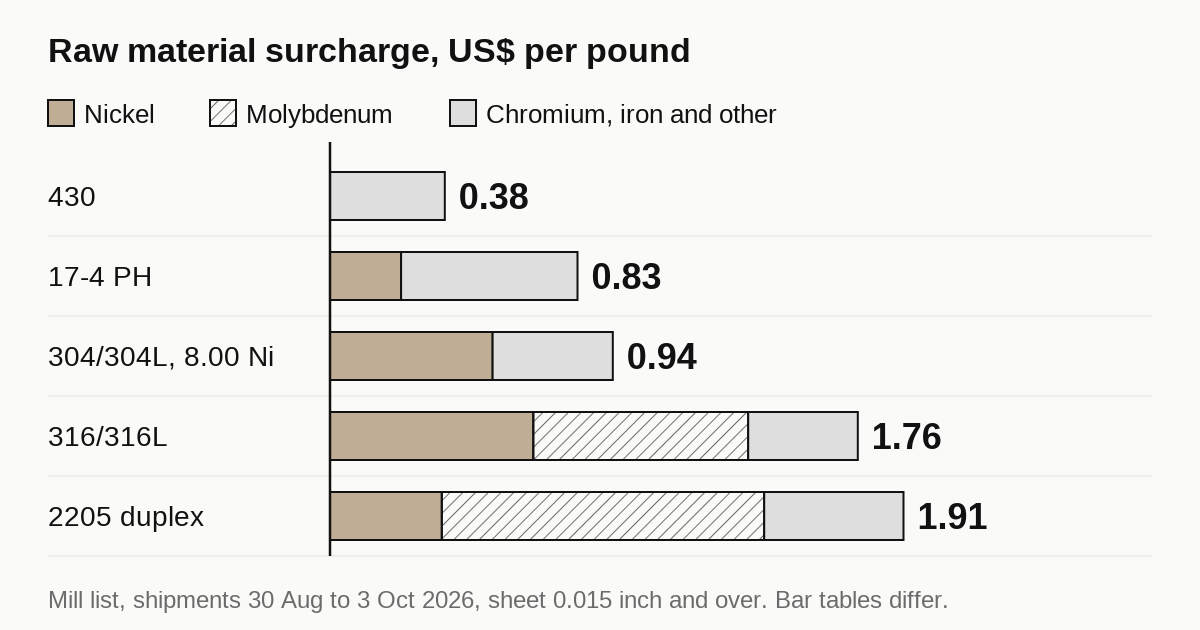
This guide shows what is inside the surcharge, how far it differs between 304, 316L, 2205 and 17-4 PH, and how to ask a shop to price it so that two quotes can be compared. It builds on the stainless machining cost drivers guide, where material is one of several lines.
How a mill builds the price
Outokumpu, a large European stainless producer, describes the total price as a base price, extras and the alloy surcharge. The base price is negotiated with each customer and kept apart from volatile alloy costs. Extras cover dimensions that are not standard. The surcharge is, in the mill’s words, an instrument to pass on changes in alloy costs along the value chain.
Three points from that description matter to a buyer:
- The surcharge is product specific. Alloy content differs between grades, so each grade has its own figure.
- Monthly averaging is the industry standard. The surcharge reflects average alloy cost over a fixed period before delivery, and mills usually publish it month by month.
- Calculation periods can differ. Two mills can quote the same grade on the same day with different reference periods.
The page that describes the surcharge names no formula and no element prices, so the table in the next section is the better guide to what drives the number.
What is inside the number
Cleveland-Cliffs publishes its stainless surcharge as a table of reference prices and a per-pound amount for each element in each grade. The table below is taken from its list for shipments from 30 August to 3 October 2026. It lists the surcharge by sheet thickness and the figures below use the 0.015 inch and thicker column, so treat them as directional for bar, which bar producers price on their own tables.
| Grade | Nickel line, $/lb | Molybdenum line, $/lb | Total surcharge, $/lb | Total, $/kg |
|---|---|---|---|---|
| 430 | none | none | 0.3828 | 0.84 |
| 17-4 PH | 0.2371 | none | 0.8252 | 1.82 |
| 304 or 304L, 8.00 Ni | 0.5420 | none | 0.9427 | 2.08 |
| 316 or 316L | 0.6776 | 0.7164 | 1.7594 | 3.88 |
| 2205 | 0.3727 | 1.0746 | 1.9115 | 4.21 |
The dollar per kilogram column is the per-pound figure multiplied by 2.2046. The same table shows the reference prices it applies: nickel at $7.6463 per pound, which is about $16,860 per tonne, and molybdenum at $32.8493 per pound. These are that mill’s reference rates, not an LME quote.
Three readings follow from the table:
- Nickel and molybdenum drive the gap between grades. In the 304 line, nickel is about 57 percent of the surcharge. In the 316 line, nickel and molybdenum together are about 79 percent.
- 316L costs nearly twice the surcharge of 304. The ratio is 1.87, and 2205 is about 2.03 times 304.
- Small spec choices move the number. The same table lists 304 by nickel content. At 8.00 percent nickel the surcharge is $0.9427 per pound, and at 9.50 percent it is $1.0422, about 11 percent more. A 316L with a molybdenum minimum of 2.75 percent is listed at $2.0637, about 17 percent above the standard 316L figure. If the drawing does not need the tighter chemistry, do not write it.
How big the swing can be
Nickel is the volatile input. In 2020 the LME three-month nickel price fell to a 15-month low of $10,865 per tonne in late March and reached $15,810 per tonne in early August, according to Eurometal. In September and October 2020, Outokumpu’s European surcharge for 304 flat product reached 1,462 euros per tonne for October, up 92 euros on September, and its 316 figure reached 2,066 euros per tonne for September, up 153 euros.
A worked illustration, using the Cliffs table and a simple assumption, shows what that means for an order. Take 8,000 kg of bar blanks for 20,000 parts at 0.4 kg each.
| Item | 304 | 316L |
|---|---|---|
| Surcharge per kg | $2.08 | $3.88 |
| Surcharge on 8,000 kg | about $16,600 | about $31,000 |
| Nickel line up 20 percent, per kg | +$0.24 | +$0.30 |
| Added cost on 8,000 kg | about $1,900 | about $2,400 |
The last two rows assume the nickel line moves in proportion to the nickel reference price. The table’s layout, a reference rate and a per-pound amount for each element, suggests that, but the mill’s formula is the authority. The point of the illustration is the scale: a 20 percent nickel move adds a few percent to the surcharge and a smaller share of the part price, but it is real money on a long order and it is invisible if the quote does not show the material line.
Need a quote for this part? Get a quote for your stainless parts
How the surcharge reaches your quote
A shop buys bar at the surcharge that applies to the shipment period. Your quote then covers that cost in one of three common ways:
- Fixed price with a validity date. The shop carries the risk until the date and prices some buffer into the quote. A short validity window usually means the shop wants to limit that risk.
- Material line indexed to the surcharge. The part price moves up or down with a named table at the purchase date. This is the cleanest for both sides on a long program.
- Price subject to material at order date. The shop re-quotes if the surcharge has moved by more than an agreed amount.
No public survey shows which of these shops use most, and none shows how much buffer a fixed price carries. Ask each shop which method it uses and compare quotes on the same basis. A quote with no validity date and no material statement leaves you guessing which it is.
What to do about it
- Write the grade and nothing tighter than needed. Name 316L and the specification, and add a molybdenum or nickel minimum only if the application requires it. See ASTM A276 against A479 for the bar specification choice.
- State the quantity and the release schedule. Material bought for one release is priced at one month’s surcharge, and a year of releases is priced at twelve. A blanket order with a material clause is easier to compare than twelve separate quotes.
- Ask for the material line. The weight of bar per part, the price per kilogram and the surcharge basis make quotes comparable. The RFQ checklist lists what else to include.
- Check the certificate against what was quoted. The mill test certificate guide shows where the chemistry sits, which is also where a nickel or molybdenum difference would show.
- Consider the form. Bar against plate changes how much material ends up as chips, and chips carry the same surcharge per kilogram. The bar against plate comparison covers that.
For how the material line fits into a full quote, read our guide to a stainless steel machining quote.
If you want quotes on the same basis from several shops, send the drawing through the RFQ form and state the quantity and release schedule. We send one itemised quote within 24 business hours and place the work with partner shops that cut stainless.
Sources
- Cleveland-Cliffs stainless steel raw material surcharges, shipments 30 August to 3 October 2026, producer price list
- Outokumpu, alloy surcharges, how the mill describes the surcharge
- Eurometal, European stainless 304 alloy surcharges hit 10-month high for October (2020), trade press for the 2020 nickel and surcharge figures
Grade figures are one producer’s published values for sheet thickness 0.015 inch and over in one shipment window. They change monthly and differ between producers and product forms.
Frequently asked questions
What is a stainless steel alloy surcharge?
It is a variable add-on to the mill's base price that passes through the market cost of alloying elements, mainly nickel, chromium and molybdenum. Mills publish it per grade, usually month by month. The base price is negotiated; the surcharge follows the published table for the shipment period.
Why is the surcharge on 316L higher than on 304?
316L carries molybdenum and more nickel. In one mill's September 2026 table, nickel and molybdenum together make up about 79 percent of the 316 surcharge, against nickel alone at about 57 percent of the 304 surcharge. Molybdenum is the line that 304 does not have.
How often does the alloy surcharge change?
Monthly is the industry norm. Outokumpu describes monthly averaging as the standard and says surcharges are usually published month by month. Some mills publish a date window instead, for example shipments from 30 August to 3 October 2026 on one US table.
How do I protect a part price from a nickel spike?
Ask how the shop handles material: a fixed price with a stated validity, or a material line indexed to a published surcharge on the purchase date. Compare quotes on the same basis, and place long orders as a blanket order with a stated material price clause.
Need a quote for this part?
Send the drawing. We read it, send one itemised quote within 24 business hours and place the work with a partner shop that cuts stainless.
Get a quote for your stainless partsFigures in this guide are published specification limits or published typical values for the alloy, not measurements of any part. Machinability is rated against free-machining carbon steel B1112 at 100 and PREN is chromium plus 3.3 times molybdenum plus 16 times nitrogen. The conventions are set out in thereference section and the editorial standards.