Swiss turning stainless: which small parts belong on a sliding headstock lathe
October 28, 2026
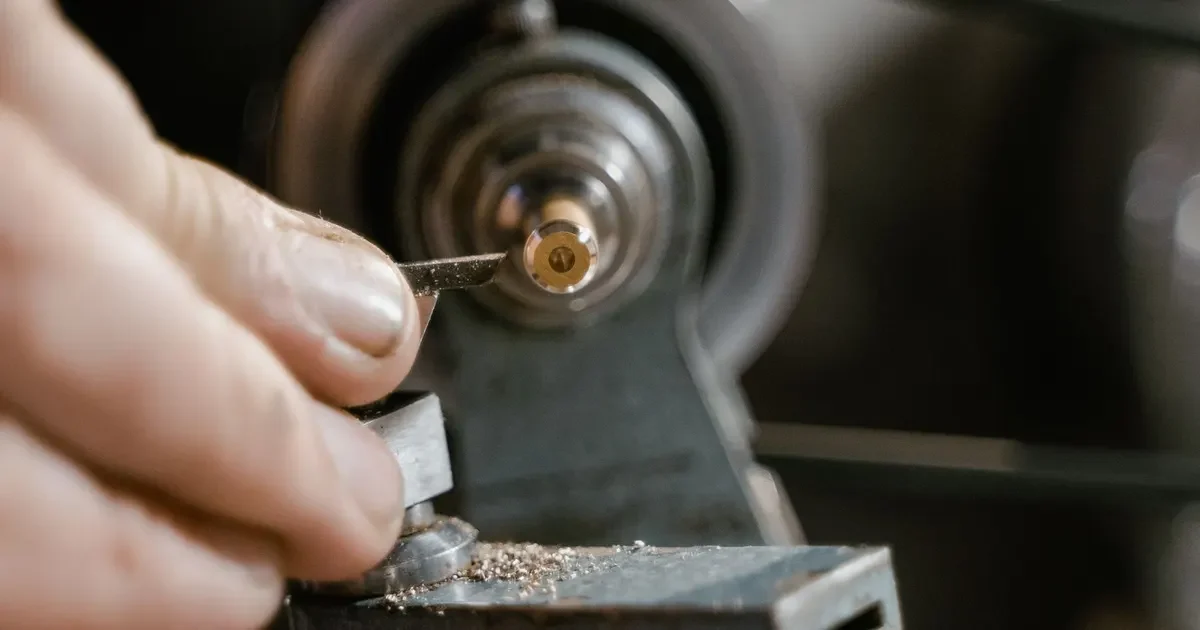
A Swiss-type lathe holds the bar in a sliding headstock and feeds it through a guide bushing, so the tool always cuts a few millimetres from the point of support. That one difference is why a 3 mm pin ten times longer than its diameter can hold a few micrometres of size on a Swiss machine and chatter itself apart on a conventional lathe.
This guide covers where Swiss turning earns its place in stainless work, how 303 and 316L behave on it, and what a buyer should state on the drawing and the quote request so the shop starts with the right bar and the right expectations. It is written for the buyer side of the table. Cutting speeds and tool geometry belong to the shop.
When a Swiss lathe is the right machine
Swiss turning is a good fit when most of these are true:
- The part is round or mostly round, with a maximum diameter of about 32 mm.
- The length is large compared with the diameter, often ten times or more.
- The part needs several operations at once, such as turning, cross drilling, milling a flat and threading, in one clamping.
- The quantity is in the hundreds to hundreds of thousands, because setup is slow and cycle time is short.
Typical stainless examples are bone screw blanks, dental and surgical pins, fluid connector bodies, sensor housings, pivot shafts, valve stems and electronic pins. A one-off prototype is rarely worth a Swiss setup. The prototype versus production guide explains where the break point sits.
A part with a large head and a thin stem can still run on a Swiss machine, but the head diameter sets the bar size and most of the bar becomes chips. Material cost per part rises quickly in stainless, so ask the shop whether a head-and-stem part is cheaper as a Swiss part or as a conventional turned part.
303 and 316L on the same machine
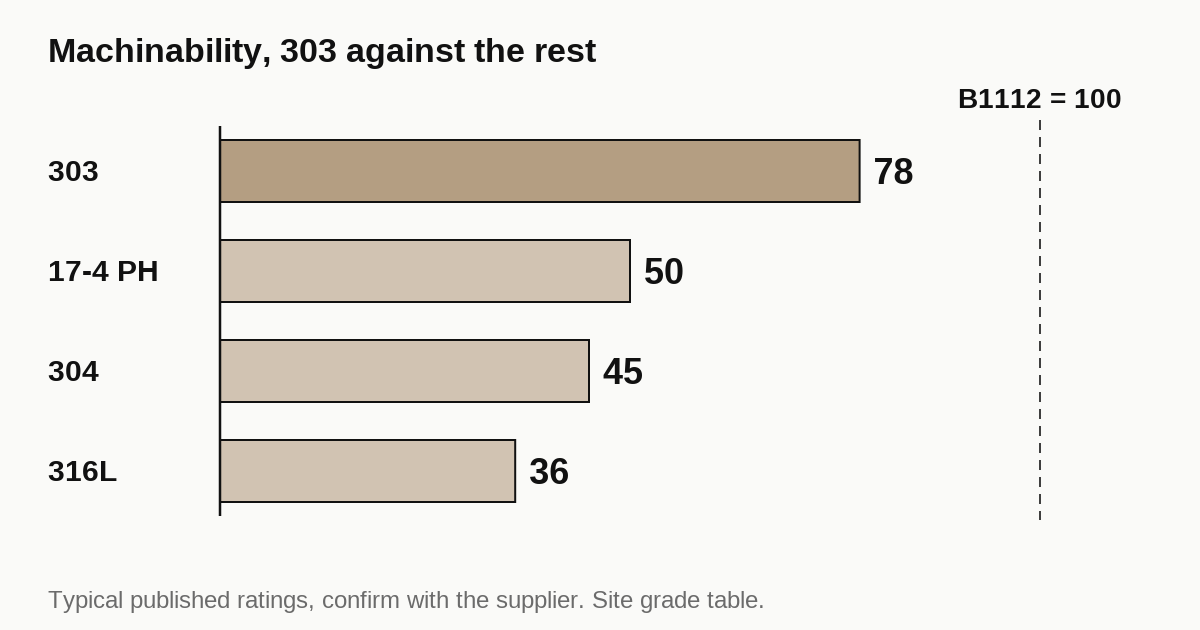
The two grades split the Swiss stainless market. The table shows published ratings from the site grade table and the usual consequences on a sliding headstock machine.
| 303 | 316L | |
|---|---|---|
| Machinability (B1112 = 100) | 78 | 36 |
| PREN, typical | 18 | 24 |
| Chip form | Short, breaks easily | Long and stringy unless chip breaking is set up well |
| Typical cycle time against 303 | 1.0 | 1.6 to 2.5 |
| Passivation and polish | Sulfide inclusions limit both | Cleaner surface, takes electropolish well |
| Weldable | No | Yes |
| Fits | Dry indoor parts, screw machine work | Wet, saline or cleaned parts, medical and food contact |
Treat the cycle time ratio as a planning range, not a quote. It moves with geometry and with how well the shop has tuned the 316L program.
303 owes its speed to added sulfur. The sulfide stringers break the chip but also act as starting points for pitting, which is why 303 should stay out of chloride service and out of anything that needs a polished or electropolished surface. The 303 against 304 and 316L guide covers that trade in detail.
316L on a Swiss machine is a different job. The chip does not want to break, and a long stringy chip wraps around the bar or the tool and spoils the surface or the next part. Shops that run 316L daily use high pressure coolant through the tool holder, chip breaking tool geometry and pecking cycles on drilled holes. A shop that does this routinely will quote it without drama. A shop that mostly runs brass and 303 will quote it high or run it badly.
Bar stock decides half the result
On a conventional lathe the chuck grips whatever bar you give it. On a Swiss machine the bar passes through a guide bushing with a running clearance of only a few hundredths of a millimetre. Three consequences follow.
Diameter tolerance. Swiss shops buy ground or precision drawn bar, often in an h9 or tighter tolerance, and select the bushing for that bar. If the drawing or purchase order forces a hot rolled bar to be turned down before use, you pay for an extra operation.
Straightness and surface. A bent bar whips inside the bushing and leaves a spiral mark. Scale or pits on the bar surface damage the bushing and the bar finish transfers to the part.
Chemistry within the grade. Free-machining 303 varies in sulfur content between mills, and the same drawing can cut differently between heats. Say so if the part needs a narrow range. For 316L the usual question is whether low sulfur or standard chemistry is wanted, and whether the bar is melted for a medical application. The food contact grades guide shows how much the choice of chemistry matters when a part touches product.
If your part needs a specific bar standard, such as ASTM A276 or A479 for stainless bar, name it on the drawing. Shops will otherwise order what is in stock.
Tolerances that Swiss turning holds easily
Swiss machines hold tighter diameters than most buyers expect, because the cut happens at the guide bushing where the bar cannot deflect. Typical figures for 303 and 316L in a stable process:
| Feature | Typical achievable | Where cost rises |
|---|---|---|
| Turned diameter | ±0.01 mm | ±0.005 mm and below needs gauging and often grinding |
| Length | ±0.05 mm | Tighter needs part-off and facing controls |
| Concentricity between diameters | 0.01 to 0.02 mm | Features turned in a second operation lose it |
| Surface finish, turned | Ra 0.8 to 1.6 µm | Ra 0.4 µm needs tuning or a polishing step |
| Cross hole position | ±0.03 mm | Depends on live tool rigidity |
These are published typical values for the process. A shop will confirm them against your drawing. For what each tolerance step costs on stainless in general, the tolerance guide puts numbers on it.
Do not copy a tight diameter tolerance onto every dimension. Give the functional diameter the tight band and leave the rest to a general note such as ISO 2768-m. Swiss machines hold a lot, but each extra tight dimension adds gauging time.
Need a quote for this part? Get a quote for your stainless parts
What to put on the drawing and in the RFQ
A short, complete request gets better quotes than a long, vague one. Include:
- Grade and bar standard, for example 316L to ASTM A276, with the certificate level you need.
- Annual quantity and the size of each release, because setup cost is spread over the batch.
- Which dimensions are critical, marked on the drawing.
- Surface requirement per ISO 1302, and whether the part will be passivated or electropolished afterwards.
- Edge condition on cross holes and shoulders. Burrs inside a 1 mm cross hole are the most common Swiss quality complaint.
- Packaging. Small stainless parts scratch each other, so say whether they ship loose, in bags or in trays.
The RFQ checklist gives the wider list.
Burrs, cleaning and the work after the lathe
A Swiss part comes off the machine in seconds and goes straight into the next process, so what happens after matters. Cross holes and the part-off face need deburring, and on 316L the burr is tough and sometimes needs brushing or electrochemical work. Decide early whether passivation or electropolish follows, because the passivation versus electropolishing guide shows they leave different surfaces, and a Swiss part with threads or fine features can be damaged by the wrong one.
Lot size and economics
Swiss setups are slow. A new part can take a shift or more to set up, prove out and run to a first approved piece, and the machine stands still while that happens. The price per part therefore depends heavily on how many pieces share one setup. A shop that quotes 5,000 pieces at a fair unit price may quote 500 pieces at nearly double, because the same setup is spread over a tenth of the parts.
Three things help a buyer get a sharper quote:
- Give the annual volume as well as the first order. Shops price a part differently when they know it repeats. A repeat part keeps its program, its tooling and its proven offsets, and the second run costs far less to start.
- Say how often you will release. Four releases of 250 pieces cost more than one release of 1,000 because each release triggers a new setup.
- Allow some flexibility on delivery. A shop can slot a stainless job between longer runs if the date is not fixed to the day, which often lowers the price.
Material is a large share of the cost on small stainless parts. A head-and-stem part cut from oversize bar wastes most of the bar as chips, so ask whether a smaller bar and a different sequence would work. Some shops quote the same part at two bar sizes so you can see the trade.
Common problems on Swiss stainless parts
Buyers who have received a bad lot of Swiss parts usually trace it to one of a short list of causes.
Stringy chips marking the surface. On 316L a chip that does not break can wrap around the bar and scratch the finished diameter. The cure is process development on the shop’s side, so ask how they control chips on this grade.
Taper and size drift. A guide bushing wears, and the bar diameter varies from one bar to the next, so the part size drifts across a long run. Good shops gauge at intervals and correct offsets. Ask how often they check and what they record.
Burrs in cross holes. Cross drilled holes are the most common complaint. Specify the deburring method and mark which holes matter.
Surface scratches from the bar feeder. Stainless marks easily, so bar quality and bar handling both count.
Slight bends after part-off. Long thin parts can bow when they drop into the catcher. State the straightness requirement if it matters.
None of these is a reason to avoid Swiss turning. They are reasons to ask the shop how it prevents each one before the first order.
Checklist before you send the drawing
- The part fits within about 32 mm diameter and is long enough to benefit.
- You have named the grade and the bar standard.
- Critical dimensions are marked and the rest sit under a general tolerance.
- Quantity and release size are stated.
- Post-process finish, deburring and packaging are written down.
If you send the drawing through the RFQ form, we send one itemised quote within 24 business hours and place the work with partner shops that cut stainless on sliding headstock machines.
Frequently asked questions
What diameter range does Swiss turning cover?
Most sliding headstock machines take bar from about 1 mm up to 20, 25 or 32 mm, with a few larger frames reaching about 38 mm. Above that range a conventional CNC lathe with a steady rest is usually the cheaper route. Confirm the real limit with the shop, because the bar capacity of the machine is only one part of the answer.
Is 303 or 316L better for Swiss turned parts?
303 cuts far faster and gives cleaner chips, so it is the economical choice for dry, indoor or mild service. 316L resists chloride and cleaning chemicals much better but cuts slowly and produces stringy chips. Pick on the service environment first and accept the cycle time that comes with the grade.
Why does bar quality matter more on a Swiss lathe?
The bar runs through a guide bushing with a few hundredths of a millimetre of clearance. Bar that is out of round, bent or oversize either jams in the bushing or lets the part wander. Ground or precision drawn bar in a tight diameter tolerance is the normal starting point.
Need a quote for this part?
Send the drawing. We read it, send one itemised quote within 24 business hours and place the work with a partner shop that cuts stainless.
Get a quote for your stainless partsFigures in this guide are published specification limits or published typical values for the alloy, not measurements of any part. Machinability is rated against free-machining carbon steel B1112 at 100 and PREN is chromium plus 3.3 times molybdenum plus 16 times nitrogen. The conventions are set out in thereference section and the editorial standards.