Wire EDM against milling for stainless parts: where each one wins
October 29, 2026
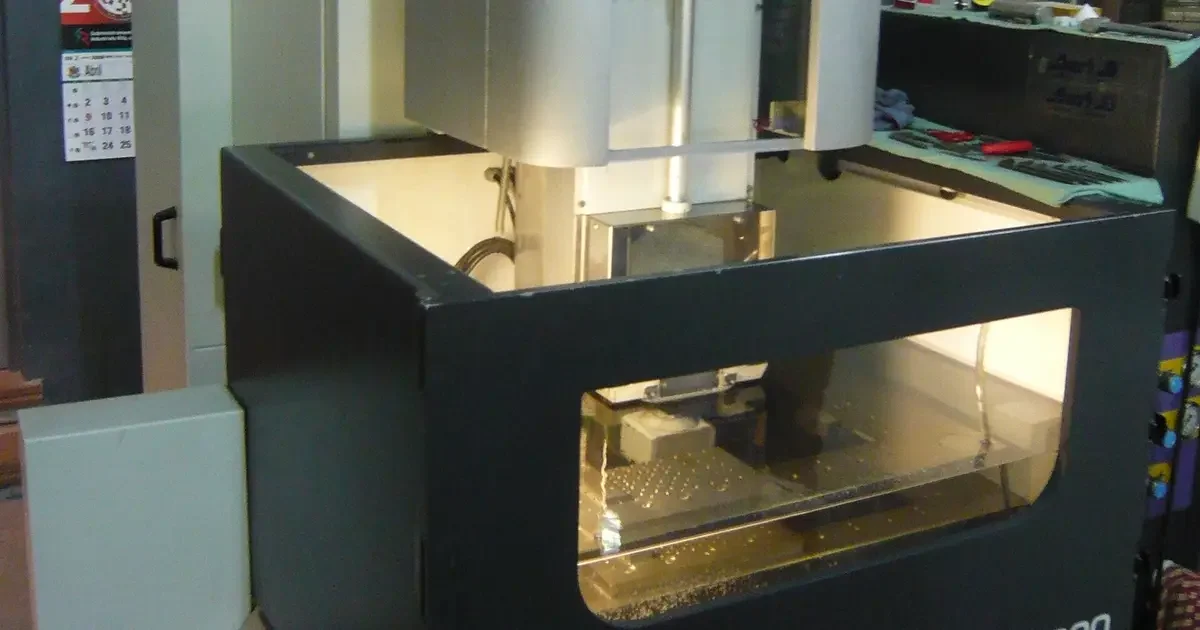
Wire EDM cuts metal with electrical sparks between a thin brass wire and the part, both submerged in deionised water. There is no cutting force, no tool wear on the part geometry and no work hardening of the cut face. For stainless steel, which punishes milling cutters with work hardening and heat, those are real advantages. They come at a price in time, in surface condition and in what shapes the process can make.
This guide is for buyers deciding whether a stainless part should be milled, wire cut or both. It shows the cases where wire EDM wins, the quality points to specify and the cost logic.
How wire EDM works, in one paragraph
A wire, typically brass and 0.25 mm in diameter, runs continuously through the part from top to bottom. A power supply pulses voltage between wire and part, and each spark melts and vaporises a tiny amount of metal. The deionised water flushes debris and cools the cut. The machine moves the part or the wire guides along a programmed path, so any profile that can be cut through the full thickness is possible. A start hole is needed for internal features. The wire is used once and discarded, and a full cut can be followed by one or more skim cuts at lower energy to improve size and finish.
Where wire EDM beats milling on stainless
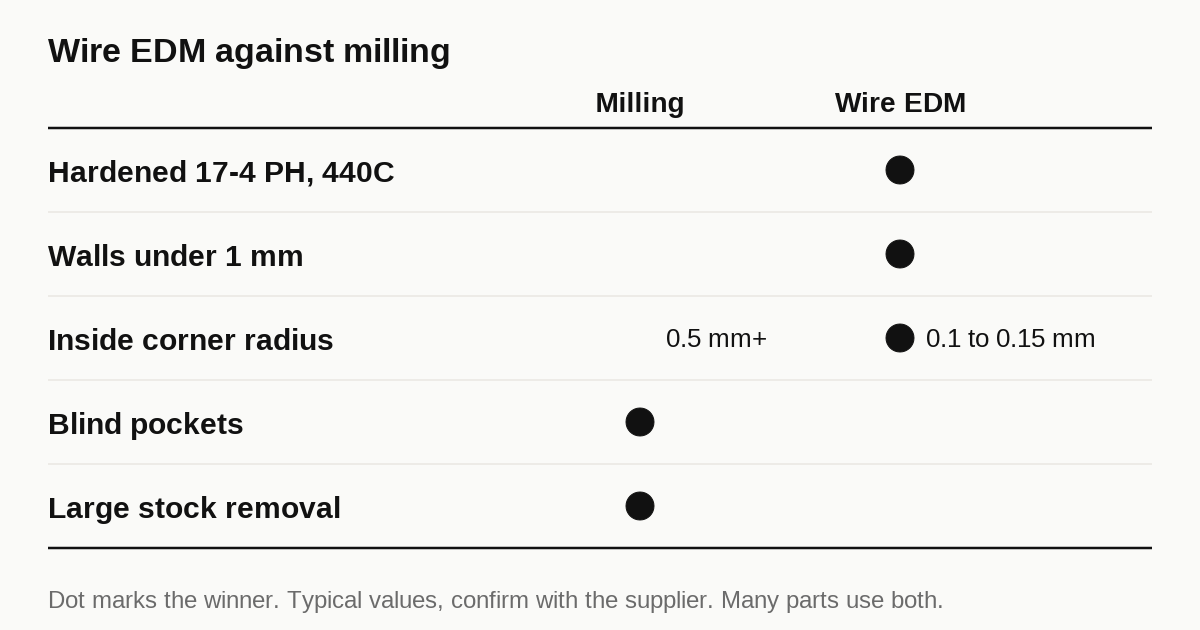
Hardened grades. A 17-4 PH part in the H900 condition or a hardened 440C part is difficult to mill. Wire EDM does not care about hardness, so the part can be heat treated first and cut afterwards. That avoids distortion from heat treatment after machining.
Thin walls and delicate features. Milling cutters push on the part. A 0.5 mm wall in stainless deflects and chatters. Wire EDM has no side force, so thin ribs, fine slots and narrow bridges cut cleanly.
Small inside corners. A milling cutter leaves an inside radius at least as big as its own radius. Wire EDM leaves a radius close to the wire radius plus the spark gap, typically 0.1 to 0.15 mm for a standard wire. A square-looking pocket in a part for a keyed fit is a typical case.
Tight profile tolerances. With skim cuts, wire EDM holds profile tolerance of ±0.005 mm and often better, and it repeats from part to part. For a tolerance this tight on stainless, milling needs several finishing passes and probing.
Stacks of identical thin parts. Thin sheets can be stacked and cut as one block, which cuts the cost per part in half or better.
Extrusion dies, gears, spline broaches and tool parts. These shapes cut through, have tight profile requirements and use hard steel.
Where milling still wins
- Soft stainless with simple geometry. A pocket in 304 or 316L cuts faster by milling.
- Blind features. Wire EDM cuts through. Blind pockets, steps and sloped bottoms need milling or sinker EDM.
- Large material removal. Wire EDM cuts a narrow kerf, so removing a lot of stock is slow. A common route is to mill most of the shape and use wire only for the critical contour.
- Short deadlines at low volume. Wire EDM setup, threading and skim cuts take time, and the deionised water system limits some shop schedules.
- Fine surface requirements without extra work. Raw rough cut wire surface is matt grey and rough.
The recast layer: what a buyer should know
Every spark leaves a thin layer of melted and re-solidified metal on the cut surface. Under it, a heat affected zone is mildly softened or hardened. For stainless, the recast layer typically has these features:
- It is a few micrometres thick on a rough cut and under 1 to 2 µm after good skim cuts.
- It can contain microcracks and a thin oxide.
- It carries traces of brass from the wire, mostly copper and zinc, which can sit on the surface.
- It has different corrosion behaviour from the base metal, so a passivation step after wire EDM is common.
For static, dry parts none of this matters. For parts under cyclic load such as springs, blades and surgical instruments, microcracks can start fatigue. For parts in chlorides or in contact with food or body fluids, the surface has to be passivated or electropolished. The passivation versus electropolishing guide shows what each does. A common drawing note is: wire EDM surfaces to be skim cut and electropolished, recast layer removed.
Typical results
The table lists typical figures for stainless on a modern wire machine. Confirm against your part with the shop.
| Item | Rough cut | With 2 to 3 skim cuts |
|---|---|---|
| Profile tolerance | ±0.02 mm | ±0.005 mm or better |
| Surface finish | Ra 1.6 to 3.2 µm | Ra 0.2 to 0.8 µm |
| Corner radius | 0.15 to 0.2 mm | 0.1 to 0.15 mm |
| Cutting speed index | 1 (fast) | 0.25 to 0.4 of rough cut time added |
| Typical thickness | 1 to 200 mm | Same |
Skim cuts add time but the surface and size improve. That is why the drawing should state the required finish rather than leaving it open.
Need a quote for this part? Get a quote for your stainless parts
What drives the price
Shops price wire EDM mostly by cut length and thickness, plus setup and finishing.
- Cut length times thickness. The cut area per hour is roughly constant, so doubling thickness doubles time.
- Number of skim cuts. Each extra cut adds 30 to 50 percent of the rough cut time.
- Number of start holes and threads. Each internal contour needs a start hole, and each one needs the wire threaded again.
- Material. Stainless cuts a little slower than carbon steel because of its chromium and nickel content.
- Fixturing. Thin or stacked parts need clamps that do not obstruct the wire path.
- Finishing. Passivation, deburring and inspection come after.
Compare with the stainless milling cost factors in the cost drivers guide. The comparison is not simply cheaper or dearer. A part that needs two milling operations, a heat treatment, a re-fixture and a grinding pass may cost more than a single wire cut.
A common combined route
Many stainless parts use both processes. The shop rough mills the outline, drills the start holes and heat treats a precipitation hardening grade. The part then goes to the wire EDM machine for the critical profiles. A final grinding or electropolish step finishes the surface.
For that route, the drawing should show the condition at which wire cutting happens. For 17-4 PH, cutting after aging avoids distortion, but the machine must cut hard material. Cutting before aging is easier but the part will shrink slightly during aging, so the cut dimensions need an allowance. The 17-4 PH guide explains the aging step.
What to put in the RFQ for wire EDM work
- Grade, bar or plate standard and thickness.
- Which profiles are wire cut and which are milled.
- Profile tolerance on the wire cut features and the surface finish needed.
- Whether a recast layer is acceptable, and the finishing step if it is not.
- Condition of the material at the time of cutting, for hardening grades.
- Quantity, because stacking and multi-part setups reduce cost.
The RFQ checklist has the wider list of information that makes a quote accurate.
Stainless-specific points
A few behaviours are particular to stainless on a wire machine.
Oxide and heat tint on the cut face. The sparks leave a thin dark oxide on the cut surface, which is not the same as the passive film. A light chemical clean or passivation brings the surface back to a clean, protective state, and the citric versus nitric guide explains which acid suits which grade.
Stress release. Cutting a profile out of a plate releases residual stress, and thin parts can move after they are cut free. Where flatness matters, leave a tab until the last cut, or specify a stress relief before cutting. Hardened parts are especially prone to movement.
Thickness and flushing. Very thick sections need good flushing to clear debris from the kerf. Cut speed falls and accuracy suffers when flushing is poor, so ask for the thickest feature in the part when requesting a quote.
Wire marks and taper. A rough cut can leave faint wire marks and a slight taper over a tall cut. Skim cuts remove most of both. If a straight, square wall matters, say so and state a taper tolerance.
Start holes. Every internal contour needs a start hole, drilled or made by small hole EDM. State on the drawing where start holes are allowed, because a hole in the wrong place can scrap a feature.
Checklist before you decide
- Is the material hard enough to make milling slow or costly?
- Do thin walls or small inside corners make milling difficult?
- Does the profile tolerance fall under ±0.01 mm?
- Do you need the finish at Ra 0.8 µm or better, and have you stated how?
- Will the part need passivation or electropolishing after cutting?
Send the drawing through the RFQ form and say which features you want cut by wire. We send one itemised quote within 24 business hours and place the work with partner shops that run wire EDM on stainless.
Frequently asked questions
Can wire EDM cut any stainless steel?
Yes, as long as the material conducts electricity, which all stainless grades do. Hardness does not matter to the process, so hardened 17-4 PH and 440C are routine. Thickness is limited by the machine, with many cutting 100 to 300 mm.
What is the recast layer and does it matter?
It is a thin, re-solidified surface layer left by the sparks, usually a few micrometres thick on a rough cut and thinner after skim cuts. It can contain microcracks and wire material. For fatigue loaded, medical or corrosion critical parts, specify skim cuts and a finishing step such as passivation or electropolish.
Is wire EDM more expensive than milling?
For simple pockets and profiles in soft stainless, milling is cheaper and faster. Wire EDM wins on hardened material, thin walls, tiny inside corners and tight profile tolerances, because it exerts no cutting force and does not need special tooling.
Need a quote for this part?
Send the drawing. We read it, send one itemised quote within 24 business hours and place the work with a partner shop that cuts stainless.
Get a quote for your stainless partsFigures in this guide are published specification limits or published typical values for the alloy, not measurements of any part. Machinability is rated against free-machining carbon steel B1112 at 100 and PREN is chromium plus 3.3 times molybdenum plus 16 times nitrogen. The conventions are set out in thereference section and the editorial standards.