EHEDG hygienic design: what the guideline asks of a machined stainless component and what to write on the print
November 3, 2026
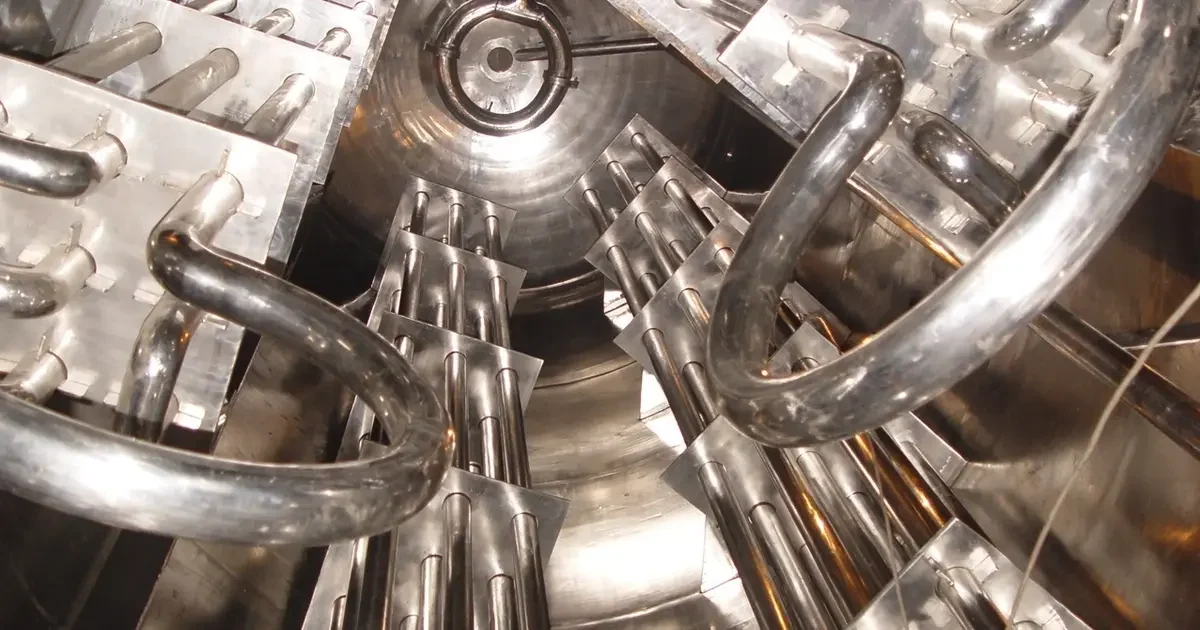
EHEDG is a guideline body, not a regulator and not a certifier of machined parts. Its rules reach your drawing through the equipment builder who buys the part. What lands on a machined stainless component is short: no thread in the product zone, no sharp internal corner, a surface that has no pits or folds, no metal-to-metal joint that traps soil and a design that drains. This guide lists those rules as written in the EHEDG documents we could open, and shows how to put each one on a print so a shop can quote it.
What EHEDG is and what it is not
The European Hygienic Engineering and Design Group is a private consortium founded in 1989, with food companies, equipment makers, research institutes and public authorities as members. A Danish food institute presentation states the position plainly: its guidelines are neither law text nor standards, and they are good advice, not a legal requirement.
They still carry weight. The EHEDG catalogue describes Guideline 8, Hygienic Design Principles, as the basis for EHEDG equipment certification. The fourth edition was released on 16 December 2025, takes a risk-based approach to preventing contamination and is free to download. The second edition of Doc 8, dated April 2004, says it was first published in 1993 to describe the hygiene requirements of the Machinery Directive in more detail, and that parts of it were later included in EN 1672-2 and EN ISO 14159. So an equipment builder working to EN 1672-2 is often applying EHEDG thinking whether or not the word EHEDG appears in the order.
One caution on the numbers below. The text we could open in full is the 2004 second edition. The 2025 fourth edition is described as risk based and may phrase or move individual limits, so treat the figures as the long-standing design practice and ask the buyer which clause and edition their specification cites.
The rules that reach a machined part
The second edition groups its hygienic design criteria under surfaces and geometry. Read for a machinist, they come down to this:
- Product contact surface. Any surface that touches the product, or from which product or condensate can drain, drop or be drawn back into it. Splash zones count.
- Threads. The document says to eliminate contact of the product with screw threads. A threaded hole that opens into the product zone is a design fault, not a machining choice.
- Corners. Preferably a radius of 6 mm or more, with 3 mm as the minimum, and sharp corners of 90 degrees or less avoided.
- Joints. Avoid direct metal-to-metal joints other than welding, because they harbour soil. Avoid steps caused by misalignment at connections. Permanent metal-to-metal product contact joints must be continuously welded and free of imperfections.
- Seals. O-rings in contact with product are to be avoided unless deformed to a flush static seal. A seal corner is the one place a corner should be sharp, with a break edge or radius of 0.2 mm to protect the elastomer.
- Drainage. Exterior and interior surfaces must be self-draining or drainable and easy to clean.
- When a rule cannot be met. The loss of cleanability has to be compensated and the effectiveness shown by testing.
The same document lists the EHEDG test methods used to show that, including Doc 2 for in-place cleanability. Those tests are run on equipment, which is why a bar-stock supplier or a machine shop cannot hand you an EHEDG certificate for a fitting.
Surface roughness: Ra is not the whole story
The 2004 text says large areas of product contact surface should have a finish of 0.8 micrometre Ra or better. It also says Ra above 0.8 is acceptable when tests show the required cleanability, and that it is the surface topography that governs cleanability: pits, folds, crevices, ruptures and peened-over irregularities can leave regions the cleaning agent cannot reach.
Its table of treatments shows why a bare Ra callout can mislead:
| Surface treatment | Approx. Ra, micrometres | What the document notes |
|---|---|---|
| Cold rolling | 0.2 to 0.5 | Smooth unbroken surface |
| Glass bead or ceramic blasting | Below 1.2 | Surface rupturing |
| Pickling | 0.5 to 1.0 | High peaks, deep valleys |
| Electropolishing | Not stated | Rounds off peaks without necessarily improving Ra |
| Mechanical polish, grit 240 | 0.2 to 0.5 | Depends on belt speed and pressure |
| Mechanical polish, grit 180 | 0.6 or less | Depends on belt speed and pressure |
A blasted part can pass an Ra of 0.8 and still leave ruptured surface, which is why the bead blasting guide treats it as a cleanability risk on product contact faces. For what the Ra number measures and how a shop reports it, see the Ra guide for stainless.
Need a quote for this part? Get a quote for your stainless parts
How this differs from 3-A
Both frameworks ask for the same things in the shop: a smooth surface, radiused corners and no crevices. The difference is how they decide. The 3-A standards fix a finish number for product contact surfaces, and EHEDG leaves room for a rougher surface when cleanability is demonstrated. If a part is bound for both US and EU customers, draw to the stricter of the two and say so once on the print.
What to put on the drawing
Name the clause the buyer needs, then state the feature. A shop cannot quote against “EHEDG compliant”.
Product contact surfaces: Ra 0.8 micrometre maximum, free of pits, folds and crevices, no blasting Internal corners on product contact surfaces: R3 mm minimum, R6 mm where space allows No threads or blind holes open to the product zone, fasteners on the non-product side Weld joints: continuous, as drawn, no undercut, no crevice at the root Seal groove corner: break edge 0.2 mm Passivated per ASTM A967, certificate per lot
On material, the 2004 document points to 304 or 304L for mild service up to pH 6.5 to 8, chlorides up to about 50 mg/L and temperatures up to about 25 °C. It points to 316 or 316L when chlorides and temperature are roughly double those values and recommends 316L for pipework and vessels because of its weldability. The food contact grade guide goes through that choice. For welded assemblies, EHEDG Guideline 9 covers welding stainless steel to hygienic requirements; its first edition dates from July 1993, it addresses thin-walled material under 3 mm and the group is updating it. The weldment machining guide covers the order of operations.
Passivation does not change geometry, but a food buyer will ask for the certificate, and the citric against nitric guide explains what to put on the print.
If you need quotes for a food or dairy component with these features, send the drawing through the RFQ form and list the product contact surfaces. We send one itemised quote within 24 business hours and place the work with partner shops that cut stainless. The food industry page collects the guides written for this audience.
Sources
- EHEDG, Guideline 8 Hygienic Design Principles, fourth edition catalogue entry
- EHEDG, announcement of Guideline 8 fourth edition, 16 December 2025
- EHEDG, Guideline 9 Welding stainless steel to meet hygienic requirements
- EHEDG Doc 8 Hygienic Equipment Design Criteria, second edition, April 2004, copy hosted by a third party
- Wirtanen, Hygienic equipment design, DTU National Food Institute, 2015
Guideline editions and limits are as published on the dates above. Confirm the edition and clause with the equipment builder before you release a drawing.
Frequently asked questions
Is EHEDG a standard or a legal requirement?
No. EHEDG guidelines are neither law nor standards. A university food institute describes them as good advice from a recognised body. They matter because equipment makers and food processors write them into purchase specifications, and because parts of EHEDG Doc 8 were carried into EN 1672-2 and EN ISO 14159.
Can a single machined part be EHEDG certified?
EHEDG certification is described as applying to equipment, with Guideline 8 as its basis. A machined component is judged as part of the assembled equipment. Ask the equipment builder which clauses and which cleanability test apply to your part, and draw those, rather than writing EHEDG compliant on the print.
What surface roughness does EHEDG ask for?
The second edition of Doc 8 (2004) says large product contact areas should have Ra 0.8 micrometres or better, and accepts a rougher surface if tests show the required cleanability. It adds that topography, not the Ra number alone, governs cleanability. The current fourth edition is risk based, so confirm the clause with the buyer.
What is the minimum internal corner radius for food contact parts?
The 2004 edition of EHEDG Doc 8 gives 6 mm or more as preferred and 3 mm as the minimum, and says sharp corners of 90 degrees or less must be avoided. A sealing corner may be sharp, with a break edge or radius of 0.2 mm so the elastomer seal is not cut.
Need a quote for this part?
Send the drawing. We read it, send one itemised quote within 24 business hours and place the work with a partner shop that cuts stainless.
Get a quote for your stainless partsFigures in this guide are published specification limits or published typical values for the alloy, not measurements of any part. Machinability is rated against free-machining carbon steel B1112 at 100 and PREN is chromium plus 3.3 times molybdenum plus 16 times nitrogen. The conventions are set out in thereference section and the editorial standards.