Nickel release rules for machined stainless parts that touch skin: what the EU limit means for grade choice
October 31, 2026
The EU does not limit how much nickel is in a stainless part. It limits how much nickel the part releases into sweat. Under REACH Annex XVII entry 27, an article in direct and prolonged skin contact must release no more than 0.5 micrograms per square centimetre per week, and a post assembly for a pierced body part no more than 0.2. Published tests put 304, 316L and 430 far below that. They put 303, the free-machining grade, close to it or over it. That is the trade this site is built around: the grade that cuts easily is the one that cannot go on the skin-contact surface.
This guide covers what entry 27 says, how the test works, what the published data show for common grades and what to write on a drawing or RFQ for a part that goes to the EU. It is not legal advice, and a compliance specialist has to decide whether a given part counts as skin contact.
What entry 27 says
Entry 27 of Annex XVII to the REACH Regulation (EC) 1907/2006 restricts nickel in three situations:
- Post assemblies inserted into pierced ears and other pierced parts of the body must release less than 0.2 micrograms per square centimetre per week.
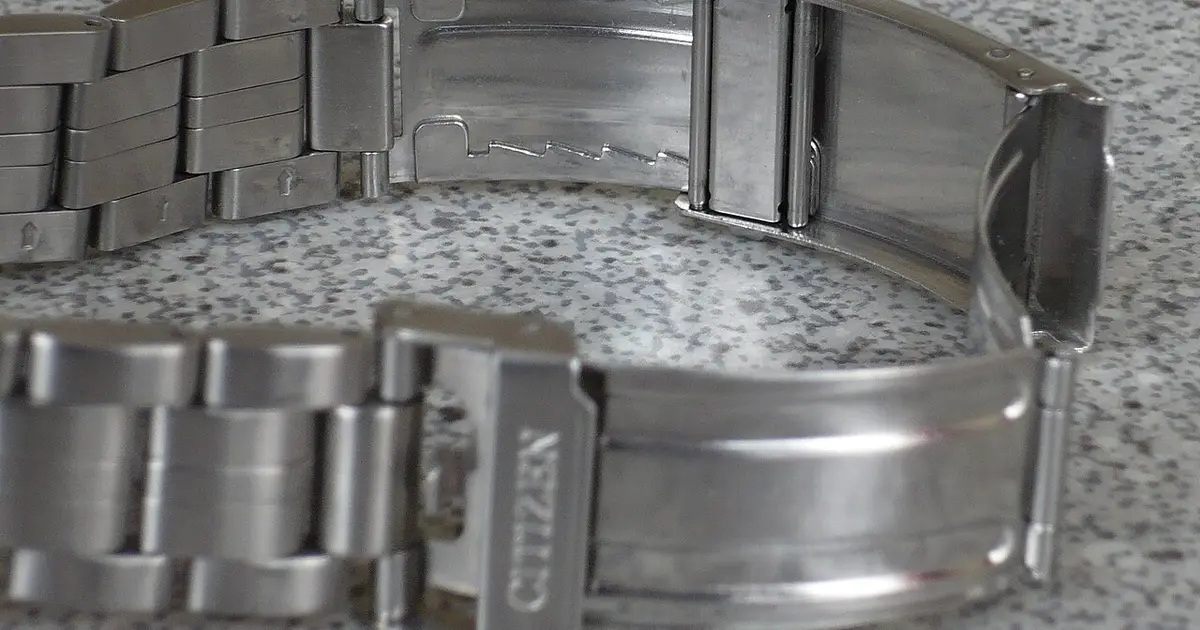
- Articles in direct and prolonged skin contact, listed as examples such as earrings, necklaces, bracelets, chains, anklets, finger rings, wrist-watch cases, watch straps and tighteners, and rivet buttons, tighteners, rivets, zippers and metal marks on garments, must not release more than 0.5 on the parts that touch the skin.
- Coated articles may use a non-nickel coating only if it keeps release at or below 0.5 for at least two years of normal use.
Articles that do not conform cannot be placed on the market, and the standards adopted by the European Committee for Standardisation are the test methods. The rule began as Directive 94/27/EC. A migration limit replaced an earlier cap on nickel content in 2004, and the rule moved into REACH on 1 June 2009.
The list in the entry is introduced by “such as”, so it gives examples and does not name every article. Whether a clasp, a buckle, a handle or an instrument housing counts as direct and prolonged contact is a classification question for your compliance team. The entry does not mention medical devices. A device maker should ask its regulatory team which rules apply, and the medical industry page covers the certificate questions that apply to medical work.
How EN 1811 measures release
EN 1811 is the reference method. Each sample goes into artificial sweat for one week, and the nickel in the solution is then measured, typically by atomic absorption or ICP-MS. The current edition is EN 1811:2023, published on 22 February 2023, which replaced EN 1811:2011+A1:2015. The Commission adopted it as the harmonised method in a notice published on 20 December 2023.
Points that matter to a buyer, taken from a summary of the 2023 edition:
- The result unit is micrograms per square centimetre per week, the same as the REACH limit.
- For articles with the 0.5 limit, a result of 0.88 or below is treated as compliant. Ask the laboratory how it reports results near the limit.
- Coated articles can need both EN 1811 and EN 12472, the wear and corrosion simulation, where nickel in the outer coating is uncertain.
- Samples are the finished article’s skin-contact parts. A test on the bar is not a test on the part.
What the published data show
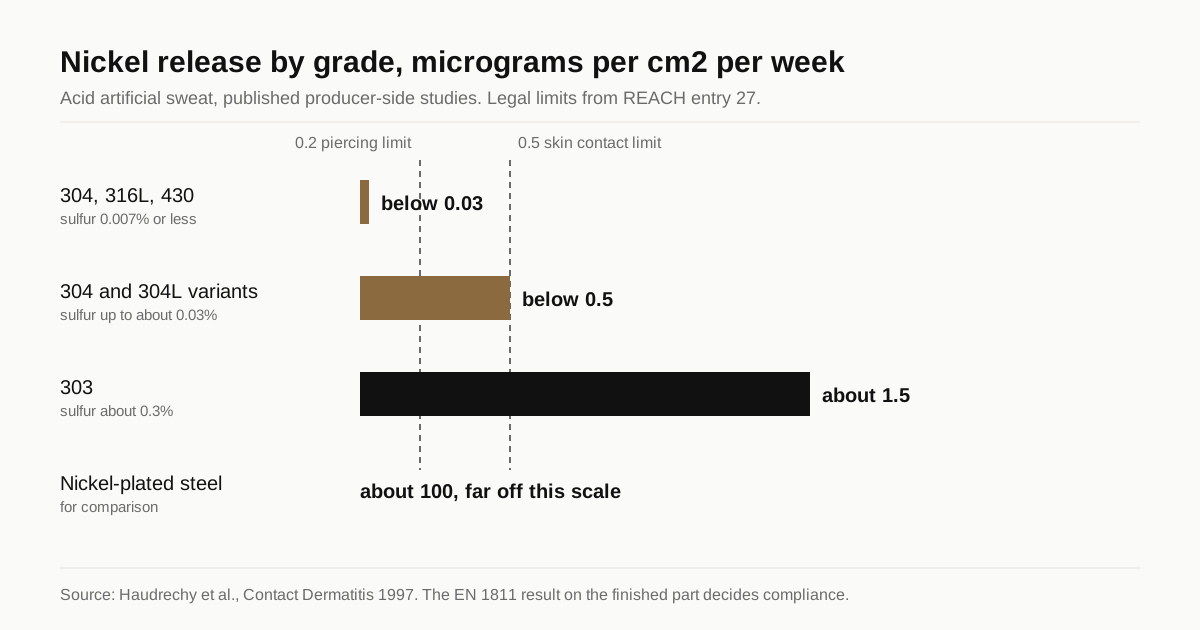
A 1997 paper from a stainless producer’s research centre recaps an earlier 1994 study and adds its own tests in acid artificial sweat. The table summarises both. The paper and the EUROFER safety information sheet come from the producer side, so weigh them as industry sources.
| Grade | Sulfur | Nickel release, micrograms per cm2 per week |
|---|---|---|
| 304, 316L, 430 | 0.007 percent or less | Below 0.03 |
| 304 and 304L variants | up to about 0.03 percent | Below 0.5 |
| 303 | about 0.3 percent | About 1.5 in the first study, around or above 0.5 in the second |
| Nickel-plated steel | not applicable | About 100 |
EUROFER adds that resulfurised free-machining stainless steels, at 0.15 to 0.30 percent sulfur, release nickel at levels close to or above 0.5 in EN 1811 tests, and that they are therefore not suitable for jewellery, watch backs and watch straps. The studies tie the effect to corrosion resistance in chloride media, which is lower in a resulfurised grade. The 1997 tests found that the dimethylglyoxime spot test read negative for the 303 sample as well, so a negative spot test is not evidence of compliance. A nitric acid spot test did separate 303 from the others.
The practical reading is narrow. Low-sulfur austenitic grades measured well under the limit in these studies. 303 did not. The 303 against 304 against 316L guide covers the machinability trade, and this is where it costs something.
Need a quote for this part? Get a quote for your stainless parts
What to write on the drawing and RFQ
- Mark the skin-contact surfaces and state that the part goes to the EU. A part that goes to a watchmaker, a jewellery maker or a clothing maker is a different case from a part inside a machine.
- Name a low-sulfur grade such as 304L or 316L and say that a resulfurised grade such as 303 is not accepted on that surface. If the part needs free-machining, a split into a skin-contact part in 316L and a hidden part in 303 is a design choice for the owner of the drawing.
- State the test: nickel release per EN 1811:2023, with a limit of 0.5 micrograms per square centimetre per week, or 0.2 for post assemblies. Say who pays for it and on which sample.
- Check the sulfur on the certificate. The mill test certificate guide shows where. There is no standard sulfur threshold for the limit, so the test result decides, but a sulfur figure far above 0.03 percent is a warning.
- Say what the finish is. If the part is coated or plated, ask for both methods where coating chemistry is uncertain. The passivation against electropolishing guide covers the two common finishes for stainless, and the test should be run on the finish the part ships with.
For parts that sit in surgical or implantable fields, see also the surgical instrument specification guide. Nothing here is a medical claim, and device rules are separate from entry 27.
If you want quotes that include an EN 1811 test for EU-bound stainless parts, send the drawing through the RFQ form and mark the skin-contact surfaces. We send one itemised quote within 24 business hours and place the work with partner shops that cut stainless. We own no machines.
Sources
- Regulation (EC) 1907/2006 REACH, consolidated text, Annex XVII entry 27 (EUR-Lex)
- Haudrechy et al., Nickel release from stainless steels, Contact Dermatitis 1997 (PubMed), producer research centre study
- EUROFER, safety information sheet for stainless steel, industry body, sulfur and EN 1811
- Wikipedia, Nickel Directive, history and the EN 1811 method
- Intertek, EN 1811:2023 published (2023) and Commission updates EN 1811:2023 as harmonised method (2024), testing laboratory summaries
Limits and standards are as published on the dates above. Confirm the current harmonised standard and the scope for your article with a compliance specialist.
Frequently asked questions
What is the nickel release limit for stainless steel parts in the EU?
REACH Annex XVII entry 27 sets 0.5 micrograms per square centimetre per week for articles in direct and prolonged skin contact, and 0.2 for post assemblies inserted into pierced parts of the body. The limit applies to nickel released, not to nickel content, and is tested to EN 1811.
Does 316L pass the EN 1811 nickel release test?
Published tests measured low-sulfur 304, 316L and 430 below 0.03 micrograms per square centimetre per week in acid artificial sweat, far below 0.5. That is a grade-level result. Compliance for your part rests on a test of the finished article by a laboratory.
Why is 303 a problem for skin contact?
303 is resulfurised for free machining. Producer-side data put resulfurised free-machining stainless, at 0.15 to 0.30 percent sulfur, near or above 0.5 in EN 1811 tests, and one study measured 303 at about 1.5. The studies link the higher release to lower corrosion resistance in the resulfurised grade.
Does the nickel release rule apply outside the EU?
Entry 27 is an EU rule that applies to articles placed on the EU market. Other markets set their own requirements, which this guide does not cover. If a part ships to several regions, ask your compliance team which tests each destination needs.
Need a quote for this part?
Send the drawing. We read it, send one itemised quote within 24 business hours and place the work with a partner shop that cuts stainless.
Get a quote for your stainless partsFigures in this guide are published specification limits or published typical values for the alloy, not measurements of any part. Machinability is rated against free-machining carbon steel B1112 at 100 and PREN is chromium plus 3.3 times molybdenum plus 16 times nitrogen. The conventions are set out in thereference section and the editorial standards.