ASTM A582: free-machining stainless bar, and what the sulfur costs you
ASTM A582 · Reference page · Last reviewed 26 November 2026
ASTM A582 is the specification for free-machining stainless steel bars. A free-machining grade has sulfur or selenium added so the chips break short and the tool lasts longer. The grades most buyers know are 303 and 416. A582 is the standard that goes with them on a purchase order, the way A276 goes with 304 and 316L bar.
| Item | What to know |
|---|---|
| Standard | ASTM A582/A582M |
| Edition | A582/A582M-22, active as of October 2026, edition date 1 November 2022 |
| Covers | Hot-finished or cold-finished bars suitable for machining: rounds, squares and hexagons |
| Does not cover | Bars for forging, which fall under A314; non-free-machining stainless bars, which fall under A276 |
| Added element | Sulfur, or sulfur plus selenium, for machinability |
| Hardness | At least one test per lot, midway between the surface and the center |
| Units | Inch-pound unless the PO states the M designation; do not mix the two |
The ASTM store shows A582/A582M-22 as active and lists A582/A582M-21 and earlier editions as superseded.
What the standard covers
The ASTM abstract describes the bars as designed for machinability and for general corrosion and high-temperature service. It names rounds, squares and hexagons, and it requires the material to meet specified chemical composition limits. Bars may be supplied hot finished or cold finished in one of the conditions the standard lists.
The A582 notes state the boundaries. Bars for reforging go to A314, and bars of stainless types that are not free-machining go to A276. This matters for a mixed order: a drawing that needs 303 and 316L needs two standards.
Types in the standard
A supplier’s reproduction of the composition table shows the types. The standard has the limits, so use this as an orientation and not as a spec.
| Type | UNS | Family | Free-machining addition |
|---|---|---|---|
| 303 | S30300 | Austenitic | Sulfur, 0.15 percent minimum |
| 303Se | S30323 | Austenitic | Low sulfur plus selenium |
| 416 | S41600 | Martensitic | Sulfur, 0.15 percent minimum |
| 416Se | S41623 | Martensitic | Low sulfur plus selenium |
| 420F | S42020 | Martensitic | Sulfur, 0.15 percent minimum |
| 430F | S43020 | Ferritic | Sulfur, 0.15 percent minimum |
| 440F | S44020 | Martensitic | Sulfur, 0.15 percent minimum |
Other types are in the table, including grades with an XM designation. The selenium types are listed for better surface finish or cold forming in some uses. Confirm the exact sulfur and selenium limits in the standard.
The table lists no 304, 316 or 316L. A free-machining version of the 316 family is not part of A582, and a drawing that asks for “A582 316L” has mixed two things up.
Conditions
A582 bars are supplied in conditions the table names A, T and H. The supplier reproduction shows the martensitic types in the harder conditions, and a hardness range for each. In short, condition A is the softest delivery condition, and T and H are for martensitic types that are heat treated to a hardness range. The hardness limits and the names of the conditions are in the standard. Do not choose a condition by name alone: write the hardness range you need next to it.
The trade this site is built on
Sulfur does the work in a free-machining stainless steel. It forms manganese sulfide inclusions that break the chip. The same inclusions are weak points. They lower pitting resistance and surface finish quality, and can make cold working and welding harder.
- Corrosion. A free-machining grade generally resists chloride pitting less than its standard counterpart. The 303 against 304 against 316L guide covers the trade in numbers.
- Skin contact. Published tests put resulfurised grades such as 303 near or above the EU nickel release limit, a case covered in the nickel release guide.
- Food and clean surfaces. Where the surface must be cleanable, polished or passivated, the inclusions are a drawback. The food contact grade guide covers the grade choice.
- Martensitic types. 416 and 420F harden by heat treatment and cut well in the annealed state. The 440C and martensitic guide shows the family.
- Passivation. Free-machining grades need care in passivation, because the sulfides can be attacked by the acid. See the citric against nitric guide.
For a hidden internal part such as a shaft, a free-machining grade can save machining cost. For a surface that touches skin, food or seawater, it often costs more in risk than it saves in time. The cost drivers guide shows how much of a job’s price is cutting time.
Send the drawing with the standards named Get a quote
Which type for which job
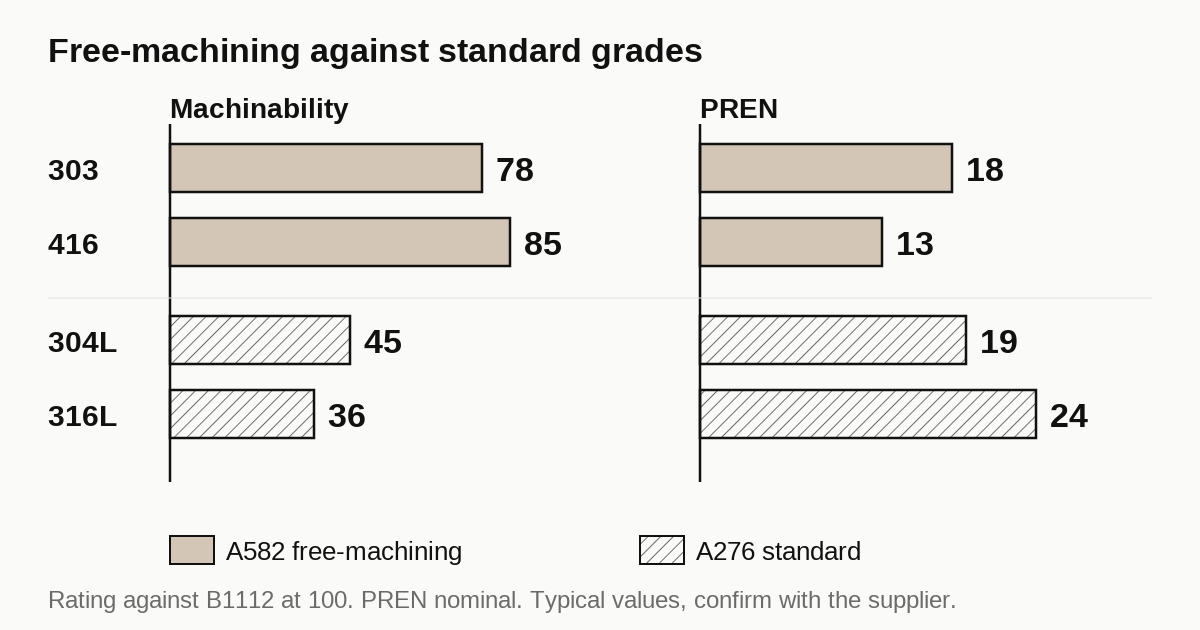
The grade reference of this site gives typical machinability ratings against free-machining carbon steel B1112 at 100: about 78 for 303 and about 85 for 416, against about 45 for 304L and about 36 for 316L. These are published typical values, not a promise from a shop. The table shows where each type tends to be used.
| Type | Where it is typically used | Watch for |
|---|---|---|
| 303 | Dry indoor parts with threads and cross holes: fittings, bushings, shafts | Pitting in chloride, nickel release on skin contact, poor weldability |
| 303Se | Parts that need a better surface or some cold forming | Cost and availability, check before naming |
| 416 | Hardened parts that need machinability: shafts, pump parts, fasteners | Lower corrosion resistance than 300 series, hardness range by condition |
| 420F | Hardened wear parts and instrument parts | Lower corrosion resistance than 304 |
| 430F | Ferritic parts, magnetic, in mild environments | Lower toughness, not for chloride |
The ranking of the grade against the duty is the point. A free-machining grade is a good choice for a dry internal part with many drilled and tapped features, because the cutting time saved is real. It is a poor choice for a part that sits in a marine splash zone or has to hold a polished, cleanable surface.
What to write on the PO
Bar, 416, ASTM A582/A582M-22, condition T, hardness [range] HB, diameter [size] with tolerance per [the general requirements standard named on the drawing]. Inspection certificate EN 10204 type 3.1 with heat number, chemistry and hardness. Lot to be hardness tested midway between surface and center.
Name the type, the standard with its edition, the condition, the hardness range and the dimensional standard. A582 relies on a general requirements standard for tolerances and testing, as A276 does, so name the one your drawing uses. Add the certificate type and say whether the bar must be a single heat.
What the certificate must show
- The standard with its edition (A582/A582M-22) and the type.
- Heat number, matching the marking on the bar.
- Chemistry, with sulfur shown and selenium for the Se types.
- Hardness results for the lot and the condition.
- Heat treatment where the condition requires it.
See the mill certificate guide for reading each line.
Common mistakes
- Writing A276 for a 303 or 416 bar. The free-machining types sit in A582.
- Specifying a free-machining grade for a pitting or food duty because the shop quoted a shorter cycle.
- Naming a condition without a hardness range.
- Mixing inch-pound and SI designations in one order.
- Substituting 304 for 303 without the designer’s approval. The two do not behave the same in machining or corrosion.
- Assuming every shop stocks the Se types. Ask before you name them.
Next step
Choose the grade from the duty first and the cutting time second, name A582 and the edition, and add the hardness range. Send the drawing to us and we send one itemised quote within 24 business hours and place the work with partner shops that cut stainless. The standards reference lists the other specifications that appear on stainless drawings, and the grade reference shows the composition limits behind each grade.
Questions buyers ask
What is the difference between ASTM A582 and ASTM A276?
A582 covers free-machining stainless bars, grades with added sulfur or selenium for easy cutting. A276 covers stainless bars that are not free-machining. ASTM states this split in the notes to A582.
Is 303 covered by A276 or A582?
A582, because 303 is a free-machining grade. The A582 notes send other, non-free-machining bars to A276 and bars for reforging to A314.
Should I use a free-machining grade for a part that is passivated or sits in chloride?
Be careful. Added sulfur forms sulfide inclusions that ease cutting and also lower corrosion resistance. For pitting duty or a polished, cleanable surface, a standard grade such as 304L or 316L usually serves better, even though it cuts more slowly.
Does the standard say how to test hardness?
ASTM states that at least one hardness test is made midway between the surface and the center on each lot, and the standard includes the hardness test methods and definitions.
Sources
- ASTM A582/A582M-22, Standard Specification for Free-Machining Stainless Steel Bars (ASTM store)
- Technicke normy, ASTM A582/A582M-22 listing, edition date 1 November 2022
- TorqBolt, ASTM A582 composition table and conditions (supplier reproduction of the standard)
Standards and rules are cited as references. They are not claims about this site or about any shop. Confirm the current edition and status with the issuing body.
Send the drawing with the standards named
Put the standard, the condition and the documents you need in the RFQ. We send one itemised quote for the finished parts, place the work with a partner shop that cuts stainless and reply within 24 business hours.
Get a quote