ASME BPE surface finish: what SF1 to SF6 mean on a machined stainless part
ASME BPE · Reference page · Last reviewed 23 November 2026
ASME BPE is the standard that biopharmaceutical equipment buyers cite for the inside surface of tubes, fittings, valves and machined parts that touch the product. Part SF of the standard sorts those product-contact surfaces into codes from SF0 to SF6. The code says two things: the maximum surface roughness, Ra, and whether the surface is electropolished.
| Item | What to know |
|---|---|
| Standard | ASME BPE, Bioprocessing Equipment |
| Editions in use | BPE-2024 (issued 29 April 2024) and BPE-2026 (issued May 2026) |
| Part that covers finish | Part SF, product contact surface finishes |
| Typical material | 316L stainless steel |
| Codes | SF0 to SF6 |
| Ra unit | Microinch and micrometre, always a maximum |
| Who sets the code | The equipment owner or designer, on the drawing |
As of October 2026 two editions can be in play. ASME’s catalogue lists BPE-2026 as the newest. The 2026 front matter sets a delay before it takes effect, and a 2024 specification may still be cited on live projects. Ask the buyer which edition the purchase order names.
The finish codes
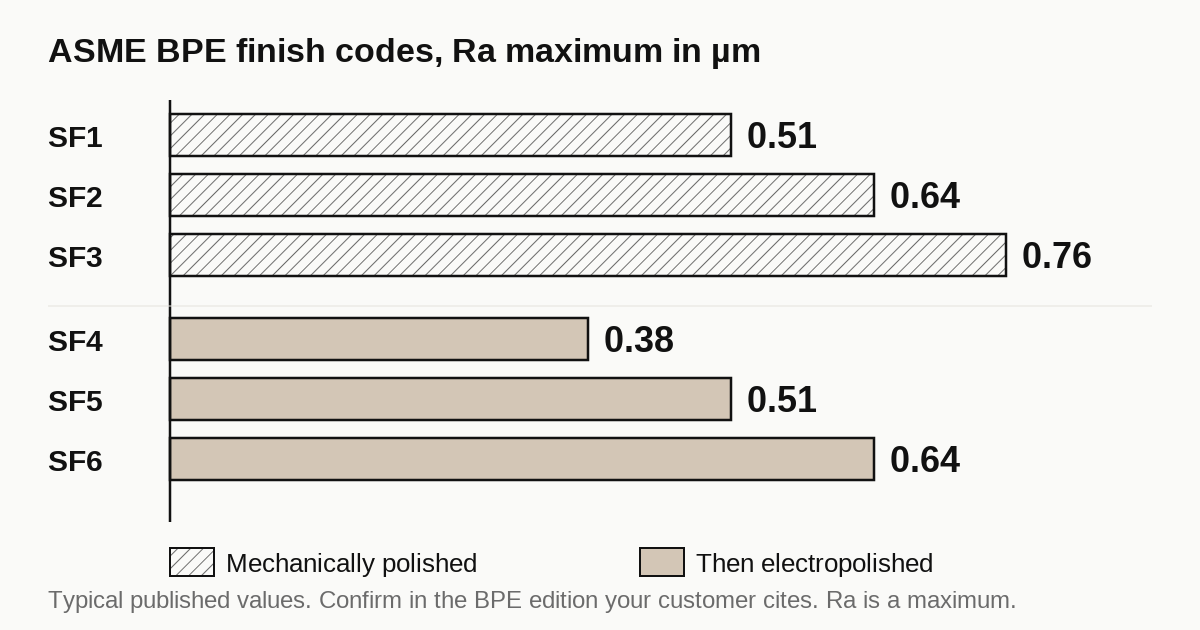
The table below shows the values that finishers and valve makers publish for the SF codes. Treat it as a guide to the structure, and check the exact limits in the edition your customer cites. The standard’s own text is the contract document.
| Code | Process | Ra maximum, microinch | Ra maximum, micrometre |
|---|---|---|---|
| SF0 | Mill finish, no Ra requirement set by the standard | none | none |
| SF1 | Mechanically polished | 20 | 0.51 |
| SF2 | Mechanically polished | 25 | 0.64 |
| SF3 | Mechanically polished | 30 | 0.76 |
| SF4 | Mechanically polished, then electropolished | 15 | 0.38 |
| SF5 | Mechanically polished, then electropolished | 20 | 0.51 |
| SF6 | Mechanically polished, then electropolished | 25 | 0.64 |
Two readings of the table matter to a buyer. First, the codes SF4 to SF6 are the electropolished ones, and the electropolish step is part of the code. If the drawing says SF4 and the part leaves the shop mechanically polished, it does not meet the code even if the Ra is low. Second, a lower number is not always a better code for the job: the cost rises with each step, and the owner picks the code from the process, not from a wish for a smoother part.
How Ra is read under BPE
Ra is measured with a contact profilometer. Finishers that publish the BPE rules say the standard sets the cutoff length and the evaluation length, and that the readings must represent the whole surface. They also stress that the Ra values are maximums, not averages: every reading on the surface must fall at or below the limit. This is different from a drawing note that says “Ra 0.8 typical”. Under BPE, one reading above the limit fails the surface.
Three consequences for the part:
- Measurement points. The drawing, or the inspection plan, should say where on the part the readings are taken. On a machined valve body with a bore, a port and a seat, that is more than one place.
- Access. A profilometer needs access. On a small bore it may not reach the surface, and the owner and shop have to agree on a proxy, such as a measured test coupon from the same process, or a replica.
- Other features. The Ra value is one control. BPE also sets acceptance criteria for pits and porosity on product-contact surfaces, which the 2026 edition revised, and it covers electropolishing and passivation records. A part can pass Ra and fail on a pit.
The surface finish guide explains what Ra measures and what it misses, and the electropolishing comparison covers what each finishing step removes.
Where the machined part sits in the sequence
A BPE-coded surface is the result of a chain, and the machine shop owns only the start of it.
- Material. 316L bar or forging with a mill certificate that carries the heat number. BPE sets requirements for materials and for the documents that come with them.
- Machining. The shop cuts to the drawing with a finish good enough for the polisher to start. A torn surface from a worn tool is hard to rescue. Where a bore cannot be reached for hand polishing, agree early how the final Ra will be reached.
- Mechanical polish. Gives SF1 to SF3 on its own, and is the base for SF4 to SF6.
- Electropolish. Takes a thin layer off the surface and smooths it. This is done by a finishing house, not usually by the machine shop. The passivation against electropolishing guide shows why the drawing must account for the metal removed.
- Passivation and cleaning. BPE also sets requirements for these steps and the records that go with them.
- Packaging and records. Clean, capped, with the finish documented.
The pharmaceutical parts guide lists the documents a biopharma buyer expects, and the rouging guide covers what happens when a finished surface is damaged in service.
Send the drawing with the standards named Get a quote
What to write on the drawing
State the code, the edition and the measurement rule. A callout that works:
Product contact surfaces: ASME BPE-2024 SF4. Mechanical polish then electropolish. Ra 0.38 micrometre maximum on every reading. Readings at the bore, the port faces and the seat, with a profilometer report. Material 316L per ASTM A276 with heat number. Passivation record required.
Leave out words such as “pharma finish” or “BPE quality”. Without the code, the edition and the readings, each shop prices a different surface. The RFQ checklist shows where finish lines sit in a quote request.
What to ask the shop for
| Document | What it shows |
|---|---|
| Mill certificate with heat number | The material and its chemistry, linked to the part |
| Ra report | Profilometer readings, points measured, instrument and date |
| Electropolish record | The finishing house, date, lot and the metal removed if stated |
| Passivation record | Method, date, lot and acceptance test |
| Packaging and cleanliness note | How the part was cleaned, capped and bagged |
For a customer who asks the shop to join ASME’s manufacturer program, ASME describes the program as certification of a manufacturer’s quality management system, and its page names tubing, fittings and valves. It does not name machined parts, so a shop or buyer who wonders whether a machined part falls inside the program should ask ASME. ASME publishes a search of certificate holders. Check the holder’s listing there. We do not issue or hold ASME certificates, and a shop that quotes you should show its own.
Common mistakes
- Citing “BPE finish” without an SF code.
- Writing SF4 on a part that cannot be reached for electropolish, such as a blind bore.
- Forgetting that electropolishing removes metal, which shifts a tight tolerance.
- Treating an Ra average as a pass when the rule is a maximum on every reading.
- Citing an old edition without checking what the customer’s project specification names.
- Taking a low Ra as proof that the surface has no pits.
Next step
Name the SF code and the edition in the RFQ, say where the readings are taken and list the records you need. Send the drawing to us and we send one itemised quote within 24 business hours and place the work with partner shops that cut stainless. For the other standards that appear on stainless drawings, see the standards reference.
Questions buyers ask
What is the difference between SF1 and SF5?
In the published tables both carry the same Ra limit, 0.51 micrometre or 20 microinch. SF1 is mechanically polished only and SF5 is mechanically polished and then electropolished. The code therefore also fixes the process, not just the number. Check the limits in the edition your customer cites.
Is the BPE Ra value an average over the surface?
No. Finishers who publish the rule describe it as a maximum: every reading on the surface has to fall at or below the limit, and the readings must represent the whole surface rather than one good spot.
Does a machine shop need to be ASME BPE certified?
Not to quote or to cut the part. ASME runs a certification program for manufacturers, and its page names tubing, fittings and valves. It does not name machined parts, so ask ASME and your customer whether a given part falls inside it. Whether the customer requires it is a contract matter. We do not issue or hold ASME certificates.
Which BPE edition applies in October 2026?
ASME issued BPE-2026 in 2026 and the front matter gives a delay before it takes effect, so BPE-2024 and BPE-2026 may both be in use this autumn. The edition that counts is the one your customer's specification names.
Sources
- ASME, BPE Bioprocessing Equipment standard page
- ECA Academy (gmp-compliance.org), ASME BPE-2026: overview of the key updates
- Harrison Electropolishing, ASME BPE specifications (surface finish table and measurement notes, finisher summary)
- Dixon, surface finish comparison sheet (manufacturer cross-reference of BPE SF codes)
Standards and rules are cited as references. They are not claims about this site or about any shop. Confirm the current edition and status with the issuing body.
Send the drawing with the standards named
Put the standard, the condition and the documents you need in the RFQ. We send one itemised quote for the finished parts, place the work with a partner shop that cuts stainless and reply within 24 business hours.
Get a quote