ASTM A182: forged stainless flanges, fittings and valve parts, and what it means for a machined part
ASTM A182 · Reference page · Last reviewed 24 November 2026
ASTM A182 is the specification for forged or rolled alloy and stainless steel pipe flanges, forged fittings, valves and similar parts for pressure service at high temperature. When a drawing says “F316L per ASTM A182”, it asks for a forged 316L part, not a part cut from bar. For a machine shop and a buyer the difference decides which stock to buy and which certificate to ask for.
| Item | What to know |
|---|---|
| Standard | ASTM A182/A182M |
| Edition | A182/A182M-26 on the ASTM store as of October 2026 |
| Covers | Forged or rolled alloy and stainless steel pipe flanges, forged fittings, valves and parts |
| Grades | Low alloy, ferritic, martensitic, austenitic and duplex, written with an F prefix such as F316L |
| Size limit | Products up to 10,000 lb (4,540 kg); larger forgings use A336 or A965 |
| Bar stock | Covered by other standards such as A276 and A479 |
| Related | ASME SA-182 in pressure vessel code work |
The ASTM store shows A182/A182M-26 with a June 2026 update date, and BSI lists a February 2026 edition. The store page also carries a status label that is hard to read, so confirm the current edition with ASTM before it goes into a contract.
Stainless F-grades you will meet
The F-grade names are the A182 way to say a grade. The AISI names in the table are the nearest match.
| A182 grade | Nearest AISI or common name | Family | Typical use |
|---|---|---|---|
| F304, F304L | 304, 304L | Austenitic | General process piping, flanges |
| F316, F316L | 316, 316L | Austenitic | Chloride service, food, pharma piping parts |
| F321, F347 | 321, 347 | Stabilised austenitic | Hot service where sensitisation is a risk |
| F51 | 2205 duplex, UNS S31803 | Duplex | Higher strength, chloride resistance |
| F53, F55 | 2507 and related super duplex | Duplex | Seawater and aggressive chloride service |
The grade list is taken from a piping reference, so read the standard for the full table and the UNS numbers. For the F316L chemistry, the carbon limit is low, as in the 316L bar grade. The 316 against 316L guide covers the trade.
Supplier summaries give the typical minimum properties as follows: F304 at 75 ksi tensile and 30 ksi yield (515 and 205 MPa); F316L at 70 and 25 ksi; F51 at 90 and 65 ksi (620 and 450 MPa). Treat these as typical values and confirm the minimums in the edition you cite.
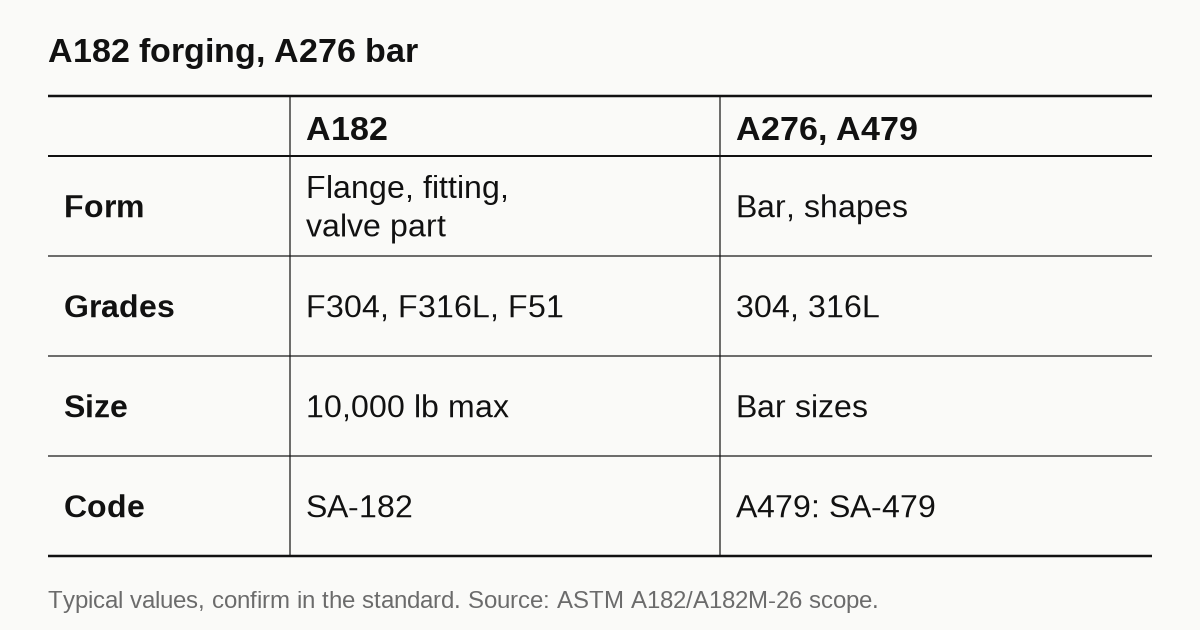
A182 against A276 and A479
| Question | A182 | A276 or A479 |
|---|---|---|
| Product form | Forged or rolled flange, fitting, valve part | Bar and shapes (A479 for pressure and high temperature use) |
| Grade naming | F304, F316L, F51 | 304, 316L, UNS numbers |
| Typical buyer | Piping, valve and pressure equipment makers | Machined parts, shafts, general fabrication |
| Heat treatment | Required condition for each grade, such as solution annealing | Condition set in the bar standard |
| Pressure code use | Adopted as SA-182 | Adopted as SA-479 and others |
The A276 against A479 guide explains the two bar standards. A buyer who writes an A182 grade on a drawing for a part the shop will cut from bar has written an ambiguous order. Settle it before the quote: either the part is a forging, or the designer accepts bar and names the bar standard.
Heat treatment and condition
For austenitic grades, suppliers describe A182 parts as supplied solution annealed, with a minimum solution temperature around 1,900 degrees Fahrenheit (1,040 degrees Celsius) followed by rapid cooling. For F51 a supplier summary gives a minimum of 1,870 degrees Fahrenheit (1,020 degrees Celsius) and a liquid quench. These are summaries, not the standard. The reason matters: the heat treatment returns the chromium carbides to solution in austenitic grades and avoids the harmful phases in duplex grades, which is the subject of ASTM A923 and ASTM A262.
Send the drawing with the standards named Get a quote
Tests and extra requirements
A182 sets chemistry and mechanical requirements and the tests that confirm them. It also has supplementary requirements that a purchase order can add. A buyer can ask for tests the base standard does not require, such as intergranular corrosion testing to A262 for austenitic parts, or the extra tests that a sour service specification adds. These do not apply unless the order says so. Read the supplementary requirements of the edition you cite, and add the ones your duty needs.
For valve parts in oil and gas, a design code such as ASME B16.34 or a materials specification such as NACE MR0175 can add hardness and condition limits on top of A182.
What to write on the PO
Valve body, forged 316L per ASTM A182/A182M-26 grade F316L, solution annealed. Inspection certificate EN 10204 type 3.1 with heat number, chemistry, mechanical results and heat treatment record. Intergranular corrosion test per ASTM A262 Practice E on one sample per heat. Marking with heat number and grade.
If the part is to be machined from forged stock, say so, and say what finish the forging is supplied in. If the part is a machined component the customer accepts in bar, write the bar standard instead.
What the certificate must show
- The standard, edition and grade, for example A182 F316L.
- Heat number, matching the marking on the part or stock.
- Chemistry by element.
- Mechanical results against the grade’s minimums.
- The heat treatment, with the temperature and cooling.
- Any supplementary test that the PO added, with the result.
The mill certificate guide explains how to read the paper, and the documentation pack guide shows what else a shop supplies with the part.
When forged beats machined from bar
A forging has a grain flow that follows the shape, and the standard tests it as a forging. A machined bar has a straight grain. For a flange or a valve body under pressure, codes and customers often prefer the forging. For a small fitting or a shaft, bar is common and cheaper. The cast against machined guide compares a third route. The shop does not decide this. The designer does, and the PO should state the answer.
Common mistakes
- Writing an A182 grade for a bar part, or a bar grade for a forged part, without saying which stock is meant.
- Citing A182 without the edition year.
- Forgetting that the supplementary tests apply only when the order adds them.
- Reading a supplier’s heat treatment summary as the standard.
- Treating F51 and F60 as the same without checking the UNS number.
- Assuming a forging certificate covers a later heat treatment or weld on the finished part.
Next step
Say whether the part is a forging or a bar part, name the edition and list the tests the duty needs. Send the drawing to us and we send one itemised quote within 24 business hours and place the work with partner shops that cut stainless. The pump and valve components guide covers the machined side of valve work, and the standards reference lists the related specifications.
Questions buyers ask
What is the difference between ASTM A182 and ASTM A276?
A182 is for forged or rolled flanges, fittings, valves and similar pressure parts. A276 is for stainless bars and shapes. A part machined from A276 bar is not an A182 forging, even when the grade name matches.
Can I machine an A182 F316L part from bar stock?
Only if the design code, the customer and the pressure-equipment rules accept it. Some codes allow bar to a related bar specification in place of a forging for small parts, and some do not. That decision belongs to the designer and the customer, not to the shop.
What do the letters F51 and F60 mean?
They are A182 grade names for duplex stainless forgings. Supplier pages give F51 as UNS S31803. F60 is understood to be the S32205 variant of 2205, and the table in the standard is the place to confirm it.
Is ASME SA-182 the same as ASTM A182?
They are closely related. ASME adopts ASTM specifications into its pressure vessel code as SA specifications, sometimes with differences. For code work, follow the edition and the version your design code names.
Sources
- ASTM A182/A182M-26 listing, scope and weight limit (ASTM store)
- BSI, ASTM A182/A182M edition listing
- WhatIsPiping, ASTM A182 (grade list and typical minimum properties, secondary source)
- Alloy Piping Products, data sheet ASTM A182 F304, F304L, F316, F316L (heat treatment summary, supplier source)
Standards and rules are cited as references. They are not claims about this site or about any shop. Confirm the current edition and status with the issuing body.
Send the drawing with the standards named
Put the standard, the condition and the documents you need in the RFQ. We send one itemised quote for the finished parts, place the work with a partner shop that cuts stainless and reply within 24 business hours.
Get a quote