Stainless pump and valve components for food processing: grade, finish, geometry and galling
October 25, 2026
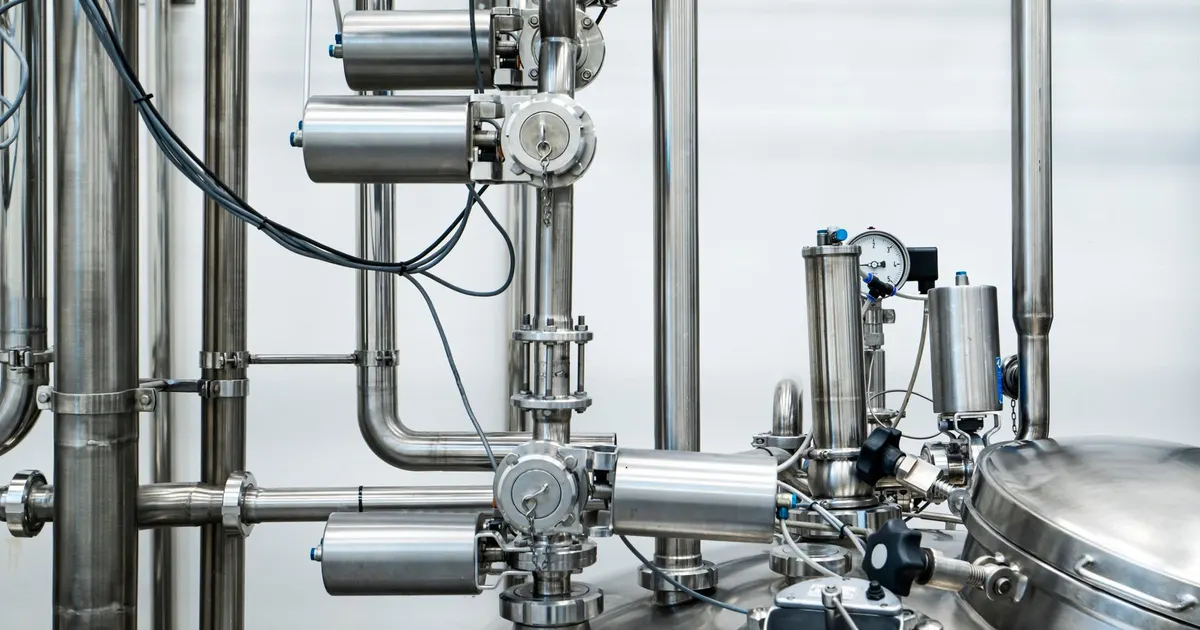
A valve in a dairy line or a pump in a juice plant lives a hard life. It sees product, hot caustic cleaning, nitric or peracetic acid sanitising, chloride in water and steam. It also has to be cleanable to a standard where a scratch or a crevice counts as a defect. Machining parts for it is partly about grade and partly about geometry and surface. Many of the failures that reach a buyer come from a drawing that names a grade and nothing else.
This guide covers the choices that decide whether a machined food-processing component works: grade, finish, shape, galling and documents. It complements the food contact grades guide, which explains why 316L is the default.
Grade by part
| Component | Typical grade | Notes |
|---|---|---|
| Valve body, product contact | 316L | Cleaning chemicals with chloride |
| Valve stem and plug | 316L, 316 with hardfacing, Nitronic 60 | Galling risk against the seat |
| Seat, bushing | 316L, PTFE, filled polymers | Different material from the stem helps |
| Pump casing, impeller | 316L, CF3M cast | Cast or machined from bar |
| Pump shaft | 316L, 17-4 PH, 2205 | Strength and fatigue, see shaft guide |
| Clamp ferrules, connectors | 316L | Hygienic connections per ISO 2852 or DIN 11851 |
| Fasteners outside the product zone | 304, A2-70 or A4-70 | Not in contact with product |
| Non-contact brackets and covers | 304 | Lower cost |
304 is often accepted for equipment that sees only mild product and mild cleaning. 316L adds molybdenum, which improves resistance to chloride and pitting. The 303 against 304 and 316L guide explains the gap. Do not use 303 or 416 on product contact parts. The sulphur inclusions that make them machine well also hold residue and start pitting.
Surface finish on product contact surfaces
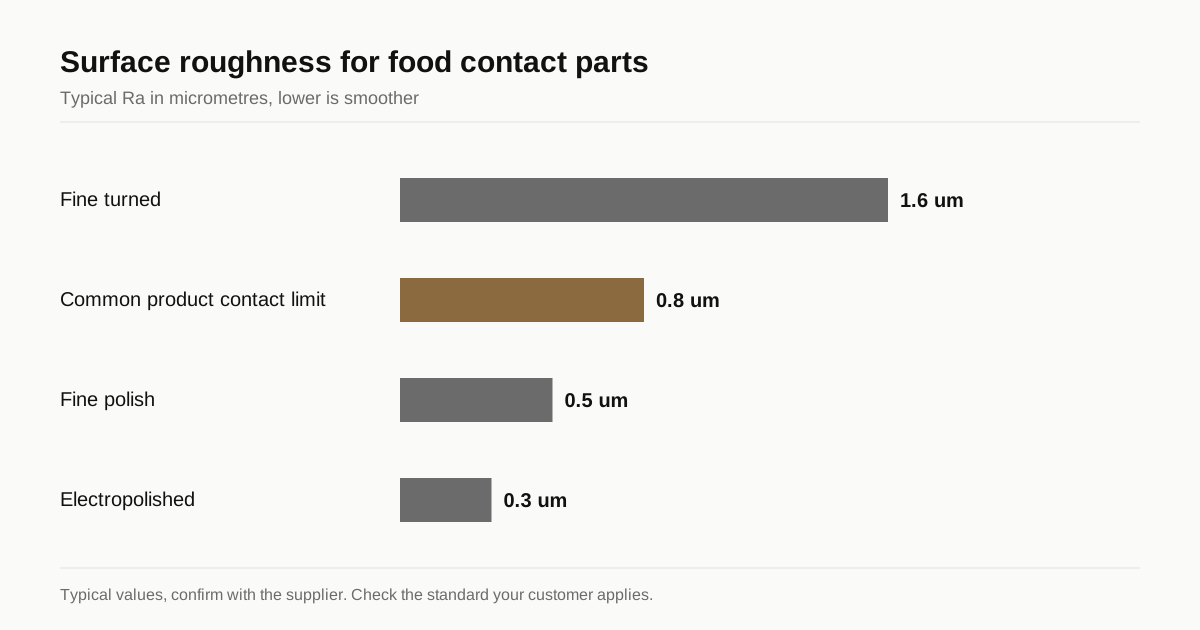
Smooth, continuous surfaces clean better. Hygienic design standards set maximum roughness on surfaces that touch product.
| Finish | Typical Ra | Typical use |
|---|---|---|
| As machined, fine turn | 1.6 µm | Non-contact, mild duty |
| Ground or polished, 32 µin | 0.8 µm | Common limit for product contact |
| Fine polish or 20 µin | 0.5 µm | Hygienic dairy and beverage parts |
| Electropolished | 0.2 to 0.4 µm | Cleanability, pharma-leaning food work |
Typical values. The 3-A Sanitary Standards often cite 32 microinch (0.8 µm) Ra or better on product contact surfaces, which is a common reference for dairy and food equipment. EHEDG guidelines give a European view of hygienic design. Check which standard your customer applies.
State Ra, the measurement direction and the surfaces that carry the requirement. Roughness measured across lay differs from along lay. The surface finish guide explains how to write it.
Electropolishing removes surface peaks and gives a passivated, smooth, easy to clean surface. The passivation versus electropolishing guide describes the trade.
Geometry that cleans and drains
Surface finish alone does not make a part hygienic. Shape matters.
- No sharp internal corners. Internal radii of at least 3 mm are a common minimum on product contact surfaces, because food residue collects in sharp corners.
- No dead legs and pockets. A blind hole or recess that holds liquid is a contamination site.
- Self draining. Surfaces slope toward drain points. Horizontal flats hold liquid.
- Threads outside the product zone. Exposed threads trap product. Where unavoidable, use seals that close them off.
- Smooth transitions. Avoid steps and ledges across the flow path.
- Crevice-free joints. Metal-to-metal contact with a gap invites crevice corrosion and bacterial growth. Use gaskets and seals designed for hygienic joints.
- Weld quality. Welded joints on food equipment are normally ground and polished flush. Machined parts that will be welded should leave the weld preparation stated on the drawing.
Link these to your drawing: mark the product contact surfaces and give a radius requirement for internal corners. A machine shop will otherwise follow the general tolerance and leave a tool radius.
Galling and seizing
Stainless valve parts seize when similar austenitic surfaces slide under load. The oxide film tears and metal welds to metal. Threaded valve stems, stem to bonnet threads, plug to seat contact and clamped fittings are typical victims.
Controls a buyer can specify:
- Different grades or hardness for the mating pair. For example 316L against a hardened 17-4 PH, or against Nitronic 60. The Nitronic 60 guide covers a galling resistant grade.
- Surface treatment. Hard chrome plating, nitriding for some grades or hardfacing where approved for food contact.
- Lubricant. Use a food-grade anti-seize on threads, where allowed. Say it on the drawing.
- Thread class and clearance. A looser class reduces galling risk. See the threading guide.
- Finish on mating surfaces. Very rough or very smooth contacting surfaces gall more readily, and a moderately smooth surface with a hardness difference works best.
Any coating or hardfacing must be permitted for food contact in the market where the equipment is sold. State this requirement and have the customer confirm it.
Machining and finishing considerations
- Material condition. Annealed bar is the norm. Cold worked bar changes behaviour and magnetism, see the 316L magnetism guide.
- Cleaning after machining. Cutting oils and fines must come off before passivation. The medical cleaning guide describes a typical chain and applies to food parts too.
- Passivation. Specify ASTM A967 or equivalent, and citric or nitric. Some food customers prefer citric.
- No contamination. Carbon steel tools and brushes must not touch the parts.
- Marking. Laser marking is common, but marks near sealing or product contact surfaces are a risk. See the laser marking guide.
Need a quote for this part? Get a quote for your stainless parts
Documents commonly requested
| Document | Why |
|---|---|
| Material certificate, EN 10204 type 3.1 | Grade and traceability |
| Surface roughness report | Ra on contact surfaces |
| Passivation certificate | Process and standard |
| Declaration of conformity for food contact materials | Required in many markets, usually issued by the manufacturer of the finished equipment |
| Weld records if welded | Procedure and welder |
The declaration of conformity is normally the responsibility of the equipment maker. We make no claim about any shop’s approvals. Ask each shop what it holds and what it can supply.
Cleaning regimes and what they do to the metal
The cleaning cycle in a food plant is harder on equipment than the product is. Understanding it helps explain why drawings call for certain grades and finishes.
Clean in place (CIP). Hot caustic soda solution, often at 70 to 80 °C, followed by water rinse and an acid wash with nitric or phosphoric acid, and then sanitiser. The caustic stage attacks some surfaces slowly and the acid stage can attack weak passive films. The cycle runs daily or more often.
Sanitisers. Peracetic acid and chlorine based sanitisers are common. Chlorine-based sanitisers add chloride and oxidiser together, which is a demanding combination for stainless. A grade at the edge of its chloride limit can pit under repeated exposure.
Steam and hot water. Steam sterilisation adds temperature cycles, and hot water above 60 °C lowers the pitting threshold.
Manual cleaning. Brushes and abrasive pads can scratch the surface and leave carbon steel fragments if the wrong tools are used.
A part that is mostly fine at room temperature may fail under this regime, so it is worth telling the shop and the designer which cleaning chemistry and temperature the equipment sees. That information affects the grade, the finish and the passivation choice. For most plants 316L with a smooth finish and clean passivation is the answer. For high chloride sanitisers or hot cycles, a higher alloyed grade may be justified.
Documents and traceability for food plants
Food plant customers have audit trails that reach back to the equipment maker, and the machined part is a link in that chain. Even if the machine shop does not issue a food contact declaration, it should provide traceability.
- A heat number on the certificate and a way to tie it to the finished part.
- A record of the finish and passivation.
- Inspection records for the critical dimensions.
- Confirmation that no restricted substances were used, if the customer requires it. For example, some customers restrict lubricants and coatings to food grade types.
Keep a copy of the certificate with the equipment build file. If a customer asks about a part five years later, that file answers the question. The vetting guide lists the questions to ask a shop about record keeping.
Seals, gaskets and the parts that meet them
A stainless component in a food line rarely works alone. It meets elastomer seals, gaskets and mating metal faces, and the machined detail at those contacts decides whether the line stays tight and cleanable.
Seal grooves should have smooth floors and walls, with a defined corner radius and no tool marks running across the groove. A scratch across a gasket seat can leak or hold product. The groove depth and width follow the seal supplier’s data, so give the seal type on the drawing and let the shop machine to the manufacturer’s recommended dimensions. Flange and clamp faces need flatness and a controlled finish, and an out of flat face rocks on its gasket and opens a crevice.
Threads that sit near seals need a clear chamfer or relief so that the seal does not cut as it passes. Machined parts that mate with moulded or extruded seals deserve an early check with the seal supplier, because a fit that works on paper can still pinch a seal in assembly.
Finally, state which elastomers the customer expects, because cleaning chemicals and temperature limit the choice, and the part geometry may change with it.
Checklist before you request a quote
- Grade for each part: 316L for product contact.
- Product contact surfaces marked, Ra stated and measurement method given.
- Internal radius minimum and drain requirements on the drawing.
- Galling control: mating grade, hardness or coating.
- Passivation or electropolish standard.
- Document list, including certificates and roughness report.
- No 303 or 416 on product contact parts.
Send the drawing through the RFQ form. We send one itemised quote within 24 business hours and place the work with partner shops that machine stainless components for hygienic equipment. We own no machines.
See also: DIN 11851 against DIN 11864 sanitary fittings, on the couplings these parts connect to.
Frequently asked questions
Which stainless grade is used for food processing valves and pumps?
316L is the standard for product contact parts, with 304 or 304L common for non-contact and less aggressive uses. Rotating or sliding contacts often need different grades or hardness to avoid galling. Cleaning chemicals with chloride push the choice toward 316L.
What surface finish do product contact parts need?
Many specifications call for Ra 0.8 µm (32 microinch) or better on product contact surfaces. Dairy and hygienic equipment often specify Ra 0.4 to 0.8 µm, and electropolishing is common for a smoother, cleaner surface. State the Ra and the measuring method on the drawing.
Why do threads and moving parts in stainless valves seize?
Austenitic stainless galls when two similar surfaces slide under load, because the oxide film tears and the metal welds. Use different grades or hardnesses for the mating parts, a hard or coated surface, or a galling resistant grade, and allow clearance.
Need a quote for this part?
Send the drawing. We read it, send one itemised quote within 24 business hours and place the work with a partner shop that cuts stainless.
Get a quote for your stainless partsFigures in this guide are published specification limits or published typical values for the alloy, not measurements of any part. Machinability is rated against free-machining carbon steel B1112 at 100 and PREN is chromium plus 3.3 times molybdenum plus 16 times nitrogen. The conventions are set out in thereference section and the editorial standards.