Melt and pour origin on stainless bar: which origin documents buyers ask for
November 21, 2026
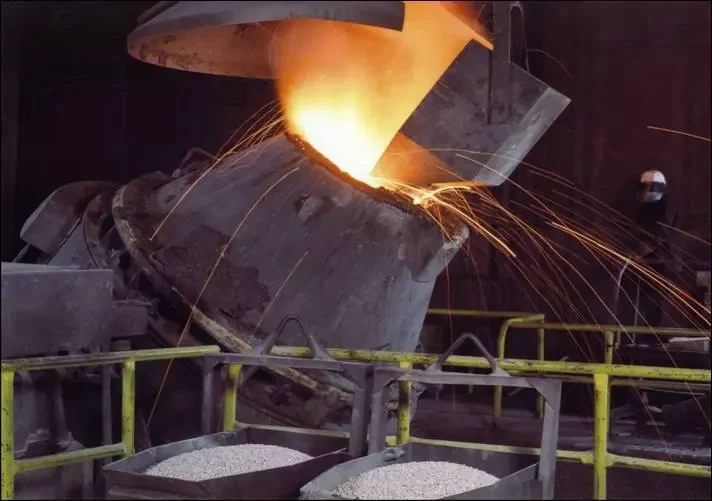
Melt and pour origin is the country where the steel in your part was melted and cast, and it is set at the mill, not at the machine shop. A part can be machined in one country from bar melted in another, and several rules ask about the second country, not the first. This guide covers which rules ask for melt and pour origin on stainless bar, what the documents in a normal order do and do not show, and the lines to put in an RFQ so a shop can answer.
We do not issue origin certificates or advise on customs law. The rules below are as published on the dates given, and a customs broker or contracting officer should confirm them for your parts.
What melt and pour means
Steelmaking has two linked steps. The metal is melted in a furnace and refined, which for stainless commonly includes an argon oxygen decarburisation (AOD) vessel like the one in the photograph. It is then poured, or cast, into a first solid form such as an ingot, slab, billet or bloom, which is rolled or forged into bar. The photograph shows the refining of a high-chromium steel at a foundry. It illustrates the step and does not show a stainless bar order.
The two steps can happen at different sites, which is why rules say melted and poured and why a country name on a certificate should state both. Bar made from scrap that is remelted abroad is not US melted, which CBP’s FAQ spells out for derivatives.
Origin can mean four different things in one order:
| Question | Who answers it | What can differ |
|---|---|---|
| Where was the steel melted and poured? | The mill | Country of the mill or its parent |
| Where was the bar rolled or drawn? | The mill or a re-roller | Country of the finishing mill |
| Where was the part machined? | The shop | Country of the shop |
| What is the part’s country of origin for marking? | A customs decision | Depends on substantial transformation |
Which rules ask for it
Section 232 duty in the United States. Proclamation 11021 of 2 April 2026 sets a 10 percent rate for derivative articles whose steel content is composed entirely of steel melted and poured in the United States. For the United Kingdom it sets a reduced rate where the steel was entirely melted and poured in the UK. It limits duty drawback to steel melted and poured in a Trade Agreement Partner country. The text we read sets no documentation test for steel, so ask your broker what evidence an importer should hold. Our Section 232 guide shows the tiers and the full-value rule.
CBP entry reporting. CBP’s Section 232 FAQ says the entry system requires the steel melt and pour country, or the aluminium smelt and cast country, to be reported for derivative classifications. It adds that even a derivative with no steel content must carry the country reported as the steel melt and pour country. The page’s FAQs on melt and pour are marked updated on 11 June 2025, and the FAQ describes an exemption for US-melted derivatives that the 2026 proclamation appears to have replaced with the 10 percent rate. Treat the reporting point as a prompt to ask your broker what the current entry rule is, and not as a final answer.
US defense contracts. DFARS clause 252.225-7009, edition January 2023, requires specialty metals in delivered items to be melted or produced in the United States, its outlying areas or a qualifying country. The clause defines specialty metals to include steel containing more than 0.25 percent of chromium, molybdenum, nickel and several other elements, so stainless falls inside the definition. A defense prime that flows this clause down will ask for melt origin on every bar lot.
Domestic content rules. For federal-aid highway projects, 23 CFR 635.410 requires that all manufacturing processes for iron and steel products, including coating, occur in the United States. That is a manufacturing test and not a melt test, and it is a reminder that domestic content rules differ in what they count. Our reference page on Build America Buy America for stainless parts covers the iron and steel rule for stainless parts.
Other markets use different regimes, and some of them look at the emissions embedded in the steel and not at its place of origin. Our CBAM guide covers the EU measure.
What the documents in an order show
| Document | What it shows | What it does not show |
|---|---|---|
| Mill test certificate (EN 10204 3.1 or equivalent) | Chemistry and mechanical results for a named heat, with heat traceability | Melt country, unless the mill states it |
| Mill test certificate type 3.2 | The same data with independent validation | Melt country, unless stated |
| Declaration of compliance (2.1) | The producer’s statement that the product meets the order | Test results or heat traceability |
| Certificate of conformance from the shop | The shop’s statement the part meets the drawing | Anything about the steel’s origin |
| Commercial invoice for the part | The country of origin the exporter declares for the part | Melt country of the bar |
| Mill’s origin declaration | Melt and pour country, if the mill issues one | Chemistry or properties |
The EN 10204 descriptions we read come from a trade site and are directional. They list chemical analysis and mechanical properties from the specific heat and lot for type 3.1, and say type 3.2 adds a second validation by an independent inspector. They do not list a country of melt. Read the actual certificate you receive, and see our guide to reading a mill test certificate for what each field traces.
Need a quote for this part? Get a quote for your stainless parts
The chain from mill to part
A melt origin claim is only as good as the chain from the mill’s heat to your part:
- Mill certificate with heat number from the producer, not a copy of a copy.
- Heat number on the bar or the tag, matched by the shop on receipt.
- Heat number on the traveler through every operation, and on the lot record at shipment.
- Certificate package that sends the mill certificate with the part, tied to the lot.
Stock bought from a trader with no mill certificate has no verified origin. Remnant bar with no tag is worse. Our bar stock buying guide for shops covers how a shop should buy and tag bar, and the documentation pack guide shows how the records follow the part.
Part origin and steel origin are different questions
CBP’s marking guidance says every foreign-origin article must be legibly marked with the English name of its country of origin unless an exception applies, and defines substantial transformation as creating a new article with a different name, character and use. It does not address machined parts made from imported bar, and suggests a binding ruling for hard cases. So the melt country and the marking country can differ, and one document should not be used to answer the other question.
What to put on the RFQ
- State whether origin matters. If no rule applies to your part, say so, and shops can quote their normal bar. If it does, name the rule: the 10 percent rate, a defense clause or a customer requirement.
- Name the melt and pour requirement. For example: bar must be melted and poured in the United States, with the mill certificate stating it.
- Require a mill certificate for every lot, with the heat number on the part record, and name the type you want (3.1 for example).
- Ask for a written origin statement from the mill or the shop, tied to the heat number, if the certificate does not carry one.
- Ask where the shop buys bar, and whether it holds stock of the origin you need. A shop with the right stock may quote a different lead time than one that has to order. The lead time guide shows how bar availability enters the total.
- Agree what happens on a mismatch. If the certificate does not support the origin, the lot is held and the shop supplies the correct documents or replaces the bar.
Do not write a requirement you cannot verify. A line that asks for US-melted bar and then accepts a certificate with no origin on it is worse than no line.
Next step
If origin affects your part, state it on the RFQ form together with the grade, the bar specification and the certificate type. We send one itemised quote within 24 business hours and place the work with partner shops that cut stainless. You deal with one contact, and each partner shop states the origin of the bar it would use.
Sources
- Proclamation 11021, Strengthening Actions Taken to Adjust Imports of Aluminum, Steel, and Copper, 2 April 2026 (govinfo)
- CBP, Section 232 aluminum and steel FAQs, FAQ entries marked updated 11 June 2025
- DFARS 252.225-7009, Restriction on acquisition of certain articles containing specialty metals (acquisition.gov)
- Cornell LII, 23 CFR 635.410, Buy America requirements
- CBP, Marking of country of origin on US imports
- Projectmaterials, EN 10204 certificate types, trade site, directional
- Wikimedia Commons, AOD vessel photo, Goodwin Steel Castings, CC BY-SA 2.0

Rules, lists and clause editions change. Confirm the current requirement with a customs broker or the contracting officer before you commit to a price or a supplier.
Frequently asked questions
What does melt and pour origin mean for stainless bar?
It is the country where the steel was melted and cast into its first solid form. It is a fact about the steel, set at the mill, and it does not change when the bar is machined, finished or shipped. The country where a part is machined can differ from the country where its steel was melted.
Does a mill test certificate show where the steel was melted?
Not as a rule. The EN 10204 3.1 descriptions we read list chemistry, mechanical results and heat traceability, and none lists a melt country. Some mills state it, so ask for it in writing on the certificate or in a separate declaration that carries the same heat number.
Why do US buyers ask about melt and pour country?
Three regimes use it. Section 232 duty has a 10 percent rate for derivative articles made wholly of steel melted and poured in the United States. CBP entry reporting asks for the melt and pour country of steel articles. Defense contracts restrict specialty metals melted or produced outside the United States and qualifying countries.
Can a shop declare melt and pour origin without the mill's paper?
It should not. Stock from a trader without a mill certificate has no verified origin, and remnant bar is worse. If origin matters, require bar bought with a mill certificate that carries the heat number, and keep the certificate with the lot record.
Need a quote for this part?
Send the drawing. We read it, send one itemised quote within 24 business hours and place the work with a partner shop that cuts stainless.
Get a quote for your stainless partsFigures in this guide are published specification limits or published typical values for the alloy, not measurements of any part. Machinability is rated against free-machining carbon steel B1112 at 100 and PREN is chromium plus 3.3 times molybdenum plus 16 times nitrogen. The conventions are set out in thereference section and the editorial standards.