Salt spray testing of stainless parts: what a pass proves, what it misses and which test to name instead
November 12, 2026
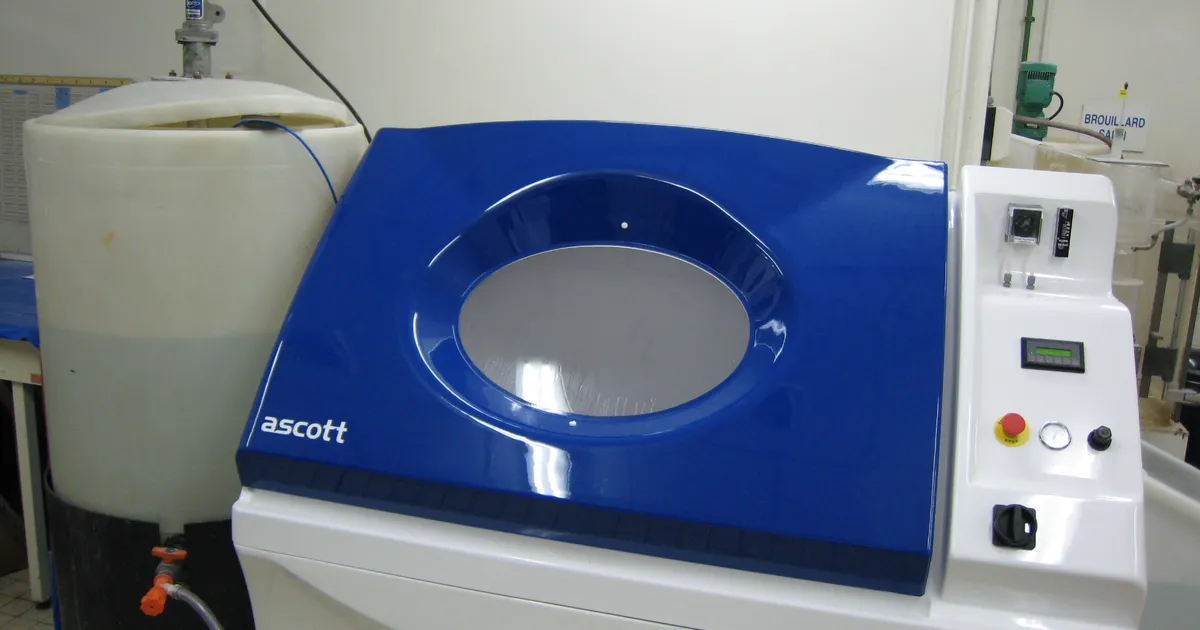
Salt spray is the corrosion test most buyers know, and it is a poor fit for most stainless parts. ASTM B117 describes how to run a salt fog cabinet. It does not say how long a part must survive, what a pass looks like or what the result means in service. For stainless it has one clear job, as a confirming test for passivation under ASTM A967. For ranking grades or predicting life in chloride, name another test. This guide explains the difference and what to write on the order.
What the test is
ASTM B117 is a practice for operating a salt spray (fog) apparatus. Its scope covers the apparatus, procedure and conditions needed to create and keep the salt fog environment. It does not specify the specimen type or exposure period for a product, and it does not say how to interpret results.
A testing laboratory page gives the usual conditions. Treat them as directional and take the real values from the standard you buy:
| Condition | Typical value |
|---|---|
| Temperature | 35 °C, with a tolerance of ±2 °C |
| Solution | 5 percent sodium chloride by weight |
| Solution pH | 6.5 to 7.2 |
| Fog collection | 1.0 to 2.0 mL per hour per 80 cm² of horizontal area |
| Specimen angle | 15 to 30 degrees from vertical |
| Duration and acceptance | None. Set by the product specification or the customer |
ISO 9227 is the international counterpart. Wikipedia lists neutral salt spray as the base test and describes acetic acid variants, with copper chloride added in the CASS version, at pH 3.1 to 3.3. A purchase order that says only “salt spray” has not said which one.
Why a pass says little about service life
The standard itself is cautious. ASTM B117 states that predicting natural environment performance from salt spray results alone has seldom been correlated with those results, and that correlation should be considered only where long term atmospheric exposure supports it. A testing laboratory adds that results cannot be turned into years of service without correlation data for the specific material and location.
For stainless there is a second problem. The test was developed for coatings. Bodycote, a heat treatment and surface treatment company, points out in a technical note that the salt spray test was designed to assess coating quality, for example porosity, and that the salt solution is harsher than seawater. Many stainless steels fail it although they serve for decades in real use. The same note cites ISO 9227’s own warning against using results as a comparative guide to long term behaviour, and an International Stainless Steel Forum paper on ranking steels by salt spray. Bodycote is a commercial source, so we treat its note as directional.
The practical result is that a salt spray test can mislead in both directions:
- False fail. Corrosion can start at surface defects where droplets sit. Bodycote shows this on 316L sheet after 72 hours in the cabinet. The part may be fine in service and the test was the wrong one.
- False comfort. A pass at a short exposure does not tell you whether the grade will pit in a warm, salty, crevice-prone service. The crevice and stress corrosion guide and the marine parts guide explain why grade and geometry decide that, not a fog cabinet.
Setup details that change the result
The note from Bodycote lists how the test conditions can mislead on real machined parts.
- Surface condition. Roughness and wettability change how long droplets stay in contact with the surface, and so how much exposure the metal gets.
- Orientation and shape. Flat panels are placed at an angle, so droplets run off. A 3D machined part can trap salt solution on horizontal areas and start corrosion at surface defects, as the note shows for a 316L sheet after 72 hours.
- Neighbouring specimens. A laboratory page warns that materials with very different corrosion products should not share a cabinet, because corrosion products can contaminate other specimens. A stainless part next to rusting carbon steel can pick up stain.
Ask the lab how the parts will be hung and what else is in the cabinet. A stainless result is only as good as the setup that produced it.
Where salt spray does belong
ASTM A967 lists seven qualitative practices to confirm that passivation worked. Practice C is the salt spray test. The standard says the tests are qualitative, aimed at removing contaminant iron and other foreign matter, and that it makes no recommendation on grade, treatment or acceptance criteria. So the order has to say what is accepted. A supplier summary of the standard gives Practice C as a 5 percent salt solution per ASTM B117 for a minimum of two hours, accepted when there is no rust or staining attributable to contaminant iron. It adds that less highly alloyed ferritic and martensitic grades can fail from the alloy, not from the passivation, so a failure on those grades does not automatically mean the bath failed. The passivation test methods guide has the full table, and the citric against nitric guide explains why free iron is the target.
Other fair uses are:
- Comparing lots of the same part under the same finish. A lab page describes the test as a comparative screening tool, which suits quality control better than prediction.
- Customer specified requirements. Some customers write a fixed exposure into their drawing. Follow it, and ask what the criterion is.
- Coated or plated parts. The test was made for coatings, so it fits them better than bare stainless.
Need a quote for this part? Get a quote for your stainless parts
Salt spray against the alternatives
| Test | What it asks | Best for | Caution |
|---|---|---|---|
| ASTM B117 or ISO 9227 salt fog | Does the surface show rust or stain after a fixed fog exposure | Passivation confirmation (A967 Practice C), coated parts, lot to lot checks | Not a service life predictor. Harsh for some stainless grades |
| ASTM A967 copper sulfate or ferricyanide | Is free iron present on the surface | Quick check on austenitic parts | Not valid on some 400 series. See the passivation test guide |
| ASTM G48 ferric chloride | How does the alloy resist pitting and crevice attack | Duplex, super duplex and super austenitic parts | Needs method, temperature and a pass limit written down. See the G48 guide |
| ASTM G150, critical pitting temperature | At what temperature does pitting start in a chloride solution | Ranking grades | Needs a lab that runs it. Named by Bodycote as a more suitable test |
| Cyclic corrosion tests, for example ASTM G85 or SAE J2334 | Wet, dry and salt cycles closer to real exposure | Parts that see weather and salt | Longer and dearer. Pass limits come from the customer |
ASTM G85 and SAE J2334 are named by a laboratory page as options for better correlation with specific environments. We did not open those standards.
What to write on the order
- Purpose. Say why: passivation confirmation, a customer requirement or a lot check. The purpose decides the test.
- Standard and edition. ASTM B117 with its year, or ISO 9227 with the variant (neutral, acetic acid or copper accelerated acetic acid).
- Exposure time. Hours, written as a number. The standard does not supply one.
- Specimens. Parts from the lot or coupons, how many and how they are hung.
- Acceptance criterion. For example no red rust visible without magnification. The standard has none, so the buyer sets it before the test.
- Report. Lab name, dates, hours, specimen identification and photographs.
- A different test where the service is chloride heavy. Name ASTM G48 or G150 instead, with method and limit.
To get quotes that include a named corrosion test, send the drawing through the RFQ form and put the test line in the notes. We send one itemised quote within 24 business hours and place the work with partner shops that cut stainless. We own no machines, and we do not run corrosion tests or choose test limits for your part.
Sources
- ASTM B117, Standard Practice for Operating Salt Spray (Fog) Apparatus
- ASTM A967/A967M-25, Chemical Passivation Treatments for Stainless Steel Parts
- Wikipedia, Salt spray test
- Bodycote, Salt spray test, suitable for stainless steels? (October 2018), commercial technical note, directional
- Sourcima, Passivation testing and verification, supplier summary of A967, directional
- Infinita Lab, ASTM B117 salt spray testing, laboratory summary of test conditions, directional
Test parameters and exposure times are as published in the sources above. Take the exact values from the standard edition on your order.
Frequently asked questions
Does stainless steel rust in a salt spray test?
It can. A heat treatment and surface specialist notes that the salt solution is harsher than seawater and makes many stainless steels fail the test, although the same steels last decades in service. Surface finish, grade and passivation all change the outcome, and no hours figure is valid for every part.
How many hours of salt spray does passivated stainless need to pass?
ASTM B117 sets no exposure time and no acceptance criteria. The product specification or the customer sets them. ASTM A967 lists salt spray as one of seven passivation tests. A supplier summary gives a minimum of 2 hours with no rust or staining from contaminant iron, so read the revision you buy.
Does 24 hours of salt spray equal years of outdoor life?
No. ASTM says correlation to natural environments is seldom found and should be considered only where long term exposures corroborate it. A laboratory page states results cannot be converted to years of service without correlation data for the specific material and location.
Which test should I use instead of salt spray for chloride pitting?
For pitting and crevice resistance of stainless, a chloride specific test is the better match, such as ASTM G48 ferric chloride tests, or ASTM G150 for the critical pitting temperature. They need a named method, temperature and acceptance criterion on the order, because the standards give none of their own.
Need a quote for this part?
Send the drawing. We read it, send one itemised quote within 24 business hours and place the work with a partner shop that cuts stainless.
Get a quote for your stainless partsFigures in this guide are published specification limits or published typical values for the alloy, not measurements of any part. Machinability is rated against free-machining carbon steel B1112 at 100 and PREN is chromium plus 3.3 times molybdenum plus 16 times nitrogen. The conventions are set out in thereference section and the editorial standards.