Stainless grade suffix letters: what L, H, F, N and Ti change on a part
November 21, 2026
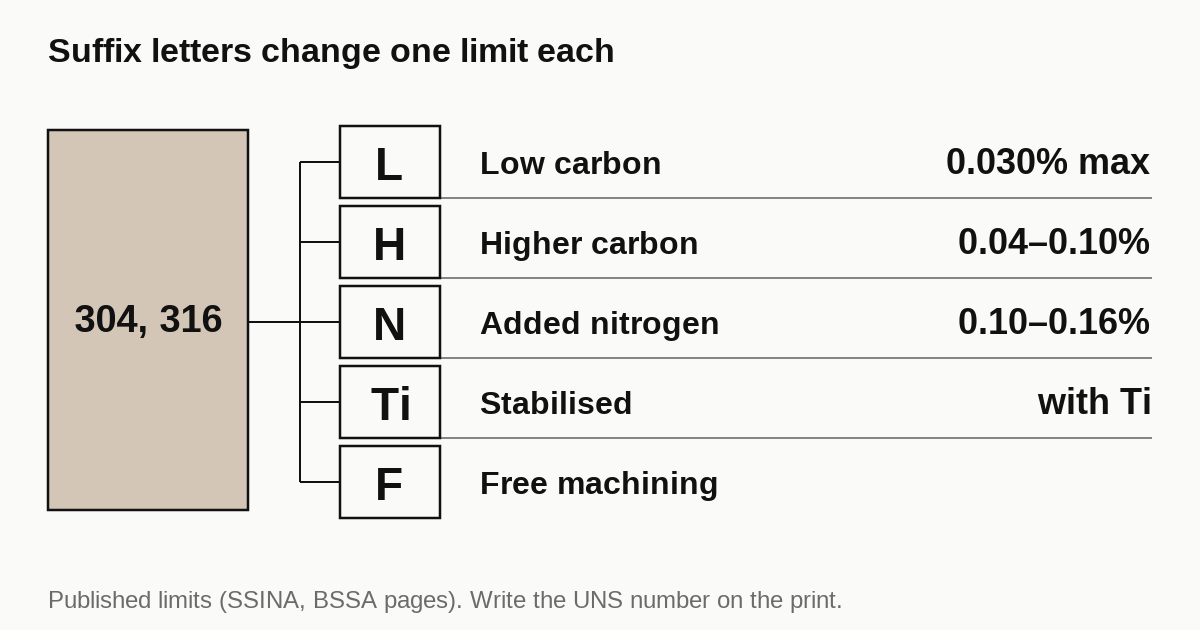
The letters after a stainless number change one limit in the specification, and each limit has a consequence for corrosion, strength, welding or machining. A drawing that says 316L and a drawing that says 316 are two different materials on paper. This page explains what each common letter changes, with the limit in numbers where the sources give one.
Put the base number and the letter in the same place on the print, and add the UNS number. The stainless grade selection guide shows how to choose the base grade first.
The common suffixes
| Suffix | Meaning | Example (UNS) | Limit that changes | Source |
|---|---|---|---|---|
| L | low carbon | 304L (S30403), 316L (S31603) | carbon 0.030 % max, against 0.08 % max for 304 and 316 | AZoM, SSINA |
| H | higher carbon, for hot strength | 304H (S30409), 316H (S31609) | carbon 0.04 to 0.10 % | BSSA, AZoM |
| N | added nitrogen | 304N (S30451), 316N (S31651) | nitrogen 0.10 to 0.16 % | BSSA |
| HN | higher carbon and more nitrogen | 304HN (S30452) | nitrogen 0.16 to 0.30 % | BSSA |
| Ti | titanium added to tie up carbon | 316Ti; 321 (S32100) is a stabilised grade | 321: Ti 5 × (C+N) | SSINA |
| F | free machining | 430F (S43020), 420F (S42020) | more machinable; not a chemistry limit given by these sources | SSINA, BSSA |
Sources: AZoM, Stainless Steels: L, H and Standard Grades; SSINA, Composition/Properties; BSSA, chemical compositions of heat-resisting stainless steel grades and its machinability article. The limits are for the plate and bar specifications on those pages (ASTM A240 in AZoM’s case). The standards were not read. Opened 25 October 2026.
L: low carbon
AZoM says 304 and 304L have the same composition limits for every element except carbon, and that neither is specified to have a minimum carbon. The low carbon content keeps carbide from precipitating at grain boundaries after welding or heat exposure, which is why L grades are used for welded and hot parts. Without welding or high-temperature exposure, AZoM says the corrosion resistance of standard and L grades is identical.
The L grade is slightly weaker on paper. For ASTM A240 AZoM lists minimum tensile strength of 515 MPa for 304 and 485 MPa for 304L, and minimum yield strength of 205 MPa against 170 MPa, both with 40 percent minimum elongation. AZoM adds that in practice mills generally ensure L heats meet the strength of the standard grades. If strength is a design limit, write the number you need, not the letter.
Note one caveat from AZoM: product specifications for some forms, particularly tube and pipe, have a limit of 0.035 or 0.040 percent for 304L and 316L. The 304 against 304L comparison goes further.
H: high carbon
H grades have improved strength at high temperatures, generally above 500 °C, according to AZoM, and are usually made as pipe and plate. The BSSA table gives carbon of 0.04 to 0.10 percent for 304H, 316H, 321H and 347H. AZoM adds that austenitic H grades should have a grain size of ASTM No. 7. A drawing that calls for 304H is a drawing for hot service. Do not substitute 304 or 304L for it.
N: nitrogen
The BSSA table lists 304N and 316N with 0.10 to 0.16 percent nitrogen, and 304HN with 0.16 to 0.30 percent. The base grades carry no minimum. The SSINA table caps nitrogen at 0.10 percent for 304 and 304L, so the N grades sit at or above that cap. The sources we opened do not state the purpose of the N suffix, so ask the supplier what property you gain before you specify it.
Ti: titanium
SSINA lists 316Ti with 321, 347 and 20-Cb3 as the common stabilised austenitic grades, where stabilising elements form carbides that are more stable than chromium carbide. For 321 the SSINA table gives titanium of 5 × (C+N). Stabilised grades are chosen for long hot exposure, where an L grade is not enough.
Need a quote for this part? Get a quote for your stainless parts
F: free machining
The F marks a free-machining version. In the BSSA machinability article, free-machining 430F has an index of 0.90 against 0.60 for standard 430, on a scale where free-machining low alloy steel is 1.0. The same table gives 0.85 for 303 against 0.52 for 304, and 0.95 for 416 against 0.50 for 410. The scale is relative and is meant for ranking steel types only, not for choosing speeds and feeds. SSINA lists 430F and 420F under their own UNS numbers.
The free machining stainless grades article covers the grades and their trade-offs.
Letters that are not on the list
Other letters turn up on drawings. SSINA lists 309S and 310S, for instance, each at 0.08 percent maximum carbon. Names vary by region and by standard, and EN uses numbers such as 1.4404 in place of 316L. SSINA’s own advice is that when specifying stainless chemistry you reference the ASTM standard and the UNS number, because common names alone can cause confusion. The article on UNS numbers on a drawing shows how.
What to write on the print
- Base grade and letter together. 316L, not 316 L or 316 low.
- The UNS number. S31603 for 316L.
- The standard. ASTM A276 or A240, or EN 10088, for the product form.
- A property, if it matters. Write the minimum strength or maximum carbon you need, not just the letter.
- Read the certificate. The carbon, nitrogen and titanium actually found are on the mill certificate.
Closing: letters are limits, so state the limit
A suffix tells the shop which limit to hold. Decide which one you need, then say it with the UNS number. For the base grade choice, return to the stainless grade selection guide. To have a drawing with the grade and letter written out quoted by partner shops that cut stainless, send an RFQ.
Sources
- AZoM, Stainless Steels: L, H and Standard Grades, L and H purpose, carbon limits and ASTM A240 minimum properties. Opened 25 October 2026.
- SSINA, Composition/Properties, compositions of 304, 304L, 316, 316L, 321, 309S, 310S, 430F and 420F, and the UNS advice. Opened 25 October 2026.
- BSSA, Chemical compositions of AISI (ASTM/ASME) and UNS heat resisting stainless steel grades, H and N grade limits. Opened 25 October 2026.
- BSSA, Influence of steel family (type) on machinability, machinability index including 430F, 303 and 416. Opened 25 October 2026.
- SSINA, Intergranular Corrosion, stabilised grades including 316Ti. Opened 25 October 2026.
Frequently asked questions
Can I use 304 where the print says 304L?
Not without checking. The two grades have the same limits for everything except carbon, which is 0.08 percent maximum for 304 and 0.030 percent maximum for 304L. Neither has a minimum carbon. A heat certified as 304 may or may not meet the L limit, so read the carbon on the mill certificate.
What does the H in 304H or 316H mean?
A deliberately higher carbon range, 0.04 to 0.10 percent, to hold strength at high temperature. AZoM puts the benefit generally above 500 °C. The trade is that H grades sensitise when used at about 450 to 850 °C. It is a hot-service grade, so do not substitute it for the base grade on cost alone.
Does the F in 430F mean the same on every grade?
In the sources we opened, F marks the free-machining version of a grade, such as 430F beside 430. The sources do not give a rule that covers every grade, and 303 carries no F at all. Use the UNS number on the print to settle what is meant, because SSINA advises it be given with any common name.
Need a quote for this part?
Send the drawing. We read it, send one itemised quote within 24 business hours and place the work with a partner shop that cuts stainless.
Get a quote for your stainless partsFigures in this guide are published specification limits or published typical values for the alloy, not measurements of any part. Machinability is rated against free-machining carbon steel B1112 at 100 and PREN is chromium plus 3.3 times molybdenum plus 16 times nitrogen. The conventions are set out in thereference section and the editorial standards.