Nickel origin and forced-labour due diligence for buyers of machined stainless parts
November 21, 2026
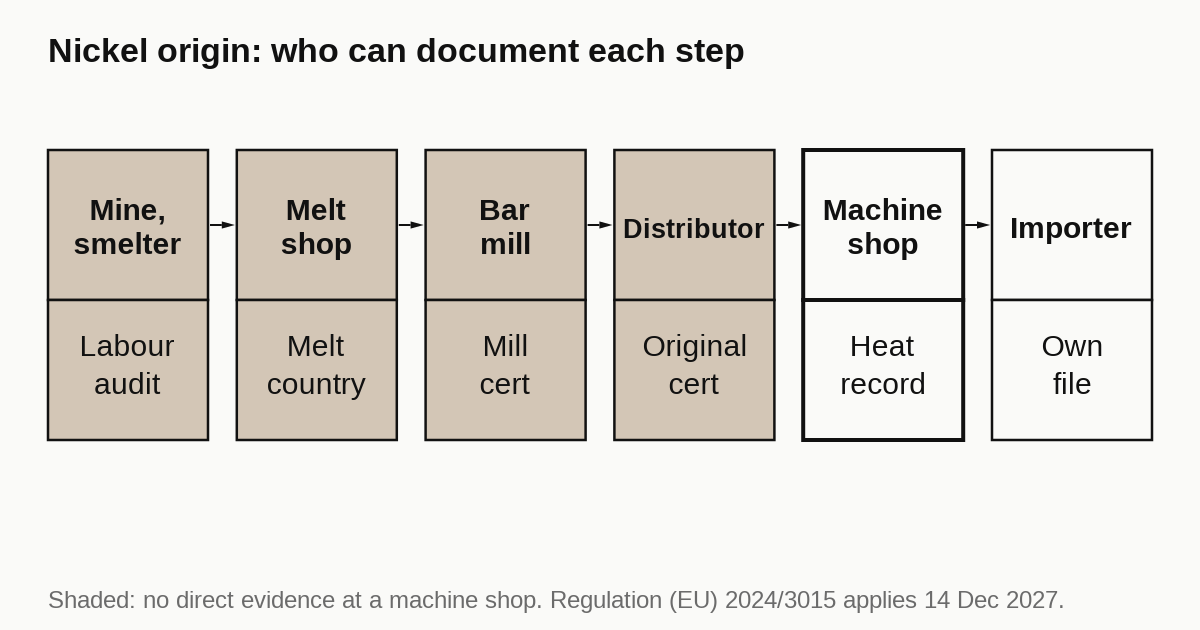
The EU ban on products made with forced labour applies from 14 December 2027, and it covers a machined stainless part as it covers any other product. Nickel is where a stainless buyer should look first, because most of the world’s nickel comes from one country where forced labour has been reported in its production. A machine shop can document which mill made your steel. It cannot document how the nickel in that steel was mined or smelted, so the work for a buyer is to ask the right party for the right paper.
We are not a law firm, an auditor or a certifier. We issue no certificate and make no audit claim. This guide is not legal advice, and the facts are as published up to 25 October 2026.
What the Regulation asks
Regulation (EU) 2024/3015 prohibits placing products made with forced labour on the EU market and exporting them. Law firm notes on the Commission’s guidelines make five points that matter here:
- It applies to all products and sectors and to every economic operator, including importers and non-EU businesses selling into the EU. There are no turnover or staff thresholds, so small buyers are covered.
- It is an obligation of result. Due diligence is described as a useful tool and not a legal duty in itself, but a product that turns out to be made with forced labour is banned however careful the buyer was.
- A product is in scope even when only a component was made with forced labour, and the ban reaches forced labour at any stage from extraction to manufacture.
- Authorities pick whom to investigate by proximity to the forced labour, leverage, size and economic resources and supply chain complexity. They can ask for multi-tier supply chain maps, purchase orders, invoices and shipping records.
- The main sanction is a product ban and withdrawal. Fines apply mainly to failing to comply with a decision.
The Commission adopted guidelines on 26 June 2026, referenced C(2026) 4386 final, and a notice followed in the Official Journal on 3 September 2026. The Regulation sets answer deadlines for operators of 30 to 60 working days in an investigation, and the authority decides on a substantiated concern within 30 working days of the replies. As of the September 2026 notes we read, only ten Member States had designated their authority and the forced labour risk database had not gone live. The guidelines point to the OECD due diligence approach: scope your risks, then assess the most severe in depth.
Where nickel enters a stainless part
Austenitic grades such as 304 and 316L carry nickel, and it reaches your part through a long chain. The table shows each step, who holds the evidence and what a buyer can usually get.
| Step | Typical fact | Who holds the evidence | What a buyer can usually ask for |
|---|---|---|---|
| Nickel ore mining and smelting | Indonesia produced an estimated 2.6 million of the world’s 3.9 million tonnes of mine output in 2025 (USGS) | The smelter and the ore buyer | A mill statement on its nickel sources |
| Melt shop | Stainless melt shop output was 64.2 million tonnes in 2025, 64 percent in China (World Stainless Association) | The melt shop | Melt country, mill policy, audit summaries |
| Scrap input | Nickel from scrap was about 60 percent of US apparent nickel consumption in 2025 (USGS) | The mill and its scrap dealers | Recycled content statement, scrap supplier policy |
| Bar mill or re-roller | The bar is rolled or drawn from the melt | The mill | Mill certificate with heat number |
| Distributor or stockist | Cuts and resells bar | The distributor | Original mill certificate, not a copy |
| Machine shop | Cuts the part and records the heat | The shop | Heat to part traceability, purchase records |
| Importer of record | Places the part on the EU market | You or your agent | Your own file of all of the above |
Two features make nickel hard to trace. First, scrap and primary nickel mix in the melt, and the certificate chemistry shows the result and not the source. Second, a mill’s nickel may pass through several traders before it reaches a smelter. One large European mill says on its own sustainability pages that a growing share of nickel production is controlled by companies with limited transparency, and that this limits its responsible sourcing options. That is a mill’s statement about its own market, and it is a fair summary of the problem.
What the evidence says about nickel
The US Department of Labor’s List of Goods Produced by Child Labor or Forced Labor carries an entry for nickel from Indonesia, under forced labour, stating that there are multiple reports that adults are forced to work in the production of nickel there. A government listing describes a product and a country. It is not a finding about any mill, smelter or shop, and the EU Regulation relies on its own process and a risk database that is still being built.
The USGS puts Indonesia at about two-thirds of world nickel mine output in 2025. The Philippines, Russia, Canada, New Caledonia and China each mined an estimated 120,000 to 270,000 tonnes, and a mill can buy nickel from several of these sources. The question for a buyer is not whether the country is on a list, but whether the mill that made your heat can show how it checks its nickel suppliers.
What a machine shop can and cannot prove
| A shop can show | A shop cannot show |
|---|---|
| Which mill or distributor sold each bar lot, by purchase order | Where the nickel in the bar was mined or smelted |
| The mill certificate and heat number carried to the part record | Labour conditions at the mine, smelter or melt shop |
| The melt country, if the mill states it on the certificate | Whether a heat contains scrap or primary nickel |
| Its own workforce policies and the subcontractors it uses for finishing | The mill’s audit results, unless the mill shares them |
| Receiving checks such as PMI that confirm the grade | Anything about origin from a PMI reading, which measures chemistry only |
Our guide to melt and pour origin on stainless bar covers the documents a normal order carries, and reading a mill test certificate shows what each field traces. A certificate ties a heat to chemistry and test results. It does not speak to labour.
Need a quote for this part? Get a quote for your stainless parts
What to ask a shop
- Which mill made the bar for this part, and which distributor sold it? Ask for both names and for the original mill certificate with the heat number.
- Where was the steel melted? If the certificate does not state the country, ask for a written statement tied to the heat number.
- Does the shop hold a forced labour or supplier code of conduct from the mill? Some mills publish one, and Outokumpu’s current code is linked from its supplier page. Ask the shop to attach the version that applies to your heat.
- Does the mill state a position on its nickel sources? The shop can ask the mill and pass the answer on. Do not accept a verbal reply.
- Which subcontractors touch the part? Passivation, heat treatment, plating and polishing sit in the chain. Our guide to a passivation subcontractor audit shows what to check.
- How are purchase records kept, and for how long? An authority can ask for purchase orders, invoices and shipping records, and the answer deadlines are short. Ask for retention of the full lot record.
- Will the shop tell you if the mill changes? A change of mill changes your supply chain map. See change notification for validated parts.
A shop that answers with its own policy and a mill statement is giving you what it holds. A shop that says it has no information on the mill should not be your only source on a high-volume part.
How much effort fits which part
The guidelines advise scoping first and going deep only on the most severe and likely risks. For a stainless buyer that means:
- List parts by grade and mill. Nickel-bearing grades (304, 316L, 17-4 PH and the duplex grades) go first. Ferritic 430 and martensitic 410, 416 and 420 carry little or no nickel.
- Group by mill. Ten parts from two mills need two mill files, not ten.
- Ask each mill once. Keep the written reply, the date and the certificate for each heat.
- Revisit when something changes. A new mill, a new distributor or a price change that looks too good is a reason to review the file.
- Plan for the answer deadlines. The Regulation gives operators 30 to 60 working days in an investigation, so a file that takes months to assemble is too slow.
For how origin interacts with price and quota rules in 2027, see our market review and 2027 plan, and for where stainless bar comes from in trade data, our trade flow post.
Dates to keep
| Date | What | Source |
|---|---|---|
| 26 June 2026 | Commission adopts guidelines on the Regulation | Covington |
| 3 September 2026 | Guidelines notice in the Official Journal | Osborne Clarke |
| September to November 2026 | Commission webinars planned | Covington |
| 14 December 2027 | Regulation applies | Covington, Osborne Clarke |
The risk database and the single portal for submitting information are in development, so check the Commission’s pages before you rely on either.
Next step
If you want shops that can state the mill, the heat and the melt country for your parts, put the requirement on the RFQ form with the grade, the bar specification and the certificate type. We send one itemised quote within 24 business hours and place the work with partner shops that cut stainless. You deal with one contact, and each partner shop states the bar origin it would use.
Sources
- Covington, European Commission publishes Forced Labour Regulation guidelines, July 2026
- Jones Day, EU forced labor guidelines: mandatory due diligence in disguise, July 2026
- Osborne Clarke, Regulatory Outlook September 2026, modern slavery
- US Department of Labor, List of Goods Produced by Child Labor or Forced Labor, nickel entry for Indonesia
- USGS, Mineral Commodity Summaries 2026, Nickel
- World Stainless Association, stainless steel melt shop production in 2025, 27 February 2026
- Outokumpu, sustainable supply chain and continuing sustainability work in the ferronickel supply chain, 7 November 2025
The EUR-Lex text of the Regulation was not reachable when we checked, so the Regulation’s content is cited from the law firm notes above. Confirm with counsel before you rely on it.
Frequently asked questions
When does the EU forced labour ban apply to stainless parts?
Regulation (EU) 2024/3015 applies from 14 December 2027 to all products placed on the EU market or exported from it, with no size or sector threshold. It is an obligation of result: a product made with forced labour at any stage may not be sold in the EU, whatever checks you ran. The Commission's guidelines of 26 June 2026 explain how authorities are expected to apply it.
Do I have to trace stainless back to the nickel mine?
The Regulation does not set a tracing depth. Authorities can ask for multi-tier supply chain maps and they choose where to investigate by risk, proximity, leverage and size. A realistic aim is to know the melt shop and mill for each heat, ask each for a written position on forced labour, and keep the records.
Can a machine shop prove its stainless is free of forced labour?
Not for the upstream steps. A shop can show which mill made each heat, through the mill certificate and heat number, and it can state its own labour practices and subcontractors. It cannot see how nickel was mined or smelted, and a certificate shows chemistry, not labour conditions. The mill is the next party that holds that evidence.
Is nickel from Indonesia banned in the EU?
No. The Regulation bans no country and no material. It bans products made with forced labour. The US Department of Labor lists Indonesian nickel among goods with reports of forced labour, which is a reason to ask questions about your mill's nickel sources, not a finding about any one mill or shop.
Need a quote for this part?
Send the drawing. We read it, send one itemised quote within 24 business hours and place the work with a partner shop that cuts stainless.
Get a quote for your stainless partsFigures in this guide are published specification limits or published typical values for the alloy, not measurements of any part. Machinability is rated against free-machining carbon steel B1112 at 100 and PREN is chromium plus 3.3 times molybdenum plus 16 times nitrogen. The conventions are set out in thereference section and the editorial standards.