Stainless steel in 2026: what nickel, mills and trade rules did, and what to plan for 2027
November 21, 2026
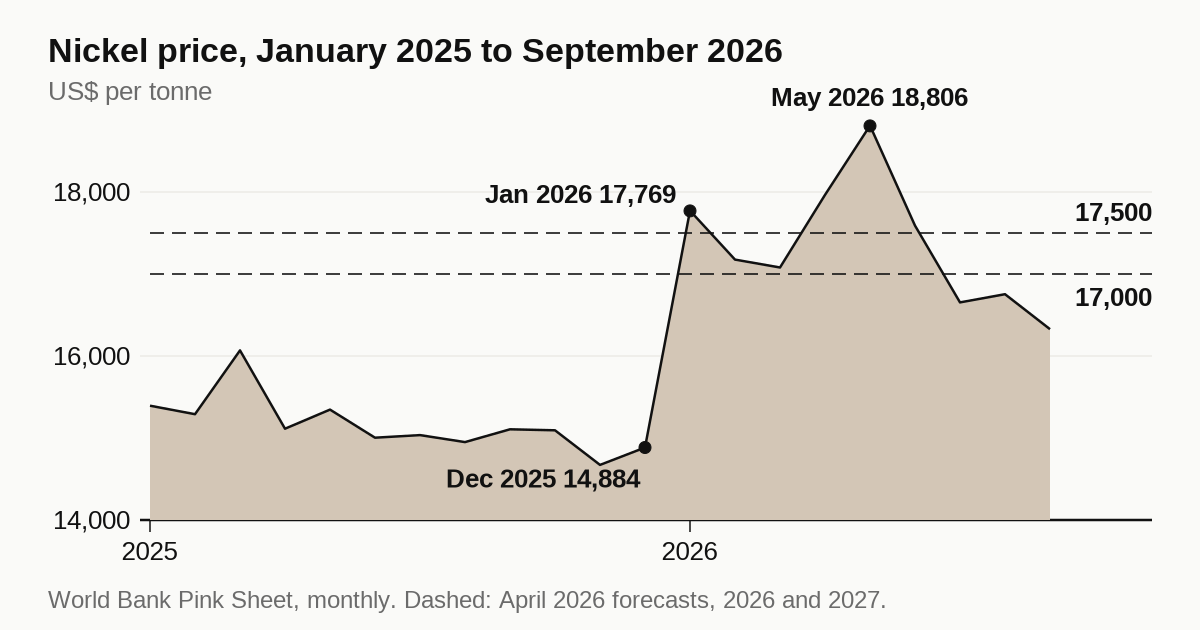
Nickel, the input that moves the price of austenitic stainless most, averaged 17,344 US dollars a tonne from January to September 2026. That is 14 percent above the 2025 average of 15,162 and the highest first nine months of a year since 2023, when the average was 22,943. The rise began in January, when Indonesia moved to cut its 2026 ore quota, and prices have eased since the May peak. For a buyer of machined stainless parts, planning 2027 comes down to three things: a nickel clause in the quote, a document that says where the steel was melted, and a second shop for the parts that cannot stop.
This is a review of facts as published up to 25 October 2026, with forecasts labelled by whose they are. Nothing here is a price forecast of our own or advice on when to buy.
Nickel and the alloy surcharge
Mills sell stainless on a base price plus a monthly alloy surcharge that follows nickel, chromium and molybdenum. Our guide to the alloy surcharge and part price shows how it reaches a quote. The World Bank Pink Sheet gives the nickel series:
| Period | Average nickel, US dollars per tonne | Lowest month | Highest month |
|---|---|---|---|
| 2022 | 25,834 | 21,482 | 33,924 |
| 2023 | 21,521 | 16,461 | 28,195 |
| 2024 | 16,814 | 15,445 | 19,587 |
| 2025 | 15,162 | 14,671 | 16,066 |
| January to September 2026 | 17,344 | 16,324 | 18,806 |
Three readings follow. First, 2025 was the lowest of the five periods and its monthly range was only about 1,400 dollars wide, so a quote written in 2025 had little nickel risk. Second, December 2025 to January 2026 was a step of 2,885 dollars, or 19 percent, in one month (14,884 to 17,769). Third, since the May peak of 18,806 the price has fallen 13 percent to 16,324 in September.
Why it moved
The January step has a stated cause. Argus reported on 11 February 2026 that Indonesia’s energy ministry would cut the 2026 nickel ore production quota (RKAB) to 260 to 270 million tonnes, about one-third below the 379 million tonnes approved for 2025. It tied the LME nickel high of 18,950 dollars on 29 January to the supply cut, to geopolitical tension and to a planned change in the ore benchmark price formula. The USGS puts Indonesia at 2.6 million of the 3.9 million tonnes of world nickel mine output in 2025 (estimate), two-thirds of the total, which is why one ministry’s quota moves the world price.
The cut was not final. Shanghai Metals Market reported on 20 August 2026 that the ministry had started approving revised 2026 quota applications for dozens of companies, and that some miners that had halted over quota issues could resume. It said the extra tonnage had not been disclosed. The USGS adds that the International Nickel Study Group counted a global primary nickel surplus of 182,000 tonnes in 2024 and 189,000 tonnes in the first nine months of 2025. A market in surplus since 2022 that still jumped on a quota announcement points to supply policy and not demand as the cause.
What mills charged this month
Outokumpu publishes its alloy surcharge tables on its site. The North America table for 1 to 30 November 2026, updated 23 October, lists 304L and 304 core (EN 1.4307) at 0.9010 dollars a pound, or 1,986 dollars a ton, and 316L Supra (EN 1.4404) at 1.7205 dollars a pound, or 3,793 dollars a ton. The 316L surcharge is 1.9 times that of 304. The table shows the surcharge only and not the base price. The same report page also offers reports for European customers, so read the table that applies to your mill, your region and your month.
Output and where it is made
The World Stainless Association counts melt shop output. Its 2025 figures and its first half of 2026:
| Region | 2024, thousand tonnes | 2025, thousand tonnes | Change | H1 2026, thousand tonnes | H1 change |
|---|---|---|---|---|---|
| China | 39,441 | 40,868 | +3.6% | 21,068 | +7.1% |
| European Union | 5,770 | 5,659 | -1.9% | 2,913 | -3.7% |
| United States | 1,950 | 2,099 | +7.6% | 1,147 | +3.2% |
| World | 62,821 | 64,157 | +2.1% | 32,964 | +5.0% |
China made 64 percent of the world’s stainless in 2025. World output grew 5.0 percent in the first half of 2026, and the EU was the only major region to fall. The World Stainless Association page for the first half carries no outlook for the rest of 2026, so any view of 2027 demand is a forecast by someone else.
What the trade statistics show for bar
Machined parts start as bar. Eurostat’s trade data for stainless bars, rods and sections (HS 7222) show extra-EU imports of 512 million euros in January to August 2026, down 19 percent from 633 million in the same months of 2025, with tonnes down 14 percent. The data were updated on 16 October 2026 and the 2026 figures are provisional. Our trade flow post for stainless bar has the origin tables. Treat eight months as a signal and not a trend, because monthly imports arrive in large lumps in the first month of most quarters.
Trade rules that now sit in a quote
EU steel regulation. Regulation (EU) 2026/1384 replaced the safeguard on 1 July 2026. The Commission’s trade page confirms the regulation replaced the safeguard that applied until 30 June 2026. Per the Crowell & Moring summary, the out-of-quota duty rose from 25 to 50 percent, quota volumes are fixed by quarter within a year running 1 July to 30 June, and importers must provide evidence of the country where the steel was first melted and cast from 1 October 2026. The official text on EUR-Lex was not reachable when we checked, so these points rest on the Commission page and the law firm summary. Trade-press summaries of the country quotas list stainless bars and light sections among the categories with named country allocations, but we did not read the Official Journal annexes. Ask your customs broker whether your bar’s CN code is covered.
US duty. In our Section 232 guide, stainless bar sits in the 50 percent tier and some machined pump and valve parts in the 25 percent tier, both charged on full value. The guide has the headings and a worked example.
Carbon. Our CBAM guide covers what an EU importer reports for stainless steel parts.
Dates for a 2027 plan
| Date | What happens | Who it touches |
|---|---|---|
| 31 December 2026 | Current EU quota distribution act expires; scope review of excluded CN codes due | EU importers of steel products |
| January to June 2027 | New implementing act needed for the quotas; do not assume current volumes continue | EU importers of steel products |
| 30 June 2027 | Commission assessment of downstream products containing steel | Buyers of steel articles into the EU |
| 1 July 2027 | Carry-over rules for unused quota take effect per product category | EU importers |
| 1 October 2027 | Melt and pour data start to inform quota allocation | EU importers |
| 14 December 2027 | EU Forced Labour Regulation applies | Every operator placing products on the EU market |
The first five rows come from the Crowell & Moring summary of the steel regulation. The last row is the application date given in the Covington and Osborne Clarke notes on the Forced Labour Regulation. Our guide to nickel origin and forced labour checks covers the last row.
Need a quote for this part? Get a quote for your stainless parts
Reference forecasts, and what they say
The World Bank’s April 2026 Commodity Markets Outlook forecasts nickel at 17,000 dollars a tonne for 2026 and 17,500 for 2027, up from 15,162 in 2025. The January to September average of 17,344 is already above the 2026 figure. The World Bank updates the table twice a year, so check whether a newer edition has replaced it. A single forecast is not a plan, and the table has no stainless price line of its own, only the metals that feed it.
What to put in the 2027 buying plan
- Index the material line. For orders longer than one quote validity, ask shops to name a published monthly surcharge table and the month it applies to. Our guide to passing a nickel surcharge through a quote shows the clause.
- Ask for the melt country in writing. A mill certificate does not state it as a rule; see melt and pour origin on stainless bar.
- Check lead times against bar availability. Quota windows and tariffs change what mills ship and when. The lead time guide shows where the weeks go.
- Qualify a second shop for the parts that cannot stop. See dual sourcing machined stainless parts.
- Compare quotes on the same basis. The quote comparison guide lists the lines to align.
To get stainless quotes that state the material basis and the bar origin, send the drawing through the RFQ form and say where the parts will be imported. We send one itemised quote within 24 business hours and place the work with partner shops that cut stainless.
Sources
- World Bank, Commodity Price Data (The Pink Sheet), monthly prices, updated 2 October 2026
- World Bank, Commodity Markets Outlook, April 2026, price forecasts (Table 1)
- World Stainless Association, stainless steel melt shop production in 2025, 27 February 2026
- World Stainless Association, melt shop production in the first half of 2026, 27 August 2026
- Argus, Indonesia to cut nickel mining quota in 2026, 11 February 2026
- Shanghai Metals Market, ESDM starts approving nickel and coal RKAB, 20 August 2026
- USGS, Mineral Commodity Summaries 2026, Nickel
- Outokumpu, alloy surcharge report, North America, 1 to 30 November 2026
- Eurostat, Comext EU trade since 1988 by HS2-4-6 and CN8 (DS-045409), HS 7222, data updated 16 October 2026
- Osborne Clarke, Regulatory Outlook September 2026, modern slavery
- European Commission, access to markets, new EU safeguards on steel imports from third countries
- Covington, European Commission publishes Forced Labour Regulation guidelines, July 2026
- Crowell & Moring, EU steel overcapacity regulation: new permanent measure in force from 1 July 2026
Prices, rules and dates are as read on 25 October 2026. Confirm them with your broker or mill before you commit to a price.
Frequently asked questions
What happened to nickel and stainless prices in 2026?
The World Bank monthly nickel price averaged 17,344 US dollars a tonne from January to September 2026, against 15,162 for all of 2025. It jumped in January, peaked at 18,806 in May and eased to 16,324 in September. Mills pass nickel on through a monthly alloy surcharge, so part quotes moved with it.
What is the 2027 outlook for nickel?
The World Bank's April 2026 Commodity Markets Outlook forecasts nickel at 17,000 dollars a tonne for 2026 and 17,500 for 2027. That is the World Bank's forecast, made in April, and not ours. Treat it as one reference point and put a price adjustment clause in long quotes instead of betting on a number.
How big is stainless steel production, and where is it made?
The World Stainless Association reports 64.2 million tonnes of melt shop output in 2025, up 2.1 percent, of which China made 40.9 million. In the first half of 2026 output was 33.0 million tonnes, up 5.0 percent, with the EU down 3.7 percent and China up 7.1 percent.
Which EU steel rules matter for stainless buyers in 2027?
Regulation (EU) 2026/1384 has applied since 1 July 2026 with a 50 percent out-of-quota duty. Importers must show where steel was melted from 1 October 2026. The quota split in force covers only 1 July to 31 December 2026, so a new act is needed for 2027. Ask a customs broker whether your bar code is covered.
Need a quote for this part?
Send the drawing. We read it, send one itemised quote within 24 business hours and place the work with a partner shop that cuts stainless.
Get a quote for your stainless partsFigures in this guide are published specification limits or published typical values for the alloy, not measurements of any part. Machinability is rated against free-machining carbon steel B1112 at 100 and PREN is chromium plus 3.3 times molybdenum plus 16 times nitrogen. The conventions are set out in thereference section and the editorial standards.