How a stainless shop passes a nickel surcharge through a quote without losing the order
November 21, 2026
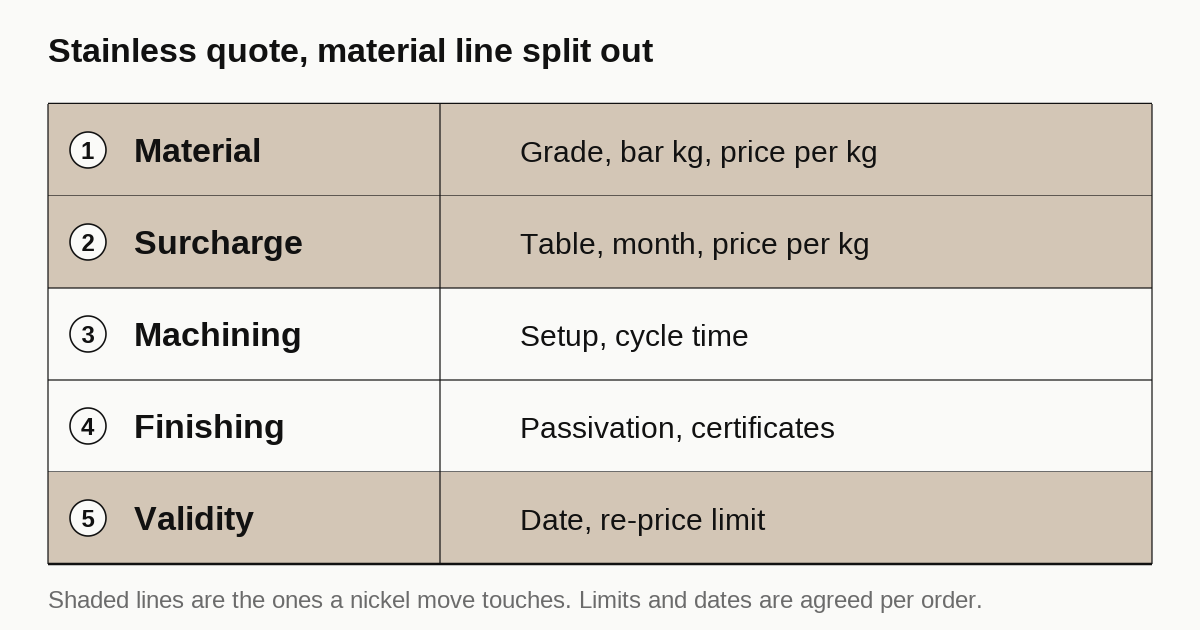
A stainless shop passes a nickel surcharge through a quote by splitting the material out of the part price and by writing down two things: how long the price holds and what moves the material line if the metal market moves first. The buyer then sees a number that can be compared with other quotes, and you are not left carrying a month of nickel movement on a job you cannot reprice. This guide is for the owner or estimator of a shop that cuts 304, 316L, 17-4 PH or duplex bar and has been caught between a quote and a bar invoice.
Each shop sets its own terms with the buyer.
The buyer side of the same subject is in our guide to the stainless alloy surcharge, which shows what is inside the number. This post is about what you write on your quote.
Why the quote has a shelf life
Outokumpu, a large European stainless producer, describes the alloy surcharge as an instrument to pass on changes in alloy costs along the value chain. It sits apart from the negotiated base price and extras, and it is specific to each product because alloy content differs between grades. The mill says monthly average calculation has been the industry standard, with the surcharge reflecting average alloy costs over a fixed period before delivery, and that surcharges are usually published month by month. It adds that calculation periods may differ.
For a shop, three things follow:
- The bar you buy later carries a different surcharge from the bar you priced. The gap between your quote date and your bar purchase date is your exposure.
- The movement can be large and quick. In March 2022 the LME suspended all nickel trading on 8 March after a spike above 100,000 US dollars per tonne, and cancelled trades from midnight that day. Trading reopened on 16 March and halted again on hitting daily limits. A report at the time said nickel had already risen 17 percent in the first week after the invasion of Ukraine. That was an extreme episode, not a norm, but it shows that a 30 day quote validity is not a safe default when nickel is unstable.
- Your supplier’s table may not match your buyer’s reference. Two mills quoting the same grade can use different periods. If you name the table on the quote, the argument about “the” surcharge never starts.
No public survey shows how much of a typical stainless part price is material, and none shows what share of shops index their quotes. Work the share out from your own last ten quotes: bar weight per part times price per kilogram, divided by the quoted part price. Expect a simple turned part to carry a larger material share than a part with a long cycle time and finishing, and remember that the chips from the bar are paid for at the same surcharge as the part.
Three ways to carry the risk
| Method | How it reads on the quote | Who carries the risk | Where it fits |
|---|---|---|---|
| Fixed price with a short validity | “Valid until a stated date” | You, until the date | Short jobs where you can buy the bar at once |
| Indexed material line | Material priced from a named table at the bar purchase date | The buyer, both ways | Long programs and blanket orders |
| Re-quote trigger | Fixed price unless the table moves beyond a stated limit | Shared | Mid-size orders with a few releases |
The bar stock buying guide covers how to buy the bar itself. Here the point is the quote: pick one method per job and write it in the quote, not in an email afterwards.
A fixed price is the easiest for the buyer to read and the hardest for you to defend when the order is large. If you have to hold a fixed price for a long order, you either buy all the bar on the purchase order date, which ties up money, or you price a buffer. A buffer you do not explain looks like a high price. Explain it as a validity: “price valid for 14 days” is easier to accept than a higher number with no reason.
What a good adjustment clause contains
Procurement guidance on raw material price adjustment lists the same parts again and again: a reference index or raw material price as the basis, a threshold, a formula, review intervals, upper and lower limits and, in a well-drafted clause, two-way movement. One glossary gives a worked illustration from an aluminium contract that you can adapt: the index is reviewed monthly, nothing changes unless it moves more than 5 percent from the base, and once triggered the component price moves by 60 percent of the index change, so a 12 percent rise lifts the price by 7.2 percent. The figures are an example of the mechanism, not a norm for stainless.
For a stainless quote the parts translate like this:
- Reference. Name the mill table or the distributor’s published surcharge you used, its month and the grade line. For nickel itself, name the index only if you and the buyer both read the same published price.
- Base. Say the surcharge amount per kilogram at the quote date, so the buyer can see the starting point.
- Share. Only the material line moves, not the whole part price. Write the bar weight per part so the share is visible.
- Trigger. A stated limit, such as “if the published surcharge for this grade differs by more than X percent from the quote date value”, so small changes do not cause constant repricing. Pick X from your own margin, and agree it with the buyer.
- Review point. The date on which the surcharge is read, for example the bar purchase date or the first day of the month of shipment.
- Direction. Both ways. A downward move goes back to the buyer.
- Limit. An upper and lower bound if the buyer asks for one.
Sample wording
You can adapt this paragraph for your quotes. It names no fee and makes no promise of price.
Material: 316L bar to ASTM A276, 0.42 kg per part. Base price per kg as quoted. Alloy surcharge: producer table for [month], [amount] per kg at quote date. This quote is valid until [date]. If the published surcharge for this grade on the bar purchase date differs from the quote value by more than [limit], the material line is adjusted by the difference per kilogram, up or down. All other lines are fixed.
Keep each sentence plain, put the numbers in, and ask the buyer to confirm the paragraph in the purchase order.
Need a quote for this part? Get a quote for your stainless parts
How to keep the order while you add the clause
Buyers compare several quotes. A quote with a clause looks riskier next to one without it unless you explain it. Three habits help.
- Show the material line. The comparing quotes guide tells buyers to look for a material statement. Be the shop that gives one. A buyer who can see bar weight, price per kilogram and surcharge can tell that your price is not padded.
- Quote the same basis each time. If you index material on every long job and fix it on every short job, say so on the quote and in the first email. The buyer learns your rule once.
- Offer a choice on larger quantities. “Fixed for 14 days, or indexed to the table with a limit” gives the buyer a decision instead of a refusal. Many will take the indexed option when it is two-way.
When a quote is for a batch with several releases, price each release separately or show the material line per release. The prototype against production guide explains how quantity changes setup share and why one number for 50 and for 5,000 pieces does not fit.
What to avoid
- A clause added after the purchase order. The buyer has agreed a price and will read a late clause as a breach.
- A one-way clause. It reads as a trap and it usually loses the order.
- A table you cannot show. If the buyer asks which surcharge you mean and you cannot name it, the clause has no force.
- A reference to nickel when the part is 17-4 PH or 2205. The surcharge for each grade includes other elements. Name the grade line, not just “nickel”.
- Claiming protection you do not have. If you buy the bar on the purchase order date, say so. If you hold stock bought at an earlier surcharge, the clause should not charge the buyer for a move you did not pay.
The quoting guide lists the other places a stainless job loses money. The surcharge is one of them, and the cheapest to fix because it needs words, not equipment.
Talk to us
If you cut stainless to drawing and want work requests that arrive with grade, quantity and release schedule written out, read the partner shops page and talk to us. We reply within 24 business hours. You quote us your own price.
Sources
- Outokumpu, alloy surcharges, how the mill describes the surcharge and its calculation period
- Wikipedia, LME Nickel, March 2022 suspension, cancelled trades and reopening
- Markets Media, LME CEO defends cancellation of nickel contracts, 17 percent first-week rise and the 8 March suspension
- Tacto, raw material price adjustment clause, procurement glossary, directional: clause parts and the aluminium illustration
Surcharge tables change monthly and differ between producers and product forms. Clause terms are agreed between you and the buyer. Have a lawyer read any clause that sits in a long contract.
Frequently asked questions
How do I pass a nickel surcharge through a stainless quote?
Split the material out of the part price. State the grade, the bar weight per part, the base price per kilogram and the published surcharge table you used, with its month. Give a validity date and say what happens to the material line if the table moves past a stated limit before the bar is bought.
Should the surcharge adjustment go both ways?
Yes. A clause that only moves up reads as a trap and loses orders. Procurement guidance describes well-drafted raw material clauses as bidirectional, so the price falls when the index falls. A two-way clause costs you nothing when the market is flat and is easier for a buyer to accept.
How often does a stainless alloy surcharge change?
Mills usually publish it month by month. Outokumpu describes monthly average calculation as the industry standard, with the surcharge reflecting alloy costs over a fixed period before delivery. Calculation periods can differ between products, so always name the table and the month in the quote.
What if the buyer refuses any adjustment clause?
Offer a short validity date and buy the bar when the purchase order arrives, or quote each release separately. Do not hide an unexplained buffer in the price. A buyer comparing quotes will see the gap, and a visible short validity is easier to defend than a high number nobody can explain.
Need a quote for this part?
Send the drawing. We read it, send one itemised quote within 24 business hours and place the work with a partner shop that cuts stainless.
Get a quote for your stainless partsFigures in this guide are published specification limits or published typical values for the alloy, not measurements of any part. Machinability is rated against free-machining carbon steel B1112 at 100 and PREN is chromium plus 3.3 times molybdenum plus 16 times nitrogen. The conventions are set out in thereference section and the editorial standards.