Shipping the first batch of machined stainless parts abroad: what the buyer wants in the box and on the paperwork
November 21, 2026
A first export batch of stainless machined parts needs two sets of paper and one clean crate. The commercial set is the invoice and packing list, written so the buyer’s customs broker can clear the goods. The quality set is the material certificate with a heat number, the passivation record, the inspection report and a certificate of conformance. The crate has to keep stainless away from carbon steel and moisture for the whole trip. This guide is for the owner or export sales engineer of a shop that has cut stainless for local customers and is about to ship abroad for the first time.
The buyer and the shop agree the details of each order directly.
Start with the buyer’s receiving rules
A shop that ships locally learns the rules of one customer. A shop that ships abroad meets three sets: the buyer’s quality agreement, the import rules of the buyer’s country and the carrier’s rules. Ask these questions before the parts are finished, not at the dock.
- Which documents does the receiving plant need with each lot, and in which language?
- Which Incoterm applies, and who books the freight?
- Does the buyer’s broker need anything on the invoice beyond the usual lines, such as a tariff heading?
- Is there a label format for the carton: purchase order, line, lot, heat?
- Is there a packing instruction, such as bag type or part separation, that is already on the purchase order?
Write the answers on the traveler or the order sheet. Our guide to the stainless shop documentation pack shows how to build the pack from the job so that these answers have a place to live.
The commercial paper: invoice and packing list
Import rules differ by country, so treat the example below as one data point, not a rule for every destination. For merchandise entering the United States, 19 CFR 141.86 lists what a commercial invoice must contain. Among other items it asks for:
- the port of entry and who sold the goods, when and to whom;
- a detailed description of each item, including the name, grade or quality and the marks and numbers of the packages;
- quantities in the weights and measures of the shipping country or of the United States;
- the price of each item and the currency;
- itemised charges such as freight, insurance, containers and packing;
- the country of origin;
- an English text, or an accurate English translation;
- the name of an exporter’s employee who knows, or can readily learn, about the transaction.
The same section requires a packing list that states the merchandise in each package in adequate detail, and asks that each invoice be numbered consecutively. Two lessons follow for a stainless shop even if the buyer is elsewhere.
- Describe the part, not only the drawing number. “Bushing, 316L stainless steel, machined, passivated” tells a broker what the part is made of. A drawing number alone tells nobody.
- Make the packing list match the cartons. Each carton gets a number, and the list says what is in each one by lot. If the buyer opens carton 3 and finds lot B where the list says lot A, the whole shipment is questioned.
On tariff headings: do not guess one. Ask the buyer’s broker which heading they use for the part and write that on the invoice if they ask for it. Tariff and duty rules change, and the buyer is the importer who answers for the declaration. Our Section 232 guide shows how much one rule can change the landed cost of a US shipment.
Incoterms in one paragraph
Incoterms 2020 are the International Chamber of Commerce rules that set who bears risk, how costs are split and who handles carriage and clearance between buyer and seller. There are eleven rules, and the contract picks one per transaction. Shops often meet EXW and FCA first. They differ on who clears the goods for export, so read the ICC text for the rule you choose and do not rely on a summary. Whichever rule you pick, name the rule, the named place and the edition in the contract. A rule without a named place does not say where risk passes.
The quality paper: what travels with the parts
The quality set is the same set a domestic medical or food buyer would ask for. Build it once per lot.
| Document | What it must show | The check before you ship |
|---|---|---|
| Material certificate | Heat number, chemistry and mechanical results for the bar used | The heat number on the certificate equals the heat number on the traveler |
| Passivation record | The treatment, the standard on the print and the test result for the lot | The record names the lot and the test method |
| Inspection report | Measured values against the drawing, with the instrument ID | The revision on the report equals the revision on the purchase order |
| Certificate of conformance | Purchase order, revision, quantity, lot, standards | It claims only what the shop holds |
| Packing list | Contents of each carton by lot | Carton numbers match the labels on the boxes |
Three points on the quality set.
Material certificates. EN 10204 separates a declaration of compliance (2.1), a test report from non-specific inspection (2.2), an inspection certificate with results from the delivered heat (3.1) and a 3.2 certificate that an independent inspector co-signs. If the buyer’s print says 3.1, send results for the heat in the bar, not a generic sheet. Our mill certificate guide shows where to look.
Passivation. ASTM A967 covers chemical passivation by nitric acid immersion, citric acid immersion and electrochemical treatment, and lists tests such as water immersion, high humidity, salt spray, copper sulfate and potassium ferricyanide-nitric acid for free iron. The print usually names one. Send the subcontractor’s record for the lot and see the passivation test methods guide for what each test proves.
Inspection. A first order is a first article for the buyer even if it is a hundredth job for you. Add the report of the first parts off the machine and the final sampling. The CMM report guide shows what a buyer reads in one.
Need a quote for this part? Get a quote for your stainless parts
Packing stainless for a long trip
Parts made from a corrosion resistant alloy can still arrive stained. The usual causes are iron from another material, water and chlorides, and damage from handling. Two stainless industry sources agree on the same rules.
- Keep carbon steel away. The Australian Stainless Steel Development Association advises storing stainless separately from carbon steel, and warns that carbon steel tie-downs can cause staining and pitting. Galvanised straps are also a problem because of zinc deposits. Use plastic or plastic-covered straps and clean pallets.
- Do not let iron dust settle. The Specialty Steel Industry of North America says iron particles from carbon steel work embed in stainless and can later rust. Packing is a work area too: the bench, the tape cutter and the strapping tool should not have touched carbon steel.
- Watch humidity and chlorides. ASSDA names chlorides from seawater, sweat, acid fumes and food residues as a major risk, especially above 55 percent relative humidity. A sea freight container can be a humid place. Bag or wrap each lot and put a desiccant pack in where the bag allows.
- Protect surfaces. Scratches and burrs come from rough handling and inadequate packing. Separate parts with clean plastic, wood or foam, and give threads and sealing faces caps.
- Check how long the film can stay on. SSINA warns that adhesive-backed papers and plastic films can age and become hard to remove. Use films the buyer accepts, and do not leave them on longer than the film maker says.
Our cleanroom packaging guide covers bag layers, caps and labels for medical lots. A food or industrial buyer may not need that grade, but the same order of steps applies: clean, dry, bag, separate, label.
Wood in the crate
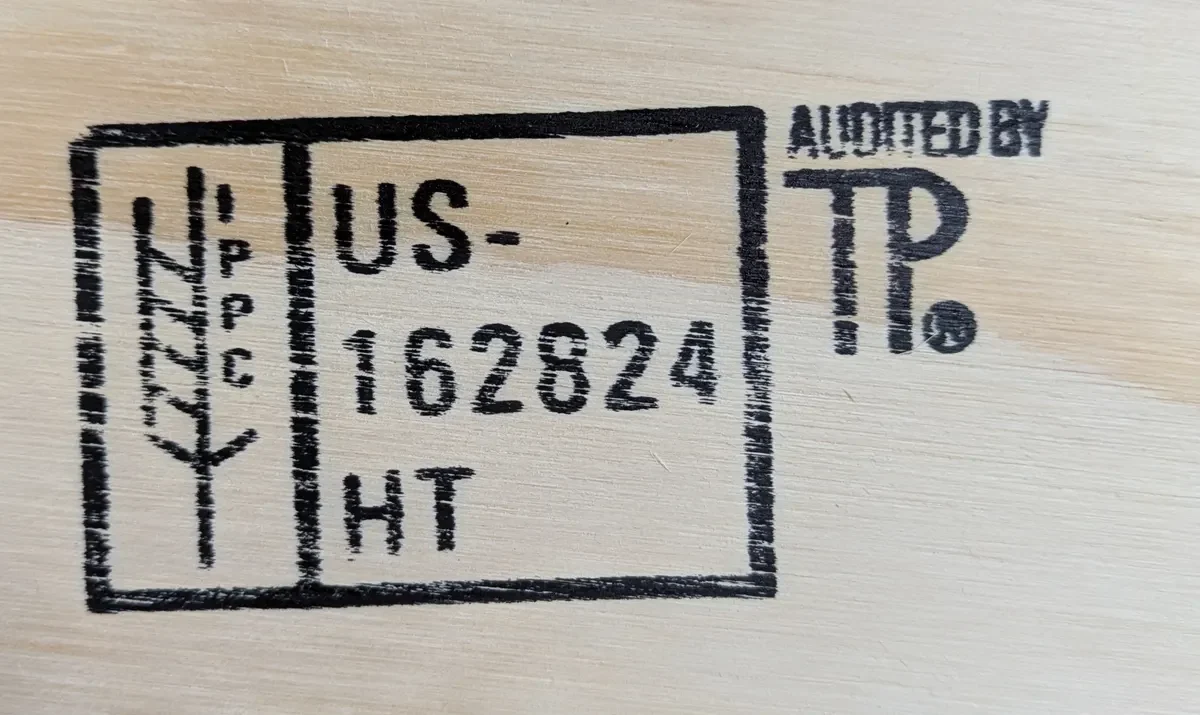
If the outer crate or pallet is solid wood and the shipment crosses a border, ISPM 15 usually applies. The standard asks for heat treatment, in which the wood core reaches 56 degrees Celsius for at least 30 minutes, or methyl bromide fumigation. A compliant piece carries a mark with the IPPC symbol, a two-letter country code, the producer or treatment provider number and a treatment code, HT for heat or MB for methyl bromide. Plywood and other processed wood are exempt, and so is raw wood 6 mm thick or less. Buy pallets and crates with the mark, and keep the supplier’s invoice. A crate without it can be held at the destination, and the delay falls on the shipment.
The day before you ship
- Lay the cartons out and read the packing list against the labels, carton by carton.
- Match the heat number on the certificate to the traveler and to the label.
- Photograph each open carton, the closed carton and the labelled crate. The photos help if the buyer reports damage.
- Check that the straps, pallet and tape are clean and not carbon steel.
- Send the buyer the invoice and packing list as a draft before the truck leaves. A broker can spot a problem in an hour that costs days at the border.
If you quote this work, say which documents the price includes. The quoting guide explains why paperwork is a real line on a stainless job, and the no-quote reply guide gives wording for when a request needs something you cannot supply.
Talk to us
If you cut stainless to drawing and want work for buyers abroad, read the partner shops page and talk to us. We reply within 24 business hours. We deal with the buyer, and you quote us.
Sources
- Cornell Legal Information Institute, 19 CFR 141.86, contents of invoices and general requirements
- International Chamber of Commerce, Incoterms 2020
- Wikipedia, ISPM 15
- ASSDA, Storage and handling of stainless steel
- SSINA, Care and use in shop
- ASTM A967/A967M-25, Chemical Passivation Treatments for Stainless Steel Parts
- Projectmaterials, EN 10204 certificate types, trade supplier blog, directional
- Wikimedia Commons, ISPM15 stamp for international shipping, VCCmatt, CC BY-SA 4.0

Import rules, tariff headings and wood packaging rules differ by country and change. The 19 CFR example applies to US entries. Confirm requirements with the buyer’s customs broker before you ship.
Frequently asked questions
What documents go with a first export batch of stainless machined parts?
Two sets. The commercial set is the invoice and the packing list, written to the buyer's import rules. The quality set is the material certificate with the heat number, the passivation record, the inspection report and a certificate of conformance. Ask the buyer which of these the receiving plant needs before you ship.
Does a wooden crate for stainless parts need an ISPM 15 mark?
Solid wood packaging in international trade normally does. ISPM 15 asks for heat treatment of the wood to 56 degrees Celsius at the core for at least 30 minutes, or methyl bromide fumigation, and a mark that shows which was used. Plywood and other processed wood are exempt, as is raw wood 6 mm thick or less.
How should stainless parts be packed so they do not rust in transit?
Keep them away from carbon steel, including steel straps and tools, and out of damp air. Stainless associations warn that iron particles embed in the surface and later show as rust, and that chlorides and humidity above about 55 percent relative humidity raise the risk. Bag or wrap each lot and keep wood and plastic clean and dry.
Who decides the Incoterm on a first export order?
The buyer and the shop agree it in the contract, and the contract should name the rule and its edition, for example FCA with a named place under Incoterms 2020. The rule sets where risk passes and who pays for export clearance and carriage. Settle it before you quote freight, not after the parts are packed.
Need a quote for this part?
Send the drawing. We read it, send one itemised quote within 24 business hours and place the work with a partner shop that cuts stainless.
Get a quote for your stainless partsFigures in this guide are published specification limits or published typical values for the alloy, not measurements of any part. Machinability is rated against free-machining carbon steel B1112 at 100 and PREN is chromium plus 3.3 times molybdenum plus 16 times nitrogen. The conventions are set out in thereference section and the editorial standards.