Machined stainless parts for medical and food OEMs: a guide for quality and regulatory managers
November 21, 2026
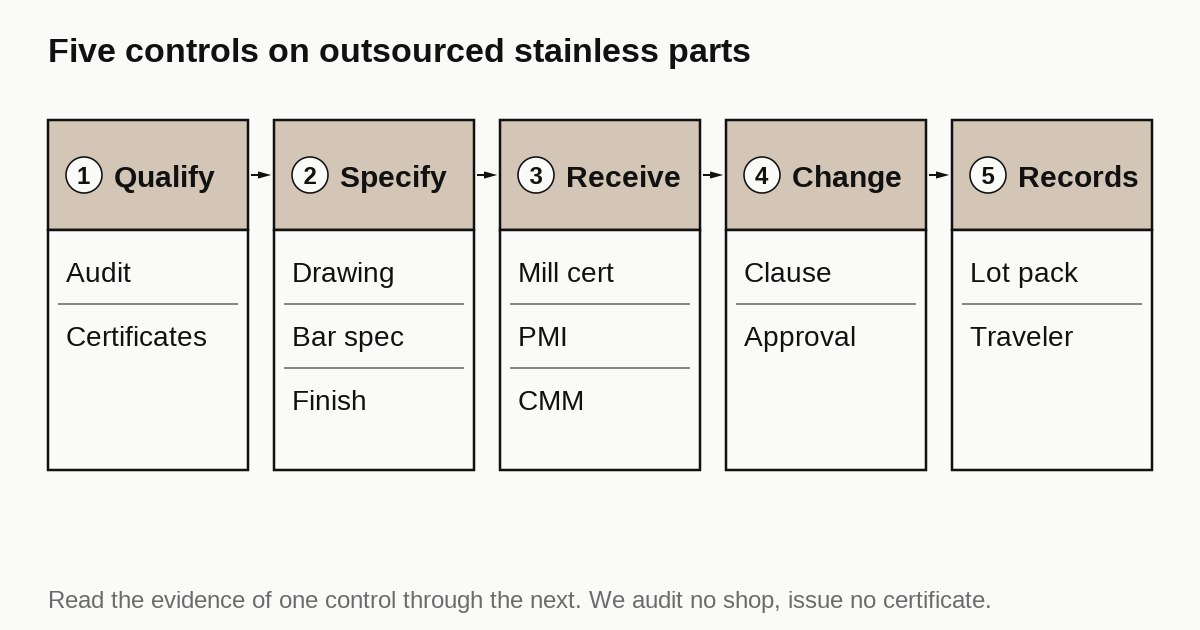
A quality manager who buys machined stainless parts from outside shops keeps five controls: qualify the shop, specify the part, check what arrives, control change, and keep the records. Each control produces evidence, and each evidence leaves a gap that another control has to cover. This guide sets the five out in one place and sends you to the page that goes deeper on each. It is written for quality and regulatory managers at medical device and food equipment makers.
We audit no shop and we issue no certificate. Shops state their own certificates. This is not regulatory advice, and facts are as published up to 25 October 2026.
The five controls at a glance
| Control | The question you must answer | Evidence you get | The gap it leaves |
|---|---|---|---|
| Qualify | Can this shop keep meeting our requirements? | Audit, questionnaire, certificates | A certificate is not a record of your parts |
| Specify | Does the order say what we approved? | Drawing, bar specification, finish, test, packaging | Words such as “passivate” or “food grade” are not a specification |
| Receive and verify | Is this lot what we ordered? | Mill certificate, PMI, finishing record, CMM report | Each check proves one thing only |
| Change | Will we hear before the process changes? | Change clause, notice period, written approval | Silent changes of bar, vendor or machine |
| Records | Can we reconstruct this lot years later? | Lot pack, traveler, retention terms | A record not made at the time cannot be made later |
1. Qualify the shop
Qualification is your decision, and certification feeds it. Our guide to ISO 13485 or ISO 9001 for machined parts shows that the requirement flows from the device maker’s risk assessment and supplier controls, and that an ISO 9001 shop can be right for instrument components and fixtures. The medical supplier audit checklist shows what an OEM audit asks of a stainless shop, and the pharma supplier questionnaire page shows how a shop should answer a questionnaire. Reading the shop’s side tells you which answers to expect and which to doubt.
One regulatory change affects the US side. The FDA says its Quality Management System Regulation became effective on 2 February 2026, that it incorporates ISO 13485:2016 by reference, and that FDA stopped using its Quality System Inspection Technique from that date. If your supplier file or a template still refers to the old technique, update the reference. The FDA page we read does not discuss supplier controls, so check the regulation text for your purchasing requirements.
2. Specify the part so the order carries it
An order that says “stainless, passivated” invites three different parts. The points that most often go missing:
- Grade and product. Name the grade and the bar specification, and write one designation system. See UNS numbers on a drawing and ASTM A276 against A479.
- Passivation. ASTM A967 lists nitric, citric and electrochemical treatment as separate methods and leaves the choice to the purchaser. Name the method and the acceptance test. See citric against nitric passivation and passivation test methods.
- Finish. Write Ra as a number and say where it applies. See the surface finish guide.
- Cleaning and packaging. A cleanroom class describes the room where bagging happens, not the cleanliness of the part. Name the cleanliness limit and the test separately, as the cleanroom packaging guide explains.
- Skin contact. Under REACH Annex XVII entry 27 an article in direct and prolonged skin contact may release no more than 0.5 micrograms of nickel per square centimetre per week. See nickel release from stainless parts.
- Food contact. EU Regulation 2023/2006 on good manufacturing practice applies to the material groups in Annex I of Regulation 1935/2004, and that list includes metals and alloys. See EU GMP for food contact stainless parts. NSF listings usually sit with the equipment builder and not the machine shop, as the NSF/ANSI 51 page explains.
3. Receive and verify: what each check proves
The most common error is to read one document as proof of another. The table lists what each one does and does not show.
| Check | What it proves | What it does not prove |
|---|---|---|
| Mill test certificate | The producer’s measured chemistry and properties for a heat | That the bar in the box is that heat |
| PMI | The chemistry of the piece in hand | Carbon, if you use standard XRF (so 316 and 316L stay unseparated), or any finishing step |
| Passivation test | Free iron and foreign matter were removed | The grade’s pitting resistance |
| CMM report | Measured values for named features | Anything, if the datums or the number of points differ from the drawing |
| Certificate of conformance | The shop’s statement that parts meet the order | Material origin, test results or traceability |
Use the combination, not one item. Our guides to reading a mill test certificate, PMI and what XRF can miss and reading a CMM report cover each. Write the PMI lot definition, sample size and what happens to a failed lot into the order before parts ship, because the extent of testing has no single rule and is set by risk.
Need a quote for this part? Get a quote for your stainless parts
4. Control change
A change you did not hear about is the real risk. Put four triggers in the purchase terms: the bar source or heat, the passivation or cleaning vendor and method, the machine or site, and any change to inspection. State the notice period in days so you have time to read the evidence and run a test lot. The change notification guide carries a clause and a form. Two cases need the same discipline:
- Grade substitution. A different grade is a change to the specification and needs written approval against a new drawing revision. The substitution checklist lists the questions to ask at four points.
- Late orders. Moving a job to another machine can change a validated process. See expediting a late order without breaking validation.
5. Records you can reconstruct
A heat number that was not written on the traveler, or a passivation lot that was not logged, cannot be reconstructed honestly afterward. The document pack guide shows the pack line by line from the shop’s side. Ask for the retention period in writing, because it comes from your contract and your quality agreement and not from the shop. Keep your own receiving record next to the shop’s pack.
A sequence for a new shop and a new part
Controls work best when they run in a fixed order. A practical sequence for a first order:
- Qualify before you quote. Scope the questionnaire or audit to the risk of the part. A clamp ferrule in a drug product path and a bracket on a frame need different depth.
- Write the specification once. Put grade, bar specification, finish, passivation method and test, cleaning and packaging on the drawing or in one controlled attachment, so the shop quotes the same part as the next shop.
- Approve a first article. Ask for the full CMM report, PMI on the first lot, the passivation record and the mill certificate tied to one lot number. Check that the datums on the report match the drawing.
- Agree the change list and the retention period in the purchase terms before production starts.
- Review the first lots against the pack. If the heat number, the finishing lot and the inspection record line up, widen the sampling plan on later lots. If they do not, ask why before the next release.
Four mistakes that recur
- Treating a certificate of conformance as the pack. It is the cover sheet. The heat, finishing and inspection records are separate.
- Writing “food grade” as a requirement. It is a description a supplier can make on its own. Name the grade, the finish and the rule you rely on.
- Reading a passing PMI result as proof of finishing. PMI reports chemistry only.
- Accepting a new bar source or finishing vendor because the paper looks the same. Both are change triggers, and an unannounced one can invalidate evidence you hold.
What changes in 2027
Two items reach the supplier file. The EU forced labour ban applies from 14 December 2027, and it will ask what you know about the steel behind a part. Our guide to nickel origin and forced labour checks says what a shop can and cannot document. The EU steel regime also now asks importers for the melt country from 1 October 2026, which our 2027 market review puts in a date table. Add an origin line to your receiving record for both.
Next step
If you want shops that can state their controls in writing, put the requirements on the RFQ form: grade, bar specification, passivation method and test, PMI plan, certificate type and change clause. We send one itemised quote within 24 business hours and place the work with partner shops that cut stainless. You deal with one contact, and each partner shop states its own certificates.
Sources
- US FDA, Quality Management System Regulation (QMSR), effective 2 February 2026
- The standards and rules named above are cited, with their sources, in each linked guide. Confirm current editions with the standards body before you write them into an order.
Facts are as read on 25 October 2026. Confirm regulatory points with your regulatory affairs team or counsel.
Frequently asked questions
Does a machined stainless part for a medical device need an ISO 13485 shop?
Not automatically. The requirement comes from the device maker's own risk assessment and supplier controls. Many instrument components and fixtures are made by ISO 9001 shops under the device maker's supplier qualification. Certification is one input to qualification and not a substitute for it.
What is the difference between PMI and a mill test certificate?
A mill certificate is the producer's record of the heat it tested. PMI checks the piece in your hand. The certificate can be correct for a heat while the wrong bar was cut for your order, so PMI links the part to the paper. Standard handheld XRF cannot measure carbon, so it cannot separate 316 from 316L.
Do passivation tests prove corrosion resistance?
No. The tests in ASTM A967 show that contaminant iron and foreign matter were removed. The standard states it makes no recommendation on the suitability of any grade. Pitting resistance depends on the grade and the finish, so the test record and the grade evidence are two different documents.
What should a purchase order say about changes?
List the changes the shop must tell you about: the bar source or heat, the passivation or cleaning vendor and method, the machine or site and any change to inspection. State the notice period in days. A shop cannot guess which changes affect your approval, and a change that looks small to the shop can invalidate evidence you hold.
Need a quote for this part?
Send the drawing. We read it, send one itemised quote within 24 business hours and place the work with a partner shop that cuts stainless.
Get a quote for your stainless partsFigures in this guide are published specification limits or published typical values for the alloy, not measurements of any part. Machinability is rated against free-machining carbon steel B1112 at 100 and PREN is chromium plus 3.3 times molybdenum plus 16 times nitrogen. The conventions are set out in thereference section and the editorial standards.